An interesting additional tool for evaluating limits:
Consider the limit \( \displaystyle \lim_{x \to 0} ~ \left\lvert x \right\rvert \sin{\left( \frac{\pi}{x} \right)} \). We cannot use the limit product rule to evaluate the limit since \( \displaystyle \lim_{x \to 0} ~ \sin{\left( \frac{\pi}{x} \right)} \) does not exist.
Looking at the plot of the function on the interval \( \left[ -\frac{3}{2}, \frac{3}{2} \right] \)

notice that the oscillations grow increasingly more crowded as \( x \) approaches \( 0 \).
Zooming in on \( x = 0 \) by decreasing the width of the interval to \( [-1, 1] \) gives: 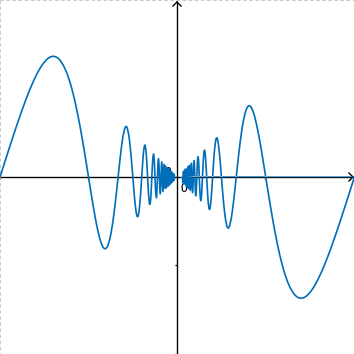
Decreasing the width of the interval to \( \left[ -\frac{1}{2}, \frac{1}{2} \right] \): 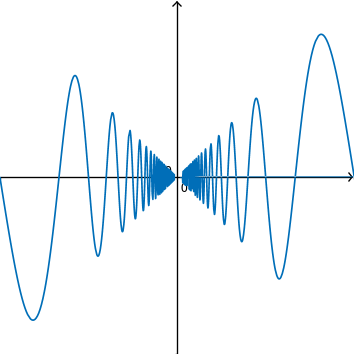
Decreasing the width of the interval to \( \left[ -\frac{1}{10}, \frac{1}{10} \right] \): 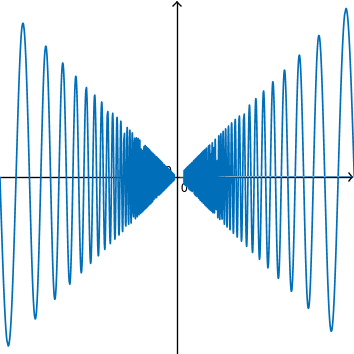
Observe that, no matter how small the viewing interval is, the function continues to oscillate extremely frequently as \( x \to \infty \). However, the amplitude of the oscillations appear to decrease linearly as \( x \to 0 \), as if the function values are bound, or “hemmed in” by lines of unit slope (observe that the amplitude approximately equals the magnitude of the \( x \) value, implying a slope of \( 1 \) on the bounding lines). This appears to force the limit to \( 0 \) as \( x \to 0 \).
This behaviour is made more apparent by combining the function with the apparent bounds \( \left\lvert x \right\rvert \) and \( -\left\lvert x \right\rvert \) on the intervals \( \left[ -1, 1 \right] \) (left) and \( \left[ -\frac{1}{10}, \frac{1}{10} \right] \) (right).
It is clear that the functions \( \left\lvert x \right\rvert \) and \( -\left\lvert x \right\rvert \) are acting to “funnel” the function \( \left\lvert x \right\rvert \sin{\left( \frac{\pi}{x} \right)} \) towards a limit of \( 0 \) as \( x \to 0 \). This is a result of the fact that the values of the sine function lie between \( 1 \) and \( -1 \) for any value of the argument; that is,
\( -1 \leq \sin{\left( \tfrac{\pi}{x} \right)} \leq 1 \) for all \( x \neq 0 \)
Thus, multiplying the inequality by \( \left\lvert x \right\rvert \) (which is non-negative), we see that
\( -\left\lvert x \right\rvert \leq \left\lvert x \right\rvert \sin{\left( \tfrac{\pi}{x} \right)} \leq \left\lvert x \right\rvert \) for all \( x \neq 0 \)
Since both of the “outer” functions \( \pm \left\lvert x \right\rvert \) approach \( 0 \) as \( x \to 0 \), so also does the “inner” function \( \left\lvert x \right\rvert \sin{\left( \frac{\pi}{x} \right)} \). Informally, the inner function gets “squeezed” or “sandwiched” between the two outer functions.
The above example illustrates the squeeze theorem, which essentially says that
If \( m(x)\), \(f(x)\), and \( M(x) \) are all defined near \( x = a \), and\[ m(x) \leq f(x) \leq M(x) \] near \( x = a \), with\[ \lim_{x \to a} ~ m(x) = L = \lim_{x \to a} ~ M(x) \] then, we also have \( \displaystyle \lim_{x \to a} ~ f(x) = L \).
- Use the squeeze theorem to show that \( \displaystyle \lim_{x \rightarrow 0} ~ x^2 \cos \left(\frac{2}{x}\right) = 0 \).
- The squeeze theorem can also be applied as \( x \rightarrow \infty \). Given that\[ \frac{3x-1}{x} \lt f(x) \lt 3 - \frac{1}{1+x^2} \text{for all } x \gt 10 \] what is \( \displaystyle \lim_{x \rightarrow \infty} ~ f(x) \)?