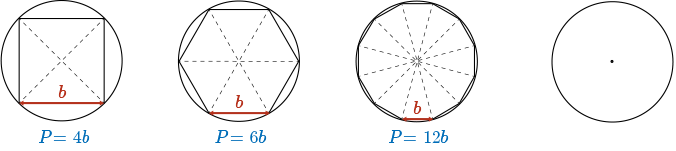
The Greek Method of Exhaustion (300-200 BC)
As the number of sides in the polygon increases, the perimeter, \(P\), of each polygon approaches (becomes closer in value to) the circumference of the circle \((2\pi r)\).
The perimeter, \(P\), of each polygon is calculated by multiplying the the number of sides in the polygon, \(n\), by the length of the base of each triangle, \(b\).
\(P=nb\) \( \approx 2\pi r\)