You begin a trip from home, point \( A \), travelling to point \( B \) and you are walking at a constant speed.
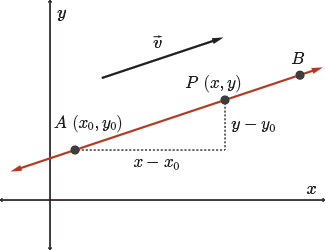
Your position, \( P \), relative to your initial position, \( A \, (x_0, y_0) \), changes over time, \( t \).
Specifically, the \( x \) and \( y \) coordinates of \( P \) depend on \( t \), the amount of time that has passed since you left home.
Your horizontal displacement at time \(t\) is \((x-x_0)\), while your vertical displacement is \((y-y_0)\).
Your velocity, \(\vec{v}\), can be described by the algebraic vector \( \vec{v}=(v_x, v_y) \), where \( v_x \) is the horizontal component of the velocity, and \( v_y \) is the vertical component.