- There is no solution provided for this question.
-
To determine which climber climbed the taller mountain, we need to find the maximum height that each climber reached during their hike. To determine which climber reached the peak first, we need to find the time \(t \gt 0\) at which each climber reached the peak of their mountain.
Differentiating using the product rule, we obtain
\[\begin{align*} h'_{1}(t) &= 1000\Big[ t^{2}(-e^{-t}) + (2t)e^{-t} \Big]=1000 e^{-t}(2t - t^{2})= 1000e^{-t}t(2-t)\\ h'_{2}(t) &= 1400\Big[t(-e^{-t}) + (1)e^{-t}\Big] =1400 e^{-t}(1 - t) \end{align*}\]
The height function of the first climber has a local extreme at \(t=2\) and the height function of the second climber has a local extreme at \(t=1\). Since \(e^{-t} \gt 0\) for all \(t\) we have \(h'_{1}(t) \gt 0 \) when \(0 \lt t \lt 2\) and \(h'_{1}(t) \lt 0\) when \(t \gt 2\). Therefore, \(t=2\) corresponds to a local maximum of the height function \(h_{1}(t)\). The same analysis will show that the point \(t=1\) corresponds to a local maximum of the function \(h_{2}(t)\). Therefore, the climbers reach their respective peaks after \(2\) hours and \(1\) hour respectively. Substituting these times values, we get the following:
\[h_{1}(2) =1000 (4)e^{-2} \approx 541 \text{ m}, ~~ h_{2}(1) =1400 (1)e^{-1} \approx 515 \text{ m}\]We conclude that climber 2 reaches the peak of his mountain first, while climber 1 climbed the taller of the two mountains.
- There is no solution provided for this question.
-
The largest rectangle of this form must have vertices at \((0,0)\), \((x,0)\), \((0, 2^{-x})\) and \((x, 2^{-x})\), for some \(x \gt 0\), as shown in the figure.
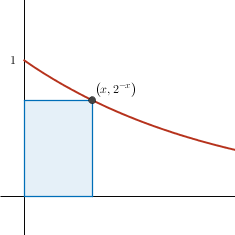
Therefore, the base of the rectangle is equal to \(x\) and the height of the rectangle is equal to \(2^{-x}\) and so a formula for the area is
\[A(x) = x 2^{-x}.\]We need to maximize this area function for \(x \gt 0\).
By the product rule, \(A'(x) = x 2^{-x}\ln(2) (-1) + 2^{-x} (1)= 2^{-x}(1 - x\ln(2))\).
We see that \(A(x)\) is differentiable for all \(x\) and so any critical points must occurs when \(A'(x)=0\). Since \(2^{-x}\neq 0\) we have \(A'(x)=0\) when \(1 - x\ln(2) = 0\) or \(x= \frac{1}{\ln(2)}\). Since there are no endpoints of the interval \(x \gt 0\) to check, we must do further analysis of the derivative to confirm that the area function has a maximum at \(x=\frac{1}{\ln(2)}\).
Since \(1-x\ln(2) \gt 0\) when \(x \lt \frac{1}{\ln(2)}\) and \(1-x\ln(2) \lt 0\) when \(x \gt \frac{1}{\ln(2)}\), the function \(A(x)\) is increasing on \(x \lt \frac{1}{\ln(2)}\) and decreasing on \(x \gt \frac{1}{\ln(2)}\). Therefore, we conclude that \(A(x)\) a local maximum at \(x =\frac{1}{\ln(2)}\). In fact, this will be the absolute maximum of \(A(x)\) on \(x \gt 0\). The maximum value is:
\[A\left( \frac{1}{\ln{(2)}} \right) = \frac{1}{\ln(2)} 2^{-\frac{1}{\ln(2)}}\approx 0.53\]
The function for the perimeter, in terms of the base of the rectangle \(x\), is \(P(x) = 2x + 2(2^{-x})\). It can be shown that this function does not have an absolute maximum value on the interval \(x \gt 0\); therefore, there is no such rectangle with maximum perimeter. (As \(x\), the width of the rectangle, approaches infinity, the height of the rectangle approaches \(0\), but the perimeter approaches infinity).
- There is no solution provided for this question.
-
-
Evaluating the limit,
\[\begin{align*} \lim_{t \to 0^+} ~ \dfrac{\ln{\left( \tfrac{1}{t} \right)}}{\tfrac{1}{t^2}} &= \lim_{t \to 0^+} ~ \dfrac{ \frac{d}{dt}\Big( \ln{\left( \tfrac{1}{t} \right) \Big)}}{\frac{d}{dt} \left( \tfrac{1}{t^2} \right)} \qquad \text{by LHR } \tfrac{\infty}{\infty} \\ &= \lim_{t \to 0^+} ~ \dfrac{ \left( \dfrac{1}{\tfrac{1}{t}} \right) \left( -\dfrac{1}{\tfrac{1}{t^2}} \right) }{\left( -\dfrac{1}{\tfrac{1}{t^2}} \right)} \\ &= \lim_{t \to 0^+} ~ t \\ &= 0 \end{align*}\]
As \( t^2 \) and \( \ln{\left( \tfrac{1}{t} \right)} \) are continuous for all \( t \gt 0 \), it follows that \( s(t) \) is continuous on \( (0, \infty) \).
Since \( \displaystyle \lim_{t \to 0^+} ~ t^2 \ln{\left( \frac{1}{t} \right)} = 0 = s(0) \), \( s(t) \) is also continuous (from the right) at \( t = 0 \). Therefore \( s(t) \) is continuous on \( [0, \infty) \).
-
Since \( s(t) \) is continuous on \( [0, \infty) \), it is continuous on \( [0, 2] \), and so, by the extreme value theorem, \( s(t) \) attains a maximum and minimum over the interval \( [0, 2] \).
Differentiating for \( t \gt 0 \),
\[\begin{align*} \dfrac{ds}{dt} &= t^2 \frac{d}{dt} \Big( \ln{\left( \tfrac{1}{t} \right)} \Big) + \ln{\left( \tfrac{1}{t} \right)}\frac{d}{dt} \Big( t^2 \Big) \qquad \text{product rule} \\ &= t^2 \left[ \dfrac{1}{\tfrac{1}{t}} \cdot \left( -\frac{1}{t^2} \right) \right] + \ln{\left( \tfrac{1}{t} \right)} (2t) \\ &= -t + 2t\ln{\left( \frac{1}{t} \right)} \\ &= t\left( 2 \ln{\left( \tfrac{1}{t} \right)} - 1 \right), t \gt 0 \end{align*}\]
so \( \dfrac{ds}{dt} = 0 \) when \( ln{\left( \tfrac{1}{t} \right)} = \frac{1}{2} \), or when \( t = \dfrac{1}{\sqrt{e}} \).
Thus there is one critical point in \( (0, 2) \). Testing the function values at the endpoints and the critical points, we get:
\[\begin{align*} s(0) &= 0 \\ s\left( \frac{1}{\sqrt{e}} \right) &= \left( \frac{1}{\sqrt{e}} \right)^2 \ln{(\sqrt{e})} \\ &= \frac{1}{2e} \approx 0.18 \\ s(2) &= 4\ln{\left( \tfrac{1}{2} \right)} \\ &= -4\ln{(2)} \approx -2.77 \end{align*}\]
A more negative value for position implies a position further to the left of its starting point; therefore, the maximum displacement of the particle to the left is \( -4\ln{(2)} \approx -2.77 \) metres.
A more positive value for position implies a position further to the right of its starting point; therefore, the maximum displacement of the particle to the right is \( \frac{1}{2e} \approx 0.18 \) metres.
- There is no solution provided for this question.
-
Consider the following diagram of the situation:
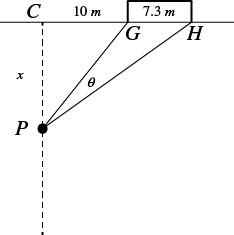
The player is located at point \(P\), the goal posts are located at point \(G\) and \(H\) and \(\angle PCG = 90^\circ \). The dotted line represents the trajectory of the shooter and so \(x\) denotes the distance between the shooter and the touchline. Using this diagram, we will derive a formula for \(\tan(\theta)\) in terms of \(x\). The goal is to find the value of \(x\) that maximizes \(\theta\).
From the diagram, we have \(\theta =\angle CPH - \angle CPG\), and so an expression for \(\tan(\theta)\) is the following:
\[\begin{align*} \tan(\theta) & = \tan(\angle CPH - \angle CPG) \\ & = \frac{\tan(\angle CPH) - \tan (\angle CPG)}{1 + \tan(\angle CPH)\tan(\angle CPG)} & \text{by the subtraction formula for tangent} \end{align*}\]
From the diagram, we see that
\[\tan(\angle CPH) = \frac{10+7.3}{x} = \frac{17.3}{x} \text{ and } \tan(\angle CPG) = \frac{10}{x}\]and so\[\tan(\theta) = \frac{\left(\frac{17.3}{x} \right)- \left(\frac{10}{x}\right)}{1 + \left(\frac{17.3}{x} \right)\left(\frac{10}{x} \right)} = \frac{\frac{7.3}{x}}{~\frac{x^{2}+173}{x^{2}}~} = \frac{7.3x}{x^{2}+173}\] We need to find the value of \(x\) that maximizes the function \(\theta(x)\) that is implicitly defined in the above formula. Note that there is a natural restriction of \(0 \lt \theta \lt \frac{\pi}{2}\) in the question.
Differentiating implicitly, with respect to \(x\), we find the following:
\[\begin{align*} \frac{d}{dx}\Big(\tan(\theta)\Big) &= \frac{d}{dx}\left(\frac{7.3x}{x^{2}+173}\right)\\ \frac{d}{d\theta}\Big(\tan(\theta)\Big) \frac{d\theta}{dx} &= \frac{(x^{2}+173)(7.3) - 7.3x(2x)}{(x^{2}+173)^{2}} & \text{by the chain rule and the quotient rule}\\ \sec^{2}(\theta) \frac{d\theta}{dx} &= \frac{-7.3(x^{2}-173)}{(x^{2}+173)^{2}} \\ \frac{d\theta}{dx} &= \frac{1}{\sec^{2}(\theta)}\left(\frac{-7.3(x^{2}-173)}{(x^{2}+173)^{2}} \right) & \text{since }\sec(\theta) \neq 0 \end{align*}\]
This derivative is defined all values of \(x\) in the domain since \(\sec^{2}(\theta) \gt 0\) and \((x^{2}+ 173)^{2} \gt 0\) for all \(x\). (Recall that \(\theta\) is defined implicitly in terms of \(x\).) We have \(\frac{d\theta}{dx} = 0\) if and only if \(-7.3(x^{2}-173) = 0\) or \(x^{2} = 173\). Since \(x\) is a distance, we must have \(x \gt 0\) and therefore, the only critical point is located at \(x = \sqrt{173} \approx 13.15\).
We can verify that \(\frac{d\theta}{dx} \gt 0\) when \(x \lt \sqrt{173}\) and \(\frac{d\theta}{dx} \lt 0\) when \(x \gt \sqrt{173}\) and so the function \(\theta(x)\) has a local maximum at \(x = \sqrt{173}\). From the diagram, this value of \(x\) corresponds to the following angle:
\[\begin{align*} \tan(\theta)& = \frac{7.3\sqrt{173}}{173+173} = \frac{7.3\sqrt{173}}{346} \approx 0.2775\\ \theta & = \tan^{-1}(0.2775) \approx 0.2707 \end{align*}\]
Therefore, the shooter should release the ball at a distance of \(\sqrt{173}\) meters away from the touchline, and at this moment the shot angle will be approximately \(0.27\) radians or \(15.5 \) degrees.