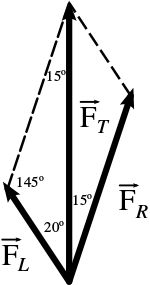
Let \( \vec{F_R} \) be the force that the right-hand dog applies to the sled, \( \vec{F_L} \) be the force that the left-hand dog applies, and \( \vec{F_T} \) be the resultant.
Let \( k \) be the ratio of the right-hand dog's force to the left-hand dog's force. Then \( \left \lvert F_R \right \rvert = k \cdot \left \lvert F_L \right \rvert \).
The force diagram is shown to the right, oriented so that the direction of the sled's motion points along the vertical. Applying the Sine Law,
\[\begin{align*} \frac{\left \lvert F_R \right \rvert}{\sin{(20^\circ)}} &= \frac{\left \lvert F_L \right \rvert}{\sin{(15^\circ)}} \\ \frac{k \cdot \left \lvert F_L \right \rvert}{\sin{(20^\circ)}} &= \frac{\left \lvert F_L \right \rvert}{\sin{(15^\circ)}} \\ k &= \frac{\sin{(20^\circ)}}{\sin{(15^\circ)}} \\ &= 1.32 \end{align*}\]
Therefore, the dog on the right pulls with a force \( 1.32 \) times greater than the dog on the left.