Let \( y \) represent the length of the man's shadow in metres. Let \(x\) represent the distance between the man and the base of the streetlight. Note that the quantities \(x\) and \(y\) are both changing with respect to time, as the man walks, and so we have \(x = x(t)\) and \(y = y(t)\).
In the diagram below, the man's head is located at \( H \), his feet at \( P \), the lamp at \( L \), the base of the lamp at \( O \), and the tip of his shadow at \( G \). Let \( OP = x \) and \( PG = y \). 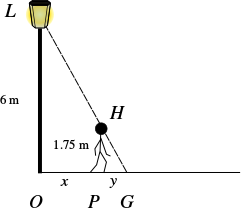
Note that \( \triangle{HGP} \sim \triangle{LGO} \), so
\[ \begin{align*} \dfrac{OG}{LO} &= \dfrac{PG}{HP} \\ \dfrac{x+y}{6} &= \dfrac{y}{1.75} \\ 4.25y &= 1.75x \\ y &= \frac{175}{425}x \\ &= \frac{7}{17}x \end{align*} \]
The rate at which the man is walking away, at time \(t\), is the instantaneous rate of change of the distance between the man and the streetlight at time \(t\). This is given by the expression
\[ \lim_{h \rightarrow 0} \frac{x(t+h) - x(t)}{(t+h)-t} =\lim_{h \rightarrow 0}\frac{x(t+h) - x(t)}{h} \]
Similarly, the instantaneous rate of change of the length of the shadow is given by
\[\lim_{h \rightarrow 0} \frac{y(t+h) - y(t)}{(t+h)-t}= \lim_{h \rightarrow 0} \frac{y(t+h) - y(t)}{h}.\]Since \(y = \dfrac{7}{17}{x}\), we have \(y(t+h)= \dfrac{7}{17}x(t+h)\) and \(y(t) = \dfrac{7}{17}x(t)\), and so\[\lim_{h \rightarrow 0} \frac{y(t+h) - y(t)}{h} = \lim_{h \rightarrow 0}\frac{\frac{7}{17}x(t+h) - \frac{7}{17}x(t)}{h} =\lim_{h \rightarrow 0} \frac{7}{17}\frac{x(t+h) - x(t)}{h} = \frac{7}{17}\lim_{h \rightarrow 0} \frac{x(t+h) - x(t)}{h} \]
Therefore, the rate at which the length of the shadow is increasing is \(\dfrac{7}{17}\) times the rate at which the man is walking away from the streetlight.