Alternative Format


Try This

Exponential Growth

In a time of popular social media, some videos grab the attention of viewers, and within days, millions of people have viewed the same video. How does this happen so quickly?

If you were entertained by a video, you may share the video with five friends. Those five friends may watch the video, and then each of them may share it with five of their friends.

A person connects to five people. Each of those five then connect to five more people.  Each of those people, connects to five more people.

Sources: People - leremy/iStock/Getty Images

As this pattern continues, the number of viewers of the video quickly grows to large numbers. This is called exponential growth. For the video to reach \(1\) million viewers in our scenario, we only need nine levels of sharing.

Lesson Goals

  • Introduce exponential notation. This is a fancy way of saying we will learn about exponents.
  • Represent whole numbers in expanded form using powers of \(10\). Expanded form is a way to write a number to show the place value of its digits.
    • E.g., \(123\) in expanded form is \(100\) plus \(20\) plus \(3\). That is, \(123 = 100 + 20 +3\)
  • Investigate square numbers and cube numbers.

Try This!

Your neighbour asks you to care for her dog while she is on vacation.  

She offers to pay you using Option A or Option B.

Option A

\($5\) each day

Option B

Days Total Payment
\(1\) Day \(2\) cents
\(2\) Days \(4\) cents
\(3\) Days \(8\) cents
\(\vdots\) \(\vdots\)

With each extra day, your total payment is doubled.

If your neighbour is going on vacation for \(15\) days, which option would give you the most money?

Think about this problem, then move on to the next part of the lesson.


Exponential Notation

Repeated Multiplication

Math uses many symbols and short forms to simplify our work with numbers.

For example, when we are adding the same number repeatedly, it is easier to communicate this using multiplication.

Both of these expressions, \(5+5+5+5+5+5\) and \(5\times 6\), give the same result, but the multiplication sign is a more efficient way to express the repeated addition.

Repeated Addition

\(5+5+5+5+5+5 = 5\times 6\)

What happens if we have repeated multiplication, such as \(2 \times 2 \times 2 \times 2\)?

Do we have a more efficient way to communicate repeated multiplication?

It turns out we do.

We can write this repeated multiplication expression, \(2 \times 2 \times 2 \times 2\), as a \(2\) with a small \(4\) up and on the right. What do you think each of these numbers, the \(2\) and the \(4\), represent in this short-form notation?

Repeated Multiplication

\(2 \times 2 \times 2 \times 2 = 2^4\)

Exponential Notation

In the expression \(2^4\), the \(2\) is called the base. The \(4\) is called the exponent. And the whole thing altogether is called a power.
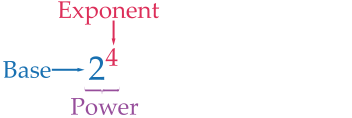
There are many ways to say a power. In these lessons, we will say this power as "\(2\) to the exponent \(4\)."

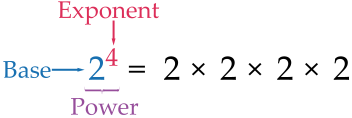
So what does \(2^4\) mean? \(2^4\) is equal to \(2 \times 2 \times 2 \times 2\). Notice our base number, in this case \(2\), tells us we are doing repeated multiplication of the number \(2\).

And the exponent, in this case \(4\), tells us there will be \(4\) copies of the base number \(2\). Therefore, in the repeated multiplication, there are four \(2\)'s multiplied together.
Let's look at a few powers of \(6\).

A few examples 

Exponential Notation Repeated Multiplication
\(6^2\) \(6\times 6\)
\(6^3\) \( 6\times 6\times 6\)
\(6^4\) \(6 \times 6 \times 6 \times 6\)

This shorter way of expressing repeated multiplication is called exponential notation.

Explore This 1

Description

During the Explore This activity, think about changing the base number and the exponent of a power. As the values of the base and exponent change, notice what happens to the repeated multiplication.

Example 1: Base = 3, Exponent = 4

\(\begin{align*} \class{hl1}{3}^\class{hl2}{4} &= \class{hl1}{3} \times \class{hl1}{3} \times \class{hl1}{3} \times \class{hl1}{3}\\ & = 81 \end{align*}\)

Example 2: Base = 9, Exponent = 5

\(\begin{align*} \class{hl1}{9}^\class{hl2}{5} &= \class{hl1}{9} \times \class{hl1}{9} \times \class{hl1}{9} \times \class{hl1}{9} \times \class{hl1}{9}\\ & = 59~049 \end{align*}\)

Online Version

https://ggbm.at/SJbZvJ6P

Explore This Revisited

You may have noticed some links between the base, the exponent, and the repeated multiplication expression.

Let's look at a few examples to make sure we are comfortable with this new notation.

  • \(5^3\) has a base of \(5\), and we will have three \(5\)'s in the repeated multiplication expression, or \(5 \times 5 \times 5 = 125\).
  • \(2^8\) will have eight \(2\)'s multiplied together in the multiplication expression. This is a value of \(256\).
  • \(10^4\) is equal to \(10 \times 10 \times 10 \times 10 = 10~000\).

We summarize these examples in the following table.

Exponential Notation Repeated Multiplication Value
\(5^3\) \(5 \times 5 \times 5\) \(125\)
\(2^8\) \(2 \times 2 \times 2 \times 2 \times 2 \times 2 \times 2 \times 2\) \(256\)
\(10^4\) \(10 \times 10 \times 10 \times 10\) \(10~000\)

Check Your Understanding 1

Question

Which of the following represents the repeated multiplication of \(7^8\)?

  1. \(7\times 7\times 7\times 7\times 7\times 7\times 7\times 7\)
  2. \(7\times 8\)
  3. \(7\times 7\times 7\times 7\times 7\times 7\times 7\)
  4. \(8\times 8\times 8\times 8\times 8\times 8\times 8\)
Answer
  1. \(7\times 7\times 7\times 7\times 7\times 7\times 7\times 7\)
Feedback

The base number tells us we are doing repeated multiplication of the number \(7\). The exponent tells us there will be \(8\) copies of the base number.

Therefore, \(7^8 = 7\times 7\times 7\times 7\times 7\times 7\times 7\times 7\)..

Example 1 — Part A

Evaluate the expression \(3^4\).

Solution

When a question asks us to evaluate an expression, we want to do the indicated calculation and find the value of the expression.

The power \(3\) to the exponent \(4\) has a base of \(3\), and we have four \(3\)'s in the repeated multiplication, or \(3 \times 3 \times 3 \times 3\).

The value of this expression is \(81\).

We summarize this as follows:

\(\begin{align*} 3^4 & \; \class{timed add2-cover remove3-cover}{ = 3 \times 3 \times 3 \times 3}\\[1ex] & \; \class{timed add2-cover remove4-cover}{= 81} \end{align*}\)

Example 1 — Part B

Evaluate the expression \(4^3\).

Solution

The power \(4\) to the exponent \(3\) has a base of \(4\), and we have three \(4\)'s in the repeated multiplication, or \(4 \times 4 \times 4\).

The value of this expression is \(64\).

We summarize this as follows:

\(\begin{align*} 4^3 & = 4 \times 4 \times 4 \\ & = 64 \end{align*}\)

Notice \(3^4\) and \(4^3\) have different values. It is important to carefully note the base and exponent when dealing with exponential notation.

Check Your Understanding 2

Question

What is the value of \(3^2\)?

Answer

\(9\)

Feedback

The base number tells us we are doing repeated multiplication of the number \(3\). The exponent tells us there will be \(2\) copies of the base number.

Therefore,

\(\begin{align*} 3^2 &= 3 \times 3 \\ &= 9 \end{align*}\)

Try This Problem Revisited

Your neighbour asks you to care for her dog. She offers to pay you using Option A or Option B.

If your neighbour is going on vacation for \(15\) days, which option would give you the most money?

Option A

\($5\) each day

Option B

Day 1: \(2\) cents

With each extra day, your total payment is doubled.

Solution  

Let's start with Option A.

Option A

How much would you get paid on Day \(15\)?

If you are paid \($5\) each day for \(15\) days, we multiply \(5 \times 15\) to get a total of \($75\). That is,

\($5 \times 15 \text{ days} = $75\)

Option B

For Option B, we need to look at the pattern.

You start with \($0.02\) for one day, and for each day after the payment is doubled. So \(2\) days would be \(2 \times 2\). \(3\) days would be \(2 \times 2 \times 2\). So for \(15\) days, we would have fifteen \(2\)s multiplied together. Whoa, that is a lot of \(2\)s.

Summarizing this, we have the following:

Days Total Payment
\(1\) Day \(2\) cents
\(2\) Days \(2\times 2\) cents
\(3\) Days \(2\times 2 \times 2 \) cents

This is repeated multiplication, and we can express this as exponential notation.

The base number is \(2\), and the exponent is \(15\) because there are fifteen \(2\)s in the repeated multiplication. When we perform the calculation, we get \(32~768\). That is a lot of cents.

If we convert that into dollars by dividing by \(100\), the result is \($327.68\).

That is, on Day 15, we have the following:

\(\begin{align*} & \ \ \underbrace{2\times 2\times \cdots \times 2}_{15 \text{ days}} \\ &\; = 2^{15} \text{ cents}\\ &\; =32~768 \text{ cents } \\ &\; =$327.68 \end{align*}\)

Therefore, Option B is the best choice to give you the most money.

This result may seem a little surprising. After all, Option A started with \($5\), and Option B started with only \(2\) cents. However, like we discussed with videos that are shared by millions of viewers, exponential growth can increase to large numbers very quickly.


Using Exponents in Expanded Form

Place Value Review

The location of the digits in a number is important to the number's value. What number is represented by the base ten blocks below?

Three 10 by 10 by 10 cubes.

Four 10 by 10 by 1 flats.

Six 10 by 1 by 1 rods.

Seven 1 by 1 by 1 cubes.

  • There are three \(10\) by \(10\) by \(10\) cubes that each represent \(1000\), so we have \(3 \times 1000\).
  • There are four \(10\) by \(10\) flats that each represent \(100\), so we add \(4 \times 100\).
  • There are six \(10\) by \(1\) rods that each represent \(10\), so we add \(6 \times 10\).
  • There are seven single small cubes that each represent \(1\), so we add \(7\).

\(3 \times \class{hl2}{1000} + 4 \times \class{hl1}{100} + 6 \times \class{hl3}{10} + \class{hl4}{7} = 3467\)

Writing a number in this way is called expanded form.

This format shows the value contributed by each digit in the number. This number's total value is \(3467\).

Check Your Understanding 3

Question

What is the value of \(8\times 100~000 +7\times 10~000 +2\times 1000 + 7 \times 100 + 9\times 10 +5\)?

Answer

\(872~795\)

Feedback

Expanded form expresses the value of each digit in a number. When we evaluate the expression, we get an answer of \(872~795\).

Powers of \(10\)

When we are communicating place value in expanded form, we can use exponents to represent the powers of \(10\). Let's review the first few powers of \(10\) and how we write them in exponential notation.

  • \(10\) has one factor of \(10\), so we can just write it as \(10\).
  • \(100\) has two factors of \(10\), and is written \(10^2\).
  • \(1000\) has three factors of \(10\), and is written \(10^3\).
  • \(10~000\) has four factors of \(10\), and is written \(10^4\).

This pattern would continue as we keep adding a factor of \(10\). We summarize our results in a table:

Value Factors of \(10\) Exponential Notation
\(10\) \(10\) \(10\)
\(100\) \(10 \times 10\) \(10^2\)
\(1000\) \(10 \times 10 \times 10\) \(10^3\)
\(10~000\) \(10 \times 10 \times 10 \times 10\) \(10^4\)
\(\vdots\) \(\vdots\) \(\vdots\)

Earlier in this lesson, we had base \(10\) blocks that represented the number \(3467\).

When we wrote that number in expanded form, it was

\(3467=3 \times 1000 + 4 \times 100 + 6 \times 10 + 7\)

We can further break the place values into their factors of \(10\):

\(3467 = 3 \times 10 \times 10 \times 10 + 4 \times 10 \times 10 + 6 \times 10 + 7\)

Can you see the powers of \(10\) in this expanded form? Now that we understand exponential notation, we can use it to shorten the expanded form.

\(3467 = 3 \times 10^3 + 4 \times 10^2 + 6 \times 10 + 7\)

In summary, we have

\(\begin{align*} 3467 & = 3 \times 1000 + 4 \times 100 + 6 \times 10 + 7\\[1ex] & = 3 \times 10 \times 10 \times 10 + 4 \times 10 \times 10 + 6 \times 10 + 7 \\[1ex] & = 3 \times 10^3 + 4 \times 10^2 + 6 \times 10 + 7 \end{align*}\)

Example 2

Express \(59~243\) in expanded form using powers of \(10\) in exponential notation.

Solution

First, let's write \(59~243\) in expanded form and then use exponetial notation:

\(\begin{align*} 59~243 & = 50~000 + 9000 +200 + 40 + 3\\[1ex] & = 5 \times 10~000 + 9 \times 1000 + 2 \times 100 + 4 \times 10 + 3\\[1ex] & = 5 \times 10^4 + 9 \times 10^3 + 2 \times 10^2 + 4 \times 10 + 3 \end{align*}\)

Example 3

Express \(61~092\) in expanded form using powers of \(10\) in exponential notation.

Solution

First, let's write \(61~092\) in expanded form. Notice there is a \(0\) in the hundreds place, so we don't need to include it in our expanded form. Then we use exponential notation for the powers of \(10\):

\(\begin{align*} 61~092 & = 6 \times 10~000 + 1 \times 1000 + 9 \times 10 + 2 \\[1ex] & =6 \times 10^4 + 1 \times 10^3 + 9 \times 10 + 2 \end{align*}\)

Notice that \(10^2\) does not appear.  Why do you think that is?

Check Your Understanding 4

Question

What is the value of \(5\times 10^4+2\times 10^3 +9\times 10^2 +5\times 10 +5\)?

Answer

\(52~955\)

Feedback

Expanded form with powers of \(10\) expresses the value of each digit in a number.

When we evaluate the expression, we get an ansewr of \(52~955\).


Square Numbers and Cube Numbers

Using Tiles to Make Squares

Can \(6\) identical tiles be arranged to create a square without any gaps?

Here are three attempts at creating such a square. The best we can do is making a rectangle with six tiles, but we cannot make a square.

Square tiles arranged in a 2 by 3 pattern.

Square tiles arranged in three rows. One row with 3 tiles, one row with 2 tiles, and one row with one tile.

Square tiles arranged in a 3 by 2 pattern.

How many tiles are needed to make a square?

One solution is to use \(4\) tiles. We could arrange them in a \(2\) by \(2\) array to create a square.

Explore This 2

Description

Determine which numbers of tiles between \(1\) and \(10\) can be arranged into a square without any gaps.

Two examples are given.

  • Seven tiles cannot be formed into a square.
  • Four tiles can be formed into a square.
Online Version

https://ggbm.at/qgKdjyeq

Square Numbers

In the Explore This activity, you may have noticed that only \(1\) tile, \(4\) tiles, and \(9\) tiles could be used to create a square.

\(1\)

One tile created a \(1\times 1 \) square.

\(4\)

Four tiles created a \(2\times 2\) square.

\(9\)

Nine tiles created a \(3\times 3 \) square

If we had access to more tiles, what would be the next number of tiles that could be made into a square?

The next square would be a \(4\times 4\) square, and would have \(16\) tiles.

\(16\)

\(4\times 4\)

Next would be a \(5 \times 5\) square, with \(25\) tiles.

\(25 \)

\(5\times 5 \)

We could continue in this way, increasing the side length of the square by \(1\) each time to determine all of the numbers of tiles that could be used to make a square.

These numbers have a special name in math. They're called the square numbers because they represent the areas of a square that have an integer side length. Let's record this as a definition.

A square number is the result of an integer multiplied by itself.

It represents the area of a square with an integer side length.

A square number can also be called a perfect square.

\(49\) is a square number because it is equal to \(7\) multiplied by itself.

If we were given \(49\) tiles, we could create a square that was \(7 \times 7\). The expression \(7 \times 7\) can be written in exponential notation as \(7\) to the exponent \(2\). But we often read this as "\(7\) squared," because squaring a number means making a square with the side length of that number.

\(\begin{align*} \huge 49 \\ 7 \times 7 = & 7^2\\ \end{align*}\)

The First \(12\) Square Numbers

We have already come across the first few square numbers. Take a moment to familiarize yourself with the first twelve square numbers. While the term used to describe these numbers might be new to you, you will recognize these numbers from your knowledge of the multiplication chart.

Product Exponential Notation Square Number
\(1\times1\) \(1^2\) \(1\)
\(2\times2\) \(2^2\) \(4\)
\(3\times3 \) \(3^2\) \(9\)
\(4\times4\) \(4^2\) \(16\)
\(5\times5\) \(5^2\) \(25\)
\(6\times6\) \(6^2\) \(36\)
\(7\times7\) \(7^2\) \(49\)
\(8\times8\) \(8^2\) \(64\)
\(9\times9\) \(9^2\) \(81\)
\(10\times10\) \(10^2\) \(100\)
\(11\times11\) \(11^2\) \(121\)
\(12\times12\) \(12^2\) \(144\)

Check Your Understanding 5

Question

For each number below, determine whether or not it is a square number.

  1. \(28\)
  2. \(25\)
  3. \(60\)
  4. \(51\)
Answer
  1. \(28\) is not a square number.
  2. \(25\) is a square number.
  3. \(60\) is not a square number.
  4. \(51\) is not a square number.
Feedback

A square number is the result of an integer multiplied by itself.

\(5^2=25\)

Thus, the only square number is \(25\).

Non-Square Numbers

Explain why \(29\) is not a square number. Can you use the images below to explain why \(29\) cannot be a square number?

\(A=25\)

5 by 5 tiles are used to create a square with side length of 5.

\(A=29\)

A square of unknown side length has side length between 5 and 6.

\(A=36\)

6 by 6 tiles are used to create a square with side length of 6.

Will a square with an area of \(29\) have an integer side length? 

Think about this before moving on.

Cube Numbers

\(2^2 = 2 \times 2 \)

We read this as "\(2\) squared."

Another exponent that gets its own special name is the exponent \(3\). For example:

\(2^3 = 2 \times 2 \times 2\)

We read this as "\(2\) cubed."

Why do you think the exponent \(3\) is read "cubed?"

Similar to our square numbers relating to the area of a square, the cubed numbers relate to the volume of a cube.

A \(1\times 1\times 1\) cube has a volume of \(1\), so \(1\) is a cube number.

\(1\)

\(1\times 1\times 1\)

A \(2\times 2\times 2 \)  cube has a volume of \(8\), so \(8\) is a cube number.

\(8\)

\(2\times 2\times 2 \)

A \(3\times 3 \times 3 \)  cube has a volume of \(27\), so \(27\) is a cube number.

\(27\)

\(3\times 3 \times 3 \)

And the pattern continues.

A cube with a side length of four.

\(64\)

\(4\times 4 \times 4 \)

Cube Numbers Continued

A cube number is the result of an integer multiplied by itself twice.

It represents the volume of a cube with an integer side length.

For example, \(125\) is a cube number because it is equal to \(5\) multiplied by itself twice, or \(5 \times 5 \times 5\).

\(125\)

\(\begin{align*} 5 \times 5 \times 5 & \class{timed add3-cover remove4-cover}{ = 5^3} \end{align*}\)

We can represent this expression using the exponential notation of \(5^3\), which we can read as "\(5\) cubed."

If we had \(125\) small cubes that were \(1\) unit by \(1\) unit by \(1\) unit, we could arrange them to create a larger cube. The side length of the large cube would be \(5\) units.

A 5 by 5 by 5 cube.

Square numbers and cube numbers have special names, because in the real world, we often work with area and volume.

Take It With You

\(64\) is a square number since

\(64 = 8 \times 8 = 8^2\)

  1. Can you write \(64\) in exponential notation as a cube number?  
  2. Are there any other exponential notations that will result in \(64\)?