Fractions with Like Numerators
Example 5
In addition to being able to easily compare two fractions that have the same denominator, when two fractions have the same numerator, we can also compare those by inspection. Again, we're going to work through a couple of examples to show how we can do this.
Use \(\gt\), \(\lt\), or \(=\) to compare \( \dfrac{3}{8} \) and \( \dfrac{3}{4} \).
Let's first think of these fractions as part of a pizza.

Remember the denominator of each fraction tells us how many pieces each pizza is cut into. Since the denominators of these two fractions are not the same, the slices of each pizza are actually of a different size.

We now look to the numerator in each fraction, and we notice that they are the same.

We are going to take three slices from each pizza.
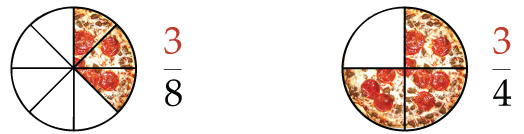
Source: Pizza - Zack Middleton/flickr/CC BY SA 2.0 (adapted)
If you're really hungry, which pizza would you take your three slices from? I know I would take three pieces from the second pizza, because they are larger. The slices in the first pizza are smaller, because the whole is divided into more pieces than the second pizza is.
To answer the question, we say \(\dfrac{3}{8}\) is less than \(\dfrac{3}{4}\).
We would write this as:
\(\Large \dfrac{3}{8} \lt \dfrac{3}{4} \)
This leads us to an important fact.
If two positive fractions with the same numerator are compared, the one with the smaller denominator is the larger fraction.
It may seem strange at first that a smaller denominator means a larger fraction. However, think back to our example with the pizzas. When the denominator was smaller, the size of each slice in the pizza was larger. Larger slices means more pizza.
Example 6
Let's look at one more example together before you try one on your own.
Use \(\gt\), \(\lt\), or \(=\) to compare \( \dfrac{7}{13} \) and \( \dfrac{7}{9} \).
Let's try to use the important fact from our previous example. Remember, it said that if two fractions with the same numerator are compared, the one with the smaller denominator is the larger fraction.
Applying this reasoning to our new example, we note first that our fractions do have the same numerator, which is \(7\). So we look to their denominators: \(13\) is larger than \(9\).
Therefore, we can conclude that \(\dfrac{7}{13}\) is smaller than \(\dfrac{7}{9}\).
\(\dfrac{7}{13} \lt \dfrac{7}{9}\)
If this is still challenging for you to visualize, draw it out. Let's go back to our example using pizzas.

When we look at \(\dfrac{7}{13}\) and \(\dfrac{7}{9}\) drawn out using pizzas, then we can see that the slices in the second pizza are larger than the slices in the first.

This means that if we chose \(7\) slices from each pizza, the second one would yield us more overall pizza in the end.
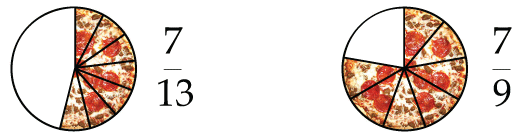
We can conclude from our diagrams that \(\dfrac{7}{13}\) is less than \(\dfrac{7}{9}\).
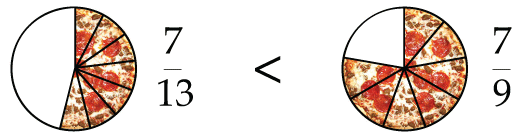
Source: Pizza - Zack Middleton/flickr/CC BY SA 2.0 (adapted)
Recall the Try This problem we did at the beginning of this lesson. Remember when I asked you to compare three small squares with three large squares and to determine which had a greater area?
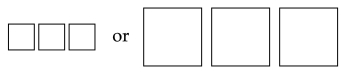
This concept is actually the exact same as comparing fractions with like numerators. In both cases, the size of each piece is different, but you're taking the same amount.
Check Your Understanding 3
Question
Use \(\gt\), \(\lt\), or \(=\) to compare \( \dfrac{15}{16} \) and \( \dfrac{15}{8} \).
\(\dfrac{15}{16}~\boxed{\phantom \square}~\dfrac{15}{8}\)
Answer
\(\dfrac{15}{16} \lt \dfrac{15}{8}\)
Feedback
Since \( \dfrac{15}{16} \) and \( \dfrac{15}{8} \) have a common numerator of \(15\), the fraction with the larger denominator is the smaller fraction. Since \(16\) is greater than \(8\), the fraction \( \dfrac{15}{16} \) is less than \( \dfrac{15}{8} \).
Example 7
Let's put everything that we have learned in this lesson together in one final example.
Three students are competing in a race. After \( 10 \) minutes, Anne has finished \( \dfrac{3}{8} \) of the race, Blair has completed \( \dfrac{3}{7} \) of the race, and Cooper is \( \dfrac{5}{7} \) of the way through the race.
If all students maintain their current standing, who will come in first, second, and third place?
Take a moment to try this problem on your own.
Solution
To solve this problem, we need to first choose two fractions to compare.
We notice that 3/7 and 5/7 have a common denominator, so it makes sense that we can start there.
\(\dfrac{3}{7} \lt \dfrac{5}{7}\)
Since the numerator \(3\) is less than the numerator \(5\), we can conclude that \(\dfrac{3}{7}\) is less than \(\dfrac{5}{7}\).
If we think about what this would look like on a number line, \(\dfrac{3}{7}\) would be to the left of \(\dfrac{5}{7}\).

Next, we notice that \(\dfrac{3}{8}\) and \(\dfrac{3}{7}\) have a common numerator, so we can compare those two fractions next.
\(\dfrac{3}{8} \lt \dfrac{3}{7}\)
Since the denominator of \(\dfrac{3}{8}\) is greater than the denominator of \(\dfrac{3}{7}\), we conclude that \(\dfrac{3}{8}\) is less than \(\dfrac{3}{7}\).
Thinking about this on the number line, Since \(\dfrac{3}{8}\) is less than \(\dfrac{3}{7}\), this means that \(\dfrac{3}{8}\) would be to the left of \(\dfrac{3}{7}\) on the number line.

In this example, I've used the number line as a tool to keep track of how my numbers compare to each other. To summarize our results, I can read the numbers on the number line, starting from left and moving to the right.

When we combine our work, we get
\( \class{timed add16-hl2 remove13-hl2}{\dfrac{3}{8}} \lt \dfrac{3}{7} \class{timed in18}{\lt \class{timed add16-hl2 remove13-hl2}{\dfrac{5}{7}}} \)
It's interesting, because while answering this question, we've actually managed to show something else. We have shown that \(\dfrac{3}{8}\) is less than \(\dfrac{5}{7}\). Think about how the fraction \(\dfrac{3}{7}\) actually helped you to compare the fractions that don't have a common numerator or a common denominator.
Our final step is to go back and answer our question. So since \(\dfrac{3}{8}\) is less than \(\dfrac{3}{7}\), which is less than \(\dfrac{5}{7}\), we conclude that Cooper will finish first, Blair will finish second, and Anne will finish third.
Check Your Understanding 4
Question
Order the fractions, \(\dfrac{1}{5}\), \(\dfrac{3}{4}\), and \(\dfrac{3}{5}\) from least to greatest.
\(\boxed{\phantom\square} \lt \boxed{\phantom\square} \lt \boxed{\phantom\square}\)
Answer
\(\dfrac{1}{5} \lt \dfrac{3}{5} \lt \dfrac{3}{4}\)
Feedback
Notice that \(\dfrac{3}{5}\) and \(\dfrac{1}{5}\) have like denominators while \(\dfrac{3}{4}\) and \(\dfrac{3}{5}\) have like numerators.
\(\dfrac{1}{5}\) is smaller than \(\dfrac{3}{5}\) and \(\dfrac{3}{4}\). Comparing \(\dfrac{3}{4}\) and \(\dfrac{3}{5}\) using the fact that these fractions have like numerators tells us that \(\dfrac{3}{5}\) is smaller than \(\dfrac{3}{4}\).
Take It With You
In the pre-season games, Jason completed \(\dfrac{2}{3}\) of his passes and Jan completed \(\dfrac{5}{6}\) of his passes.
Which player would you start in the opening game?
Provide a reason for your choice.