The Square Root of a Perfect Square Versus Non-Perfect Square
Perfect Squares and Square Roots
We can show that
\(4^2=4\times 4 = 16\)
We say that \(16\) is a perfect square because it is the square of the integer \(4\).
A square of any integer is called a perfect square.
The first few perfect squares are:
\(1,~ 4,~ 9,~ 16,~ 25, ...\)
It would be a good idea to take a minute and be sure that you can recall the first twelve perfect squares. And to find these, you're going to take an integer and multiply it by itself.
In addition, we call \(4\) the square root of \(16\), we write \(\sqrt{16}=4\). The radical symbol, \(\sqrt{ \phantom{16} }\), is used to show a square root.
To summarize,
Since
\(\begin{align*} 4^2&=16 \\ \sqrt{16} & \; =4 \end{align*}\)
Since
\(\begin{align*} 5^2&=25 \\ \sqrt{25} & \;=5 \end{align*}\)
Since
\(\begin{align*} 7^2&=49 \\ \sqrt{49} & \; =7 \end{align*}\)
Do a couple more examples on your own to really establish the relationship between squaring a number and finding the square root of a number.
Check Your Understanding 1
Question
Evaluate \(\sqrt{121}\).
Answer
\(11\)
Feedback
We can confirm that \(11^2=121\). As a result, we can write \(\sqrt{121} = 11\).
Non-Perfect Squares
Now, while we've been picking out specific numbers that are perfect squares, you may have started to notice that most integers are not perfect squares.
For instance, we know that \(25\) and \(36\) are perfect squares of the consecutive integers \(5\) and \(6\). What this means is that all of the integers between \(25\) and \(36\) cannot be perfect squares because there's no integer between \(5\) and \(6\) that we can square to achieve them.

Let's look specifically at the number \(29\). Since \(29\) is in the range from \(25\) to \(36\), we can conclude that \(29\) is not a perfect square. What this means is that the square root of \(29\) is not an integer.

So if \(\sqrt{29}\) is not an integer, what kind of number is it? To be able to answer this question, we need to be able to find a number that squares to \(29\).
Example 1
Approximate \(\sqrt{29}\).
Solution
We just made the observation that \(29\) is between the consecutive perfect squares \(25\) and \(36\).
So we know that the side length of a square with area \(25\) is going to be \(5\) because \(5^2\) is equal to \(25\). Similarly, the side length of a square with area \(36\) is \(6\) because \(6^2\) is equal to \(36\). Now, if we have a square with an area of \(29\), then the side lengths of this square should be larger than \(5\), but less than \(6\).
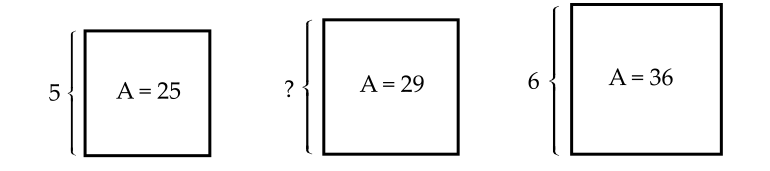
So we've determined that the \(\sqrt{29}\) is going to be \(5\) point something, but it's natural to ask ourselves if we can do better than this. Absolutely, we can.
Now that we have a starting point, we can start testing some numbers between \(5\) and \(6\) in order to find a good approximation.
Let's begin by trying \(5.1\) as well as \(5.9\). We can calculate \(5.1^2\) to be equal to \(26.01\). Furthermore, \(5.9^2\) is equal to \(34.81\).
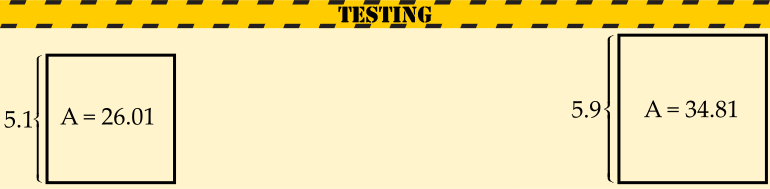
Now although all these values are closer to \(29\) than our original numbers \(25\) and \(36\) were, we can still get closer and find a better approximation.
As we go through this, keep in mind that we do not need to test all values. Right away, since \(5.1^2\) is equal to \(26.01\), I can estimate that \(5.2^2\) is probably not going to be as close to \(29\) as we can get. So I'm going to skip to \(5.3\) and try that. \(5.3^2\) is equal to \(28.09\). The square of \(5.3\) is even closer to \(29\).
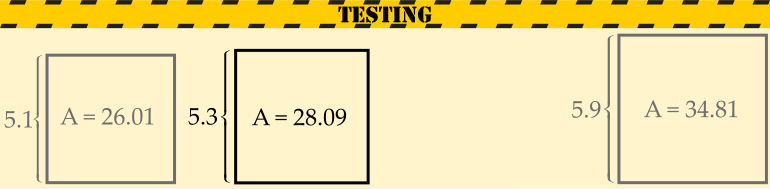
So let's now try \(5.4\) and see if we can do better again. \(5.4^2\) is equal to \(29.16\).
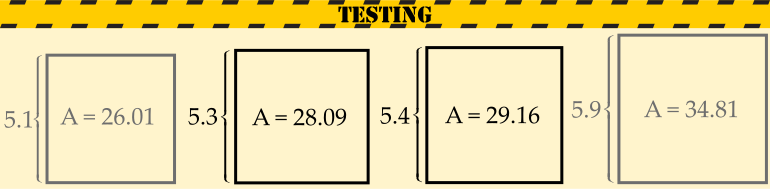
It looks like the square of \(5.4\) is as close to \(29\) as we can get using only one decimal place.
We already showed that the square of \(5.3\) is farther away, and if we square a number larger than \(5.4\), then the results are going to be larger still than \(29.16\), but we haven't actually found an exact answer.
If we increase the number of decimal digits that we can use, and we explore numbers now between \(5.3\) and \(5.4\), would we actually come across an exact answer?
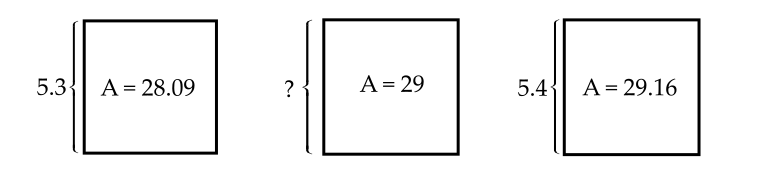
If you continue, you would start to build the following number
\(5.385164...\)
But no matter how many digits you add, you will never find a number that squares to exactly \(29\).
In fact, no rational number squares to \(29\), so \(\sqrt{29}\) is not rational.
Take a moment and think back to what the word rational means. If a number is not rational, then that means it cannot be written as a fraction, meaning that it is not a terminating or a repeating decimal.
\(\sqrt{29}\) is a number that is a non-terminating, non-repeating decimal, and with this in mind, the best we can do is approximate the value of \(\sqrt{29}\).
To finish our question and to wrap up our example, we conclude that
\(\sqrt{29}\approx 5.4 \text{ since } 5.4^2=29.16\)
Before we move on to the next part of our lesson, notice that to show \(\sqrt{29}\) is approximately \(5.4\), we have used a squiggly equal sign, \(\approx\). This is to show that the value is approximate and not equal.