Slide Notes

Glossary

All Slides


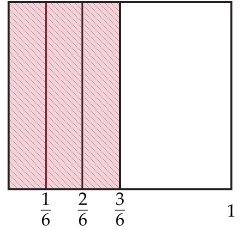
Example 3: Visual Representation


Example 3:  Numeric Representation

Stanley has \(\dfrac{1}{2}\) of a metre of birthday wrapping paper.  Each gift he needs to wrap requires \(\dfrac{1}{6}\) of a metre of paper.  How many birthday gifts can he wrap?


Summary


Example 4

Calculate \(\dfrac{2}{5} \div \dfrac{1}{3}\).


Check Your Understanding 2

Evaluate \((((((((q)*(u))*(e))*(s))*(t))*(i))*(o))*(n)\). 

Enter the fraction \(\dfrac{5}{4}\) as '5/4' or enter the mixed number \(1\dfrac{3}{4}\) as '1+3/4'.

   There appears to be a syntax error in the question bank involving the question field of this question. The following error message may help correct the problem:

null

Preview   

Step 1: Find the reciprocal of the second fraction. The reciprocal of \(\dfrac{1}{c}\) is \(\dfrac{c}{1}\).

Step 2: Multiply the first fraction by the reciprocal of the second fraction.

\(\begin{align*} (((((((q)*(u))*(e))*(s))*(t))*(i))*(o))*(n) &=\dfrac{a}{b}\times\dfrac{c}{1}\\ &=\dfrac{(a)*(c)}{b}\\ &((((((((f)*(e))*(e))*(d))*(b))*(a))*(c))*(k))*1.0\\ &((((((((f)*(e))*(e))*(d))*(b))*(a))*(c))*(k))*2.0 \end{align*}\)

Remember to reduce your final answer whenever possible.

Paused Finished
Slide /