Negative Integers
Integers on a Thermometer
Recall the Try This problem: One spring, morning the outside temperature is \(3^\circ\)C below zero. By noon, the temperature has increased \(10^\circ\)C.
We have to pay special attention to phrases such as, below \(0\). Because they tell us where this temperature is located relative to \(0\) on the thermometer.
So if we look at the thermometer for a second, we can locate \(0\).
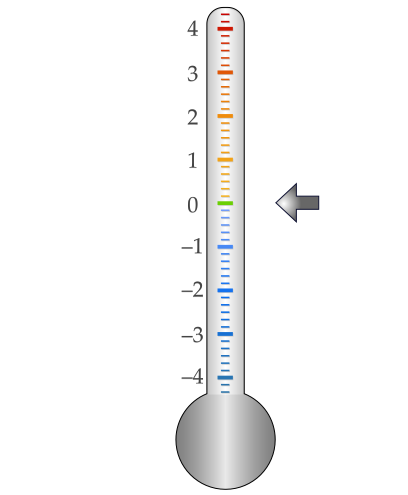
Then locate \(3^\circ\)C below.
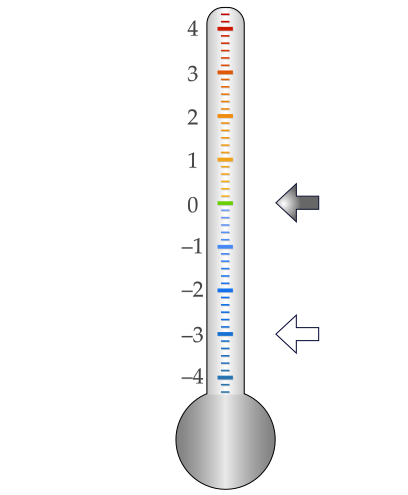
You're going to notice that on the thermometer this is denoted by the integer, \(-3\).
Now recall that the temperature scale is how we measure and describe temperature. The ultimate goal is typically to compare different temperatures.
So let's ask ourselves the following question:
How does \(-3\) compare to \(+3\)?
To make sense of this comparison let's look to a thermometer.
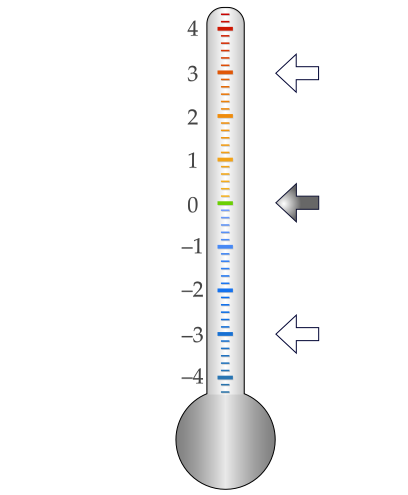
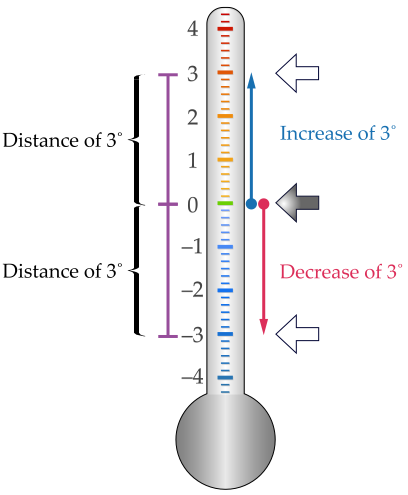
If we compare \(3\) and \(+3\), we can see that they are the exact same distance from \(0\), but lie on opposite sides of \(0\).
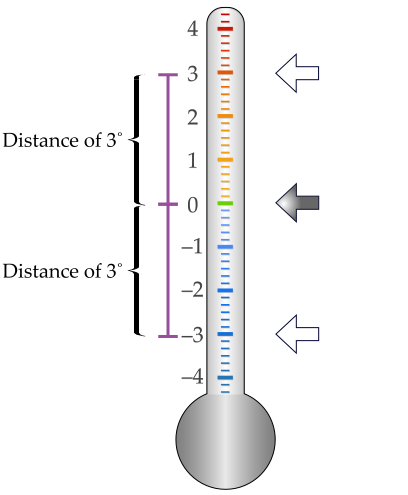
Each of these integers represents a change of exactly \(3^\circ\)C from \(0^\circ\)C. \(+3\) represents an increase, and \(-3\) represents a decrease.
Source: Thermometer - _human/iStock/Getty Images Plus
Example 1
We're now going to look at how we can use the thermometer to represent changes in temperature.
If it is \(+1^\circ\)C, how do you represent a temperature change, or a temperature increase, of \(+6^\circ\)C?
Solution
We can represent an increase of \(6^\circ\)C using an arrow that's \(6\) units long.
Since our starting temperature is \(1^\circ\)C, the arrow will start at \(1\).
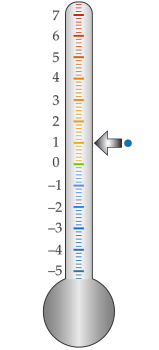
Then increase \(6\) units, and end at \(+7\).
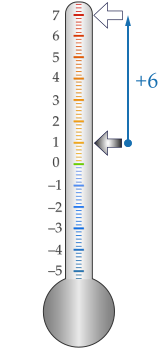
As a result, the final temperature would be \(7^\circ\)C.
If our starting point is now \(-4^\circ\)C, how do you represent a temperature change of \(+6^\circ\)C?
Solution
It makes sense that the arrow we use to represent a change of \(+6\) would be the same as the example we just did. So what needs to change here?
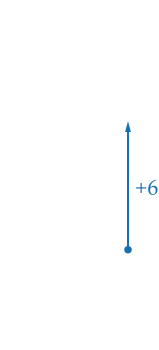
Well, our starting point. Instead, the tail of the arrow starts at \(-4\), and increases \(6\) units from there.
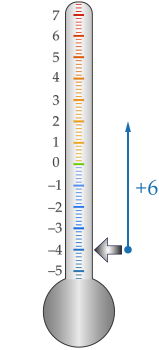
What we see is that an increase of \(6\) units from \(-4^\circ\)C gives us a final temperature of \(2^\circ\)C.
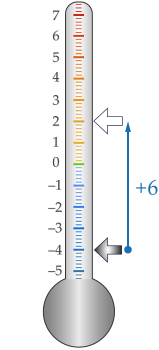
Source: Thermometer - _human/iStock/Getty Images Plus
So even though we're getting different answers here, what we really want to understand is that adding positive \(6\) to a number is the same concept regardless of whether that number is a positive integer, or a negative integer.
Example 2
So let's spin this problem a little bit.
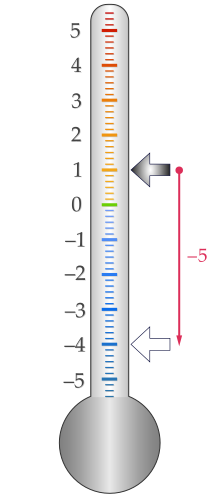
If it is \(+1^\circ\)C, how do you represent a temperature change, or temperature decrease of \(-5^\circ\)C?
Solution
Our starting point is the same as the first example we did, so we know that the arrow is going to start at \(+1\).
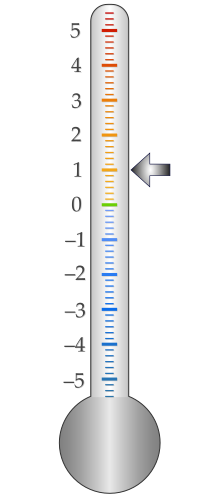
But we're not increasing our temperature this time. Instead, we're decreasing. So instead of moving the arrow up, it makes sense to do the opposite, and move the arrow downward.
To show this addition, we would start the arrow at \(+1\), and move it \(5\) units down.
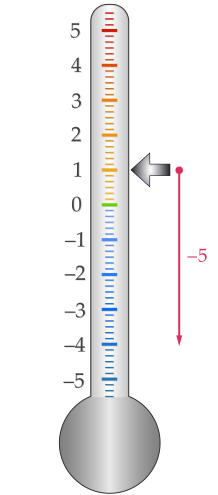
As a result, if we start at \(+1^\circ\)C,, and our temperature decreases by \(5^\circ\)C, our final temperature is \(-4^\circ\)C.
Source: Thermometer - _human/iStock/Getty Images Plus
What we see is that when we change temperature, we could end up with a negative answer.
Opposite Integers
Now, we can think of a thermometer as a number line that's been written vertically.
To understand quantity when it comes to negative numbers, it makes sense that we should actually start looking at the number line.
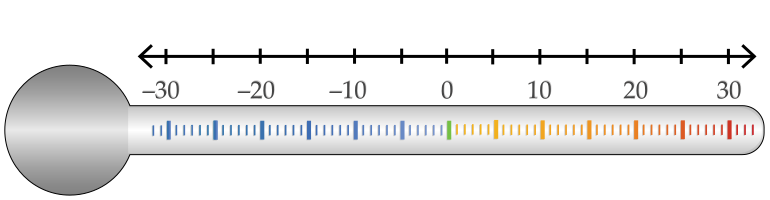
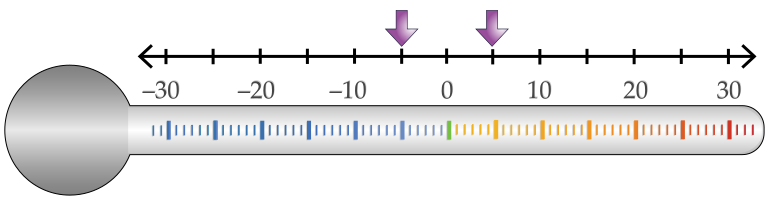
Each negative number on the number line is opposite to a positive number.
For example, \(-5\) is opposite to \(+5\).
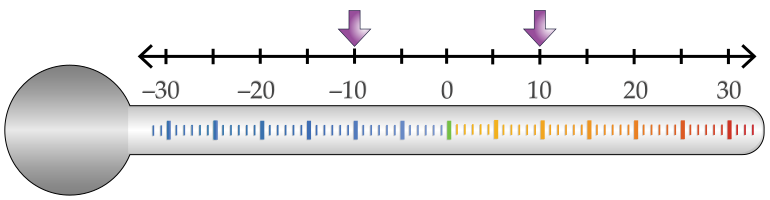
\(-10\) is opposite to \(+10\).
\(-30\) is opposite to \(+30\).
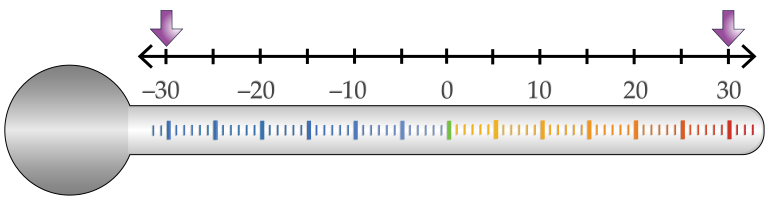
Source: Thermometer - _human/iStock/Getty Images Plus
So we've given you three examples of integers that are opposite. However, any integer has an opposite. So we can formalize this idea in a definition.
Two integers are opposite if they are the same distance away from zero, but on opposite sides of zero on the number line.
So the only integer left to consider is \(0\).
Does \(0\) have an opposite?
This is a special case of our definition. Since \(0\) is the point at which we're referencing to define opposite integers, \(0\) is its own opposite.
Check Your Understanding 1
Question
Determine the integer that is opposite to \(3\) and plot it on the following number line.

Answer
The integer that is opposite to \(3\) is \(-3\) and it is \(3\) ticks to the left of \(0\) on the number line.

Created with GeoGebra. Author: University of Waterloo. CC BY-NC-SA 4.0. https://ggbm.at/tK648BKT
Feedback
Recall that an integer is opposite to \(3\) if it is the same distance away from zero but on the opposite side of zero on the number line.