Alternative Format


Try This

Debts and Assets

Operations with integers can often be thought about in terms of money.

A negative number can represent money that you "owe." Money that you owe is another word for describing debt.

A positive number can represent money that you "have." Another term that we use to describe money that you have, is called an asset.

Sources: IOU Piggy - sqback/iStock/Getty Images Plus; Piggy and Coins - LilliDay/iStock/Getty Images Plus

Let's think back to addition to remind ourselves how owing and having money works.

If you owe your sister \($3\) and you have \($7\) in your pocket, then you really only have \($4\). Because you're going to have to use some of the \($7\) to pay back your sister.

Lesson Goals

  • Review the operation of subtraction.
  • Show subtraction on the number line.
  • Learn how to subtract integers without using a calculator.

Subtracting Money

Now, whether or not you realize it, you have known how to subtract long before you learned the difference between whole numbers and fractions.

Consider the following subtraction statement:

\(\LARGE 8-6=2\)

Many years ago, you would have learned how to perform this operation. One way that you would have learned to work with the scenario is to think about it in terms of money.

 You have \($8\), you removed \($6\), which leaves you with \($2\).

8 Canadian loonies with six crossed out leaving 2.

Source: 1 Canadian dollar coin - asafta/iStock Editorial/Thinkstock

Our Try This problem is going to get you to try and apply that thinking to integer operations.

Try This!

Explain each of the following statements in terms of money.

Specifically, consider each integer in terms of money that you 'have' or money that you 'owe.'

Then, calculate the answer and explain what it means.

  • \((-5)+2\)

  • \((-5)+6\)

  • \((-5)-9\)

  • \((-5)+(-4)\)

  • \((-5)-(-5)\)

Think about this problem, then move on to the next part of the lesson.


What Is Subtraction?

Try This Problem Revisited

Let's look at the scenarios that you came up with in the Try This problem.

Equation Explanation
\((-5)+2\)

\(=-3\)

We owe \($5\) and have \($2\),
therefore we still owe \($3\).
\((-5)+6\)

\(=1\)

We owe \($5\) and have \($6\),
therefore we have \($1\).
\((-5)-9\)

\(=-14\)

We owe \($5\) and then we remove \($9\),
therefore we owe \($14\).
\((-5)+(-4)\)

\(=-9\)

We owe \($5\) and add \($4\) more debt,
therefore we owe \($9\).
\((-5)-(-5)\)

\(=0\)

We owe \($5\) and then we remove \($5\) worth of debt,
therefore we have \($0\).

The Try This problem gave you a preview of where we're going. We're now going to start back at the beginning with subtraction and work up to include all of our integers.

Example 1

Maple Mountain has an elevation of \(642\) m. Mount Carleton has an elevation of \(817\) m.

How much taller is Mount Carleton than Maple Mountain?

Since this question is in the subtraction lesson, it naturally is a subtraction problem. But we want to start by asking ourselves why this is a subtraction problem.

The key words in the question are "how much taller."  this tells us that we want to find the difference between the two values. To find the difference, we must subtract.

Solution

So we set up our problem to subtract the elevation of Maple Mountain from the elevation of Mount Carleton.

Mathematically, we write this as

\(817-642\)

From here, we can use our knowledge of place values to subtract, and get

\(817-642=175\)

Therefore, Mount Carleton has an elevation that is \(175\) m greater than Maple Mountain.

Source: Mountain - juliaart/iStock/Getty Images Plus

Example 2

So what does subtraction actually look like on the number line?

Show the calculation \(15-7\) on the number line.

Solution

While we're learning to use the number line, it can be also helpful to think about the problem simultaneously using money. 

We start by having \($15\). And we can represent that using money as \(15\) loonies.

15 loonies.

We can also represent it on the number line using an arrow. This arrow will start at \(0\) and move \(15\) units to the right.

So what does it mean to subtract \(7\) from \(15\)?

In terms of money, it means that we must remove \(7\) loonies from the \(15\) that we have. We can see that in removing \($7\), we're decreasing what we have by \(7\).

15 loonies with 7 of them grouped together and taken away.

Source: 1 Canadian dollar coin - asafta/iStock Editorial/Thinkstock

So how would we go about showing a decrease on the number line? If we move right on the number line to show an increase, then to show a decrease, it makes sense that we would do the opposite of that, or move left. So to show a decrease of \(7\) units, we would use an arrow that is \(7\) units long and points left.

Again, remember that that arrow that shows a decrease of \(7\), starts at \(15\) because this is the amount that we are starting \(7\) from. Notice the path that the arrows create. They move from head to tail of the previous arrow.

So, we have

\(15 -7 = 8\)

When subtracting, we are finding the difference between two numbers.

That is, we are finding how much larger one number is than the other number.

Check Your Understanding 1

Question

Calculate \(\class{hl3}{12}-\class{hl1}{9}\) using the number line. 

A number line between 0 and 20 with ticks at every integer.

Answer

We can represent \(\class{hl3}{12}\) using an arrow that moves \(12\) units to the right.

We can represent \(-\class{hl1}{9}\) using an arrow that moves \(9\) units to the left. To subtract quantities means to combine them. We arrange the arrows from head to tail and the final location is at \(3\).

Created with GeoGebra. Author: University of Waterloo. CC BY-NC-SA 4.0. https://ggbm.at/ArPSh3Ud

Therefore, \(\class{hl3}{12}-\class{hl1}{9}=3\).

Feedback

The first arrow should be extended \(12\) units to the right. Since we are subtracting, the second arrow should start at \(12\) and extend \(9\) units to the left. Your final answer is where the path of arrows ends. 

Use the counters along the bottom of the number line to determine where the last arrowhead ends. This is the answer to the subtraction problem.


Subtracting Positive Integers

Example 3

Is it possible to evaluate \(5-9\)?

The reason we ask this problem is because \(9\) is larger than \(5\). So how would this work? And more importantly, how would it look on the number line?

Solution

Let's start by following the same steps that we use to show subtraction on the number line in the previous example. You can see that this calculation is almost the same as all of the other subtraction problems that you've done. The difference is that our final arrow head ends up to the left of \(0\).

How can we take away more than you have? Here, it's more helpful to think about the calculation in terms of money. We have \($5\), and we take away \($9\).

In practice, we can't actually take way more than we have. But in theory, when we remove more money than we have, we create a debt. So when we start with \($5\) and we take away \($9\), the result is that we owe \($4\). So we've made sense of the scenario using money.

Now let's look back to that number line. The subtraction is the same. We start with an arrow that represents \(5\). And from the tip of that arrow, we decrease, or move left on the number line by \(9\).

The act of subtraction is still the same.

We use the negative side of the number line to get our answer.

Check Your Understanding 2

Question

Calculate \(\class{hl3}{7}-\class{hl1}{15}\) using the number line. 

A number line from -15 to 10 with ticks at every integer.

Answer

We can represent \(\class{hl3}{7}\) using an arrow that moves \(7\) units to the right.

We can represent \(-\class{hl1}{15}\) using an arrow that moves \(15\) units to the left. To subtract quantities means to combine them. We arrange the arrows from head to tail and the final location is at \((-8)\).

Created with GeoGebra. Author: University of Waterloo. CC BY-NC-SA 4.0. https://ggbm.at/XraUzdGa

Therefore, \(\class{hl3}{7}-\class{hl1}{15}=(-8)\)

Feedback

The first arrow should be extended \(7\) units to the right. Since we are subtracting, the second arrow should start at \(7\) and extend \(15\) units to the left. Your final snwer is where the path of arrows ends.

Use the counters along the bottom of the number line to determine where the last arrowhead ends. This is the answer to the subtraction problem.

Example 4

Calculate \((-4)-8\).

Solution

We start with owing \($4\).

We then subtract or take away \(8\) more dollars, which means that we now owe \($12\) overall.

The first arrow is 4 units long, starting at 0 and ending at negative 4. The second arrow is 8 units long, starting at negative 4 and ending at negative 12.

But think back to addition. We actually have another way to write what this scenario is describing. This is the same as owing \($4\), and then increasing what we owe by another \($8\).

In summary:

Subtraction

\( (-4)-8=-12\)

Addition

\((-4)+(-8)=-12\)

So we have one scenario here and two equations that we're using to describe it. What we are seeing is that increasing what we owe by \($8\) is the same as subtracting \($8\).

Explore This 1

Description

In the following investigation, each subtraction problem has been rewritten using addition. As you explore multiple examples, look for the rule that's being used which allows us to change subtraction problems into addition problems. It is through these examples that we can find a method for subtracting integers quickly without using a number line and without the use of a calculator.

What rule allows us to change subtraction problems into addition problems? 

Example 1

\(\begin{align*} 8 - \class{hl3}{ \ 5 \ } &= \class{hl5}{3} \\ 8 + \class{hl4}{(-5)} & = \class{hl5}{3} \end{align*}\)

Therefore, \(8 - \class{hl3}{5}\) is the same as \(8+ \class{hl4}{(-5)}\).

Example 2

\(\begin{align*} (-1) - \class{hl3}{ \ 8 \ } &= \class{hl5}{(-9)} \\ (-1) + \class{hl4}{(-8)} & = \class{hl5}{(-9)} \end{align*}\)

Therefore, \((-1) - \class{hl3}{8}\) is the same as \((-1)+ \class{hl4}{(-8)}\).

Did you notice a rule that was being used to convert subtraction problems to addition problems in the investigation?

The rule is that we can change the subtraction to addition of the opposite integer. And from there, use the addition strategies we learned in a previous lesson.

Online Version

https://ggbm.at/VMUEVHdu

Example 5

Evaluate \(9 - 17\).

Take a moment and try this problem on your own.

Solution

To subtract \(17\) is the same as adding \(-17\), so we can rewrite this as 

\(\begin{align*} 9-17 &= 9+(-17) \end{align*}\)

Now all we have to do is use our integer addition strategies. When we do this we get,

\(\begin{align*} 9-17 &= 9+(-17) \\ &=-8 \end{align*}\)

You can always verify your calculations using a number line. I encourage you to do that now and check your work for this example.

Check Your Understanding 3

Question

Solve as many problems as you can in one minute.

  1. \( 7 - 28\)
  2. \(15-38\)
  3. \(16-8\)
  4. \((-9)-5\)
  5. \((-14)-9\)
  6. \(20-2\)
  7. \((-4)-39\)
  8. \(12-25\)
  9. \(4-6\)
  10. \((-14)-12\)
Answer
  1. \( 7 - 28 = -21\)
  2. \(15-38-23\)
  3. \(16-8=8\)
  4. \((-9)-5=-14\)
  5. \((-14)-9=-23\)
  6. \(20-2=18\)
  7. \((-4)-39=-43\)
  8. \(12-25=-13\)
  9. \(4-6=-2\)
  10. \((-14)-12=-26\)

Subtracting Negative Integers

Example 6

So we've looked at how we can subtract a positive integer by adding its opposite. But does this method also apply to subtracting a negative integer?

Calculate \((-9) - (-7)\).

Take a moment and try this problem on your own.

Solution

Using a money analogy, \((-9) - (-7)\) means that

  • you owe \($9\) to your parents, and
  • they remove \($7\) that you owe. 

As a result, you now only owe them \($2\).

  • IOU $1

  • IOU $1

  • IOU $1

  • IOU $1

  • IOU $1

  • IOU $1

  • IOU $1

  • IOU $1

  • IOU $1

Removing money that you owe is the same as gaining money.

\((-9)-(-7) = (-9)+7 = -2\)

What we're finding is that any subtraction problem can be changed to an equivalent addition problem.

Example 7

Evaluate \((-13)-(-5)\).

Solution

To subtract \((-5)\), the same as adding \(5\).

\((-13)-(-5) = (-13)+5\)

From here, the answer is

\(\begin{align*}(-13)-(-5) &= (-13)+5 \\ &=-8\end{align*}\)

Check Your Understanding 4

Question

Evaluate \(17-(-13)\)

Answer

\(30\)

Feedback

To solve a subtraction problem involving integers, first we rewrite the problem using addition and then use our strategies for adding integers. 

\(\begin{align*} 17-(-13) & = 17+13 &\text{To subtract } (-13) \text{, add } 13 \\ &= 30\end{align*}\)

Check Your Understanding 5

Question

Solve as many problems as you can in one minute.

  1. \(1-(-22)\)
  2. \(12-(-22)\)
  3. \(4-(-15)\)
  4. \((-11)-(-31)\)
  5. \(5-(-20)\)
  6. \(17-(-40)\)
  7. \(10-(-2)\)
  8. \(7-(-16)\)
  9. \(7-(-11)\)
  10. \((-10)-(-14)\)
Answer
  1. \(1-(-22)=23\)
  2. \(12-(-22)=34\)
  3. \(4-(-15)=19\)
  4. \((-11)-(-31)=20\)
  5. \(5-(-20)=25\)
  6. \(17-(-40)=57\)
  7. \(10-(-2)=12\)
  8. \(7-(-16)=23\)
  9. \(7-(-11)=18\)
  10. \((-10)-(-14)=4\)

Hot Air Balloon Summary

Introduction

When adding and subtracting integers, we can identify patterns that allow us to group similar problems. So far, we've seen four general scenarios:

  1. Add a positive integer to an integer.\[(-2)+9\]
  2. Add a negative integer to an integer.\[(-2)+(-3)\]
  3. Subtract a positive integer from an integer.\[(-2)-1\]
  4. Subtract a negative integer from an integer.\[(-2)-(-4)\]

Let's now take some time to describe each scenario, using the analogy of a hot air balloon.

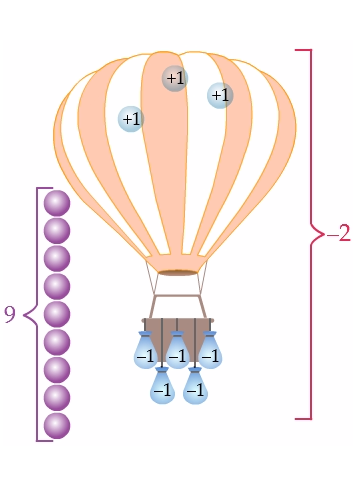
If we look at our hot air balloon, it has both units of air and sandbags. Each unit of air represents \(+1\). So in this case, we have \(3\) units of air, which represent the integer, \(+3\). Each sandbag represents \(-1\). So in this case, we have \(5\) sandbags which represent the integer, \(-5\).

Overall, our hot air balloon represents \(-2\), because that is the total of \(+3\) and \(-5\). What this means is that we have \(2\) more sandbags than units of air.

Source: Hot Air Balloon - University of Waterloo

1. Adding a Positive Integer

We're now going to use our hot air balloon to help us answer some math problems. Consider what would happen when we add a positive integer to any number.

Consider the problem

\(\class{hl2}{(-2)}+\class{hl3}9\)

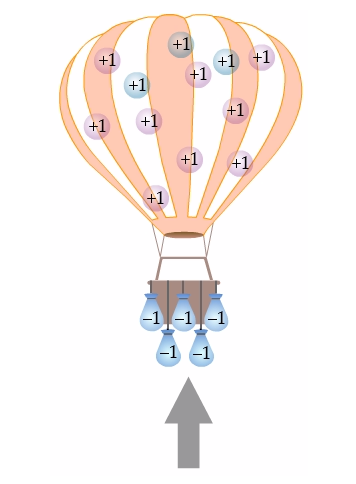
Using our hot air balloon, we remember that it already represents \(-2\). To add \(9\) to \(-2\), means that we add \(9\) units of air to the balloon.
So ask yourself, what would happen to the balloon with this addition of air?
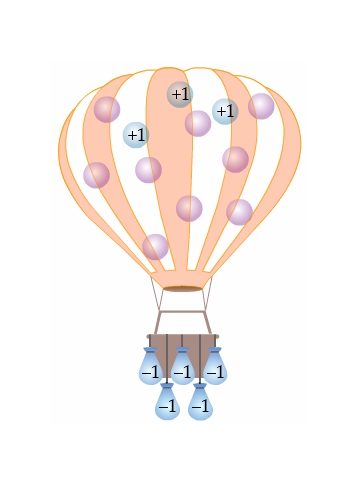
We add nine more air particles to the balloon, causing it to rise.
Source: Hot Air Balloon - University of Waterloo

But what does this mean mathematically? Well, when we add a positive integer to a number, it's just like adding air to the balloon.

Adding a positive integer to any number will result in an increase.

I encourage you to try a few more examples on your own to convince yourself that this is true.

2. Adding a Negative Integer

With our previous example in mind, how can we think about adding a negative?

Consider the problem

\(\class{hl2}{(-2)}+\class{hl3}{(-3)}\)

Again, our hot air balloon represents \(-2\). So if we want to add \((-3)\), it means that we need to add \(3\) sand bags. What's going to happen when we do this?
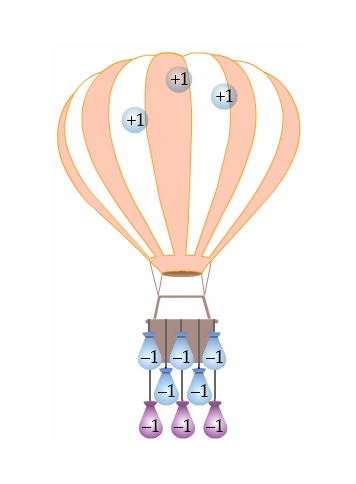
We add three more sand bags to the balloon, causing it to fall. Adding sandbags is going to cause the balloon to fall towards the ground, because sandbags weigh the balloon down.

Source: Hot Air Balloon - University of Waterloo

At this point, you should be asking yourself, what does this tell us mathematically. 

Adding a negative integer is always like adding sandbags, which leads to this important fact.

Adding a negative integer to any number will result in a decrease.

Come up with a few examples on your own right now to convince yourself that this is true.

3. Subtracting a Positive Integer

Let's now look at how subtraction works.

Consider the problem

\(\class{hl2}{(-2)}-\class{hl3}1\)

To subtract \(1\) from \((-2)\), we must remove \(1\) unit of air from the balloon, because each unit of air represents \(+1\).
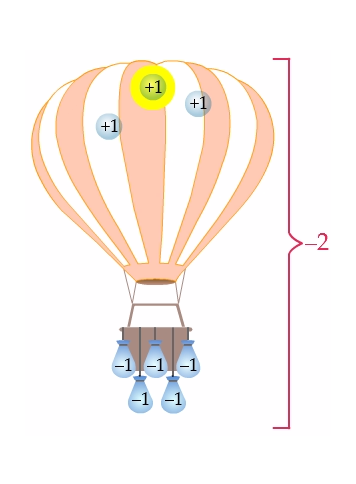
When we do this, will the hot air balloon rise or fall?

We remove \(1\) air particle from the balloon, causing it to fall. Convince yourself that removing units of air is going to cause the balloon to fall towards the ground. 
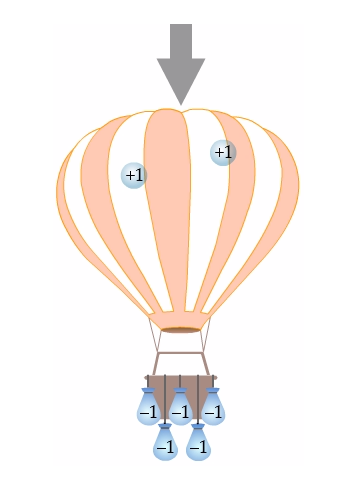
Source: Hot Air Balloon - University of Waterloo

Mathematically this means that subtracting a positive integer is just like removing air from the balloon. 

Subtracting a positive integer from any number will result in a decrease.

Again, as an exercise, try some more examples on your own. 

4. Subtracting a Negative Integer

Finally, we need to consider the last case, which means we need to consider how to subtract a negative.

Let's look at the question,

\(\class{hl2}{(-2)}-\class{hl3}{(-4)}\)

In our hot air balloon analogy, subtracting \((-4)\) means to remove \(4\) sandbags from the basket of the hot air balloon.
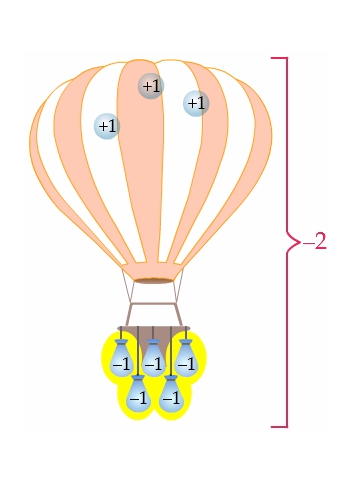
When we remove \(4\) sandbags, the hot air balloon will rise, because there are less sandbags weighing it down.
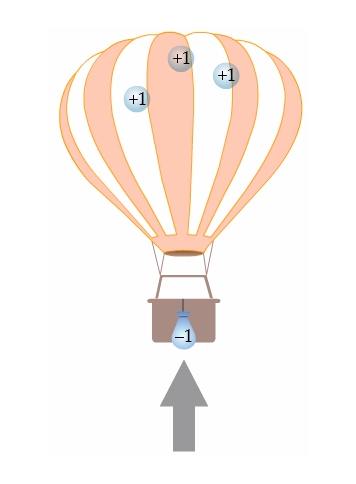
Source: Hot Air Balloon - University of Waterloo

Mathematically, this tells us that subtracting a negative integer is just like removing sandbags from the balloon.

Subtracting a negative integer from any number results in an increase.

This is a hard idea to visualize. I really encourage you to try a few more examples of this case on your own, before you move on to the next part of the lesson.

Summary

Let's look at all four examples together. We have two addition problems, \(\class{hl2}{(-2)} + \class{hl3}{9}\) and \(\class{hl2}{(-2)} + \class{hl3}{(-3)}\), and two subtraction problems, \(\class{hl2}{(-2)} - \class{hl3}{1}\) and \(\class{hl2}{(-2)} - \class{hl3}{(-4)}\). And at first, we would want to say that the addition problems are similar and the subtraction problems are similar, but now that we've illustrated each of these problems using a hot air balloon, you should have noticed something else.

\(\class{hl2}{(-2)}+\class{hl3}{9}\)

 Adding 9 air particles to the original balloon representing negative 2.

\(\class{hl2}{(-2)}+\class{hl3}{(-3)} \)

  Adding 3 sand bags to the original balloon representing negative 2.

\(\class{hl2}{(-2)} -\class{hl3}{1} \)

  Removing 1 air particle to the original balloon representing negative 2.

\(\class{hl2}{(-2)}- \class{hl3}{ (-4)} \)

  Removing 4 sandbags to the original balloon representing negative 2.

We notice that two of these problems caused the balloon to rise. And two of these problems caused the balloon to fall.

\(\class{hl2}{(-2)}+\class{hl3}{9}\)

There are 7 more air bags than sand bags, so the hot air balloon rises.

\(\class{hl2}{(-2)}+\class{hl3}{(-3)} \)

There are 5 more sand bags than air particles, so the hot air balloon falls.

\(\class{hl2}{(-2)} -\class{hl3}{1} \)

 There are 3 more sand bags than air particles, so the hot air balloon falls.

\(\class{hl2}{(-2)}- \class{hl3}{ (-4)} \)

There are 2 more air bags than sand bags, so the hot air balloon rises.

Source: Hot Air Balloon - University of Waterloo

Let's start by looking at those two expressions that caused our balloon to rise.

The first thing you should notice is that \(\class{hl2}{(-2)} + \class{hl3}{9}\) is an addition problem, but \(\class{hl2}{(-2)} - \class{hl3}{(-4)}\) is a subtraction problem. So what's actually going on here?

Well, adding air naturally will cause the balloon to rise, but subtracting what's weighing it down has that exact same effect. Adding a positive integer or subtracting a negative integer both cause an increase.

Let's now look to the other two expressions, \(\class{hl2}{(-2)} + \class{hl3}{(-3)}\) and \(\class{hl2}{(-2)} - \class{hl3}{1}\), both of which caused our balloon to fall.

We saw that removing air will cause the balloon to fall, but adding sandbags has the exact same effect. Subtracting a positive integer and adding a negative integer both result in a decrease.

Once we start to perform operations with integers, we can really begin to see more connections between addition and subtraction. Use these connections to help you with your mental arithmetic.

Check Your Understanding 6

Question

Solve as many problems as you can in one minute

  1. \((-9)-21\)
  2. \((-14) - (-31)\)
  3. \(10+31\)
  4. \((-10)+(-5)\)
  5. \(1+6\)
  6. \(19+15\)
  7. \((-17)+(-15)\)
  8. \(3+4\)
  9. \((-15)-5\)
  10. \(8-(-36)\)
  11. \(2-25\)
Answer
  1. \((-9)-21=(-30)\)
  2. \((-14) - (-31)=17\)
  3. \(10+31=41\)
  4. \((-10)+(-5)=(-15)\)
  5. \(1+6=7\)
  6. \(19+15=34\)
  7. \((-17)+(-15)=(-32)\)
  8. \(3+4=7\)
  9. \((-15)-5=(-20)\)
  10. \(8-(-36)=44\)
  11. \(2-25=(-23)\)

Take It With You

Subtraction is not commutative.

For example,

\(37 - 19 \neq 19 - 37\)

Explain why

\(37-19+3\) and \((-19)+37+3\)

are equal.

How might this help you when performing mental arithmetic?