Alternative Format


Try This

Ratio Versus Rate

Recall:

Ratio
A comparison of two like quantities.

But what happens when you want to compare quantities that are different?

In that case, we use rates. 

Rate
A comparison of two unlike quantities.

Often, we're going to see that one of these quantities involves time. But to get us started, let's take a look at an example to give us a better idea of the difference between a ratio and a rate.

Example

Consider a scenario where Louisa bought
\(7\) bananas and \(5\) apples.

RATIO

The ratio \(5:7\) compares the number of apples to the number of bananas.

The ratio \(5:12\) compares the number of apples to the total number of fruit.

Recall that these are examples of ratios because both quantities are being measured in the same way, both compare number to number.

But what if we were given more information?

What if we were told that Louisa paid
\($1.89\) for \(7\) bananas and \($4.90\) for \(5\) apples.

RATE

The rate \($1.89\) for \(7\) bananas compares the number of dollars to the number of bananas.

The rate \($6.79\) for \(12\) pieces of fruit compares the total number of dollars to the total number of pieces of fruit.

Notice that these are different from ratios because in each of these examples, we are comparing dollars to number of fruit.

The quantities are being measured in different units.

Rates All Around Us

We encounter rates all the time in the world around us.

Internet Speeds

A globe with connections similar to the Internet.

Internet speeds are represented in megabits per second, which compares the quantity of data received to the time period.

As an example, \(60\) megabits per second describes an internet speed where \(60\) megabits of data is received or sent every second.

Heart Rates

http://www.gettyimages.ca/license/155600366

Heart rates are represented in beats per minute, which compares the number of beats your heart makes to the time period.

For example, a heart rate of \(70\) beats per minute tells you that every minute, your heart beats \(70\) times.

Wages

http://www.gettyimages.ca/license/155600366

The pay for your first part time job will likely be given to you as a comparison between the number of dollars and the number of hours you worked.

For example, if your wage is \($11.50\) per hour, then for every hour you work, you will earn \($11.50\).

Sources: Internet - loops7/E+/Getty Images; Heart Rate - kahramanisan/E+/Getty Images; Waitress - asiseeit/iStock/Getty Images

Lesson Goals

  • Explore strategies for finding equivalent rates.
  • Solve problems involving unit rates.
  • Express the same rate in different units.

Try This!

Two cousins are competing in a pedal go-kart race.

Ben says that he can complete
\(250 \) metres in \(40\) seconds.

Carter says that he can complete
\(183\) metres in \(30\) seconds.

Sources: Boys - Imgorthand/E+/Getty Images

Assuming that they are telling the truth, who would you expect to win the race?

Think about this problem, then move on to the next part of the lesson.


Equivalent Rates

Definition

Let's begin our discussion on rates by considering a few more examples. We want to recall some situations where we have seen unlike quantities being compared.

A printer can print \(6\) pages in \(30\) seconds.
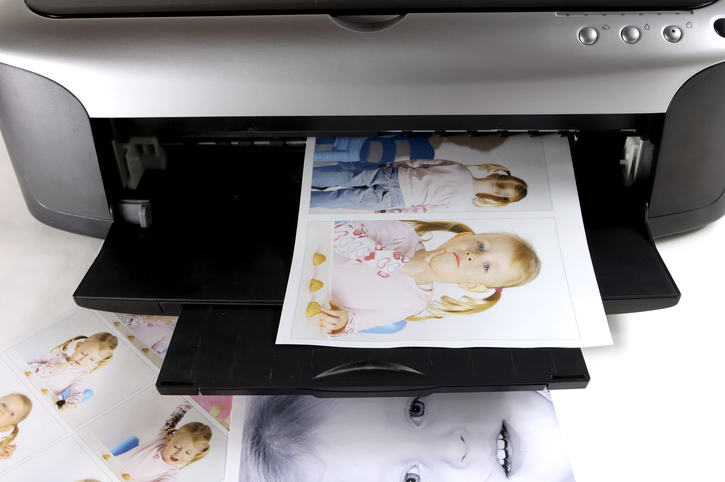
A printer.

It costs \($21.98\) for \(2\) movie tickets.
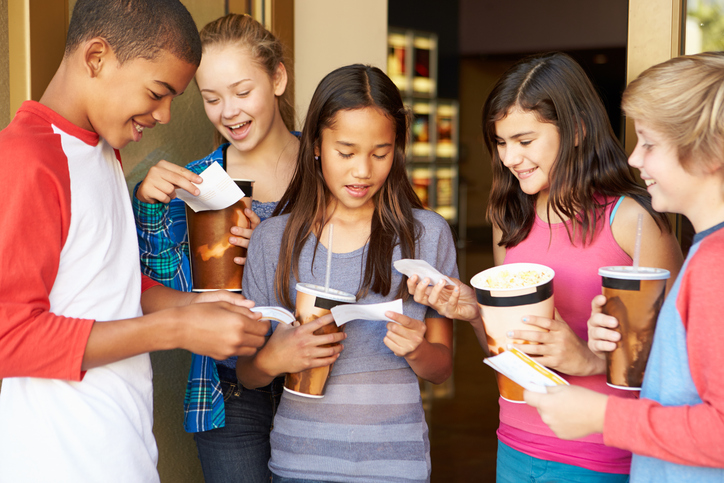
A group of young people holding movie tickets.

A student can do \(30\) push-ups in \(3\) minutes.
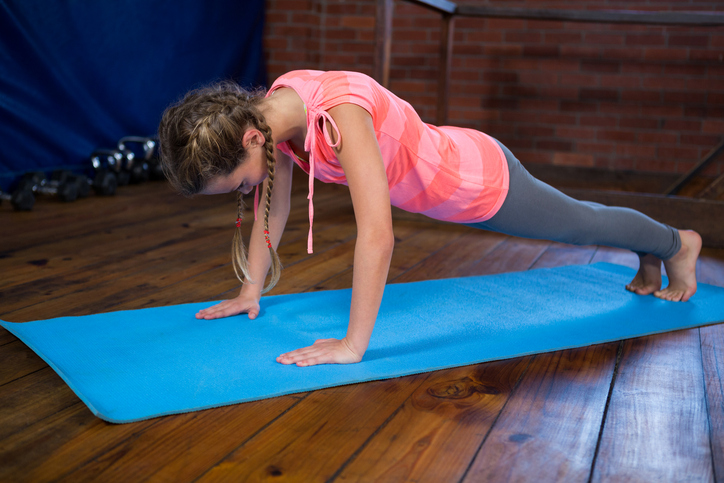
A young girl doing a push-up.

Sources: Printer - gmnicholas/E+/Getty Images; Movies - bowdenimages/iStock/Getty Images;
Push-up - Wavebreakmedia/iStock/Getty Images 

In the first example, we compare the number of pages to the number of seconds. Pages and time are different units.

In the second example, we compare the cost to the number of tickets. Cost and tickets are different units.

Finally, in the third example we compare the number of push-ups to the number of minutes. Again, push-ups and time are different units.

We call each of these a rate.

A rate is a comparison of two unlike quantities.

From these examples, we can work out that unlike quantities means that the two quantities are measured in different units.

Speed

Speed is a very common example of a rate. It compares the distance travelled to the time taken to travel this distance, or in other words,

\(\dfrac{\text{distance}}{\text{time}}\)

Consider a student who can run \(1.8\) km in \(8\) minutes. 

We can represent this rate as follows

\(\dfrac{1.8 \text{ km}}{8 \text{ minutes}} \)

We can also use a diagram to represent this information. In the diagram, the line segment represents a distance of \(1.8\) kilometres.
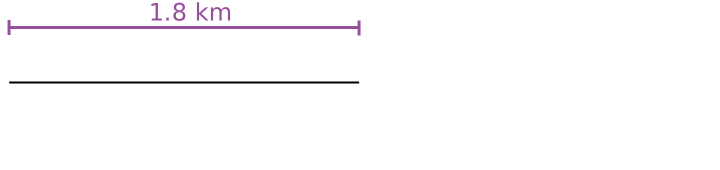
We note underneath the fact that it takes the student \(8\) minutes to run this distance.
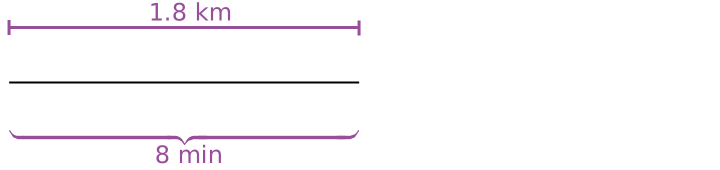
Given this rate, how far might we expect a student to run in \(1\) minute?

Well, we can divide the line segment into \(8\) equal parts, where each part represents \(1\) minute.
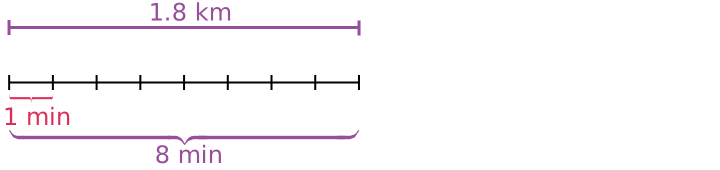
To determine the distance that we would expect the students to run, we need to determine the length that \(1\) part represents.
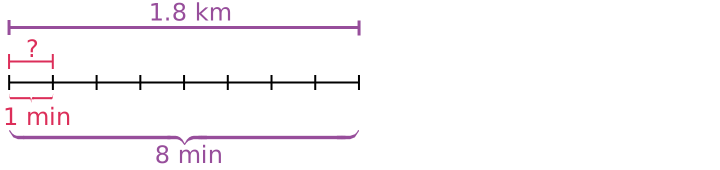
To do this, we would divide \(1.8\) by \(8\). We get that

\(\dfrac{1.8 \text{ km}}{8 \text{ minutes}} = \dfrac{0.225 \text{ km}}{1 \text{ minute}}\)

Alternatively, we could ask ourselves how far might we expect that student to run in \(16\) minutes.

We can consider two copies of the diagram to represent \(16\) minutes.
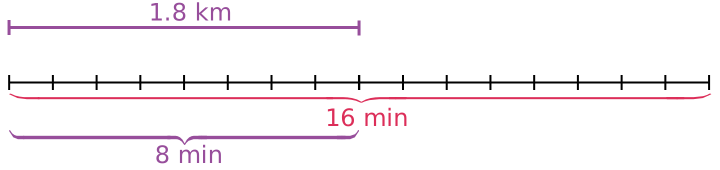
To determine the distance we would expect the student to run, we need to determine the length that this larger line segment represents.
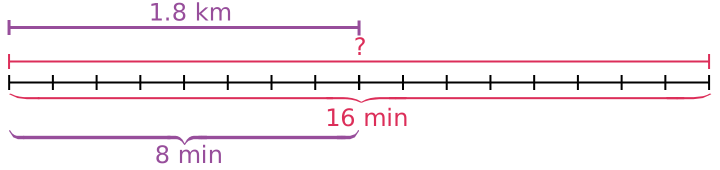
To do this, we would multiply \(1.8\) by \(2\). And we would get that

\(\dfrac{1.8 \text{ km}}{8 \text{ minutes}} = \dfrac{3.6 \text{ km}}{16 \text{ minutes}}\)

We've created three equivalent rates:

  • \(\dfrac{1.8 \text{ km}}{8 \text{ minutes}}\)
  • \( \dfrac{0.225 \text{ km}}{1 \text{ minute}}\)
  • \( \dfrac{3.6 \text{ km}}{16 \text{ minutes}}\)

All three rates are equivalent because they all represent the same relationship between distance and time.

Check Your Understanding 1

Question

Calculate the equivalent rate shown below.

\(\dfrac{6 \text{ books}}{9 \text{ weeks}} = \dfrac{\boxed{\phantom\square} \text{ books}}{3 \text{ weeks}}\)

Answer

\(\dfrac{6 \text{ books}}{9 \text{ weeks}} = \dfrac{2 \text{ books}}{3 \text{ weeks}}\)

Feedback

We can use a diagram to represent the rate \(\dfrac{6 \text{ books}}{9 \text{ weeks}}\), where each tick represents \(1\) week. 

A line segment with 9 equal parts, each part represents 1 week. In 9 weeks, 6 books were read.

When we include \(3\) weeks in our diagram, we can see that it is \(\dfrac{1}{3}\) of the length of \(9\) weeks.
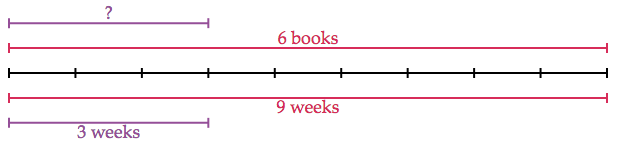
So, in order to calculate the number of books in \(3\) weeks we need to divide \(6\) books by \(3\). We know \(6 \div 3 =2 \).

Therefore, \(\dfrac{6 \text{ books}}{9 \text{ weeks}} = \dfrac{2 \text{ books}}{3 \text{ weeks}}\).

Example 1

A sprinkler expels \(30\) L of water over \(2\) minutes.

Write an equivalent rate that shows the amount of water expelled in 

  1. \(1\) minute
  2. \(5\) minutes
Solution — Part A

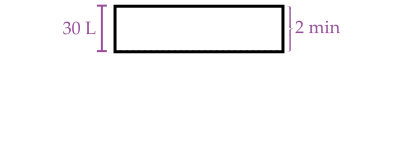
The rate at which a sprinkler expels water is \(30\) litres over \(2\) minutes. We can represent this problem visually using a diagram.

In this diagram, the bucket represents the quantity \(30\) litres.

We note using a brace that it takes \(2\) minutes for the sprinkler to expel enough water to fill this bucket.
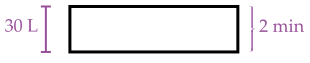
We can divide the bucket, which represents \(2\) minutes, into \(2\) equal parts. Each part representing \(1\) minute.

If \(30\) litres fills the bucket, then \(15\) litres of water would be in a half full bucket.

Therefore, \(\dfrac{30 \text{ L}}{2 \text{ min}} = \dfrac{15 \text{ L}}{1 \text{ min}}\).

Notice that \(2\) minutes divided by \(2\) is \(1\), and \(30\) litres divided by \(2\) is \(15\).
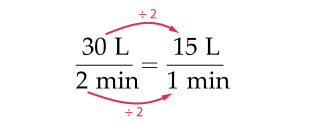
This gives us an indication on how we might solve this problem numerically.

Solution — Part B

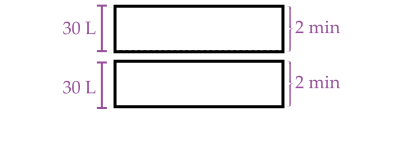
Now, to determine the quantity of water expelled in \(5\) minutes, we start with the same bucket representing the \(30\) litres of water expelled in \(2\) minutes.
If we had \(2\) buckets, then we have represented the quantity of water expelled in \(4\) minutes.
To get to \(5\) minutes, we need to add \(1\) more minute, which we can do by adding the \(1\) minute bucket from part a).
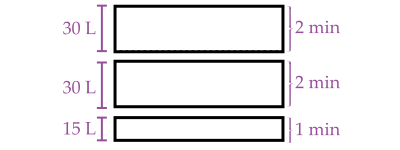
We now have \(5\) minutes worth of water.
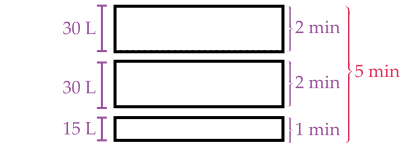
And if we add the contents of each bucket, we have \(30\) plus \(30\) plus \(15\), which is equal to \(75\) litres of water.
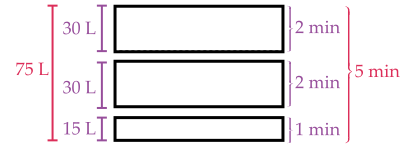
Therefore, \(\dfrac{30 \text{ L}}{2 \text{ min}} = \dfrac{75 \text{ L}}{5 \text{ min}}\).

Notice that \(2\) minutes times \(2.5\) is equal to \(5\) minutes, and \(30\) litres times \(2.5\) is equal to \(75\) litres.
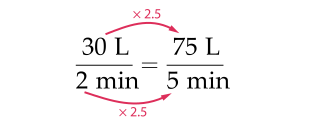
To solve this problem numerically, we could have multiplied both quantities by \(2.5\).

Check Your Understanding 2

Question

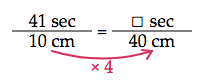
A caterpillar walks \(10\) cm in \(41\) sec. Write an equivalent rate to show how long it will take the caterpillar to walk \(40\) cm. 

Answer

\(\dfrac{164 \text{ sec}}{40 \text{ cm}}\)

Feedback

We are trying to solve the following problem. 
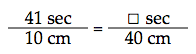
41 seconds over 10 centimetres is equal to an unknown number of seconds over 40 centimetres.

Notice that \(10 \times 4 =40\). 

That means we must multiply \(41\) by \(4\) to create an equivalent rate. 
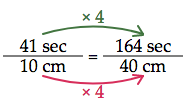
Thus, it will take a caterpillar \(164\) seconds to walk \(40\) cm.


Unit Rates

Example 2

A store offers two options for purchasing games in bulk:

Option A

\($54.75\) for \(5\) games

Option B

\($63.30 \) for \(6\) games 

Which option is a better buy?

Take a moment and try this problem on your own.

Solution

It is helpful to start by writing each of these two rates as cost over number of games.

Option A

$54.75 over 5 games.

Option B

$63.30 over 6 games.

It looks like option A costs less, but you're also buying less games. So to compare these rates accurately, we need to see how much one game costs for each option.

Let's start with option A. We want to write \(\dfrac{$54.75}{5 \text{ games}}\) as an equivalent rate, finding the cost of \(1\) game.

This means we want to solve the problem,

$54.75 over 5 games is equal to an unknown number over 1 game.

Since \(5\) divided by \(5\) is equal to \(1\), we divide \($54.75\) by \(5\) to find an equivalent rate.

We have that \($54.75\) divided by \(5\) is equal to \($10.95\). And we have that

$54.75 over 5 games is equal to $10.95 over 1 game.

Therefore, the rate \($54.75\) for \(5\) games is equivalent to \($10.95\) for \(1\) game.

Moving on to option B, we want to do the same thing. We want to write \($63.30\) for \(6\) games as an equivalent rate, finding the cost of \(1\) game. This means we want to solve the problem 

$63.30 over 6 games is equal to an unknown number over 1 game.

Since \(6\) divided by \(6\) is equal to \(1\), we can divide \($63.30\) by \(6\) to find an equivalent rate.

\($63.30\) divided by \(6\) is equal to \($10.55\) and we have that

$63.30 over 6 games is equal to $10.55 over 1 game.

The rate \($63.30\) for \(6\) games is equivalent to \($10.55\) for \(1\) game.

Option A

$54.75 over 5 games is equal to $10.95 over 1 game.

Option B

$63.30 over 6 games is equal to $10.55 over 1 game.

We can now compare the two rates. Therefore, Option B is a better deal.

Definition

A unit rate is a rate where the second quantity is \(1\) unit (e.g., \(1\) game, \(1\) kilogram, \(1\) hour, \(1\) dollar, etc.).

Let's look at a few examples.

Example 1

First, consider the rate \(60\) km in \(1\) hour. This is a unit rate because it compares the distance traveled to \(1\) hour of time.

At times, it may be helpful to write this unit rate as

\(\dfrac{60 \text{ km}}{1 \text{ h}}\)

But we typically don't say \(60\) kilometres over \(1\) hour. Instead, we say \(60\) kilometres per hour, and we usually write this as

\(60\) km/h

Example 2

Next, consider the rate \($8.49\) for \(1\) kilogram. This is a unit rate, because it compares the cost to \(1\) kilogram.

As before, there may be times where it's helpful to write this unit rate as

\(\dfrac{$8.49}{1 \text{ kg}}\)

But we typically don't say \($8.49\) over \(1\) kilogram. Instead, we say \($8.49\) per kilogram, and we usually write this as

\($8.49\)/kg

Notice that when the second quantity is equal to \(1\) unit, the \(1\) is typically not written, but we still understand it to be there.

Check Your Understanding 3

Question

Which of the following are unit rates? Select all that apply.

  1. \(\dfrac{4 \text{ apples}}{1 \text{ basket}}\)
  2. \(\dfrac{20 \text{ cents}}{1 \text{ can}}\)
  3. \(\dfrac{26 \text{ books}}{1 \text{ week}}\)
  4. \(\dfrac{1 \text{ person}}{7 \text{ tents}}\)
Answer
  1. \(\dfrac{4 \text{ apples}}{1 \text{ basket}}\)
  2. \(\dfrac{20 \text{ cents}}{1 \text{ can}}\)
  3. \(\dfrac{26 \text{ books}}{1 \text{ week}}\)
Feedback

Remember that in a unit rate, the second quantity is always \(1\) unit. Thus, the three unit rates are option a) \(\dfrac{4 \text{ apples}}{1 \text{ basket}}\), option b) \(\dfrac{20 \text{ cents}}{1 \text{ can}}\), and option c) \(\dfrac{20 \text{ cents}}{1 \text{ can}}\) because the second quantity is \(1\) unit.


Finding Unit Rates

Example 3

Find the unit rate for each rate.

  1. \(20\) km in \(5\) hours
  2. \($66\) for \(15\) m of fabric
  3. \(30\) laps in \(25\) minutes

Take a moment and try this problem on your own.

Solution — Part A

To write \(20\) kilometres in \(5\) hours as a unit rate, we want to express the rate as distance over \(1\) hour of time.

It's helpful to write this problem as

20 kilometres over 5 hours is equal to an unknown number over 1 hour.

Since \(5\) divided by \(5\) is equal to \(1\), we know that we must divide \(20\) by \(5\) to find an equivalent rate.

Since \(20\) divided by \(5\) is equal to \(4\), we have that

20 kilometres over 5 hours is equal to 4 kilometres over 1 hour.

Therefore, the unit rate is \(4\) km/h.

Take a moment and think about how you might verify that your answer is correct. If you can travel \(4\) kilometres in \(1\) hour, then in \(5\) hours you would travel \(5\) times \(4\), or \(20\) kilometres.

Solution — Part B

To write \($66\) for \(15\) metres of fabric as a unit rate, we want to express the rate as cost for \(1\) metre of fabric.

It is helpful to write this problem as

$66 over 15 metres is equal to an unknown number over 1 metre.

Since \(15\) divided by \(15\) is equal to \(1\), we know that we must divide \(66\) by \(15\) to find an equivalent rate.

Since \($66\) divided by \(15\) is equal to \($4.40\), we have that

$66 over 15 metres is equal to $4.40 over 1 metre.

The unit rate is \($4.40\)/m.

Solution — Part C

To write \(30\) laps in \(25\) minutes as a unit rate, we want to express the rate as number of laps in \(1\) minute.

It's helpful to write this problem as

30 laps over 25 minutes is equal to an unknown number over 1 minute.

Since \(25\) divided by \(25\) is equal to \(1\), we know that we must divide \(30\) by \(25\) to find that equivalent rate.

We have that \(30\) divided by \(25\) is equal to \(1.2\), and so

30 laps over 25 minutes is equal to 1.2 laps over 1 minute.

The unit rate is \(1.2\) laps/min.

Check Your Understanding 4

Question

Find the unit rate for \(120\) cents for \(1200\) bags.

Answer

\(0.1\) cents/bag

Feedback

Remember that in a unit rate, the second number is always equal to \(1\). So to find a unit rate for \(120\) cents for \(1200\) bags, we need to solve the following problem. 

120 cents over 1200 bags is equal to an unknown number of cents over 1 bag.

Notice that \(1200 \div 1200 = 1\).

That means we must divide \(120\) by \(1200\) to find an equivalent rate. 

Thus, the unit rate is \(0.1\) cents/bag.

Try This Problem Revisited

Recall our Try This problem.

Two cousins are competing in a pedal go-kart race. 

Ben can complete \(250\) metres in \(40\) seconds.

Ben, a boy on a go-kart.

Carter can complete \(183\) metres in \(30\) seconds.

Carter, a boy on a go-kart.

Assuming both cousins are telling the truth, who would you expect to win the race?

Sources: Boys -  Imgorthand/E+/Getty Images

Solution

This problem is essentially asking us to compare the two rates, \(\dfrac{250 \text{ m}}{40 \text{ sec}}\), and \(\dfrac{183 \text{ m}}{30 \text{ sec}}\). It might look like Ben pedals farther. But it also takes him more time to do so.

To compare, we need to see how far each boy pedals if they pedal for the same time. 

To do this, we must rewrite one or both rates so that they can be accurately compared. But how do we do that?

One option would be to write each as a unit rate and determine the distance each boy can travel in \(1\) second.

Ben

If Ben peddles \(250\) metres in \(40\) seconds, then in \(1\) second he can pedal \(250\) divided by \(40\), or \(6.25\) metres.

Carter

If Carter can pedal \(183\) metres in \(30\) seconds, then in \(1\) second he can pedal \(183\) divided by \(30\), or \(6.1\) metres.

We have determined that in \(1\) second, we would expect that Ben could travel \(6.25\) metres, and that Carter could travel \(6.1\) metres.

Since Ben travels farther in \(1\) second, we expect Ben to win the race.

Check Your Understanding 5

Question

Which is a better buy? 

  1. A large box of 24 bottles of water for \($5.23\).
  2. A small box of 6 bottles of water for \($0.73\).
Answer
  1. A small box of 6 bottles of water for \($0.73\).
Feedback

When we calculate the unit rates we get the following. 

Large box of bottled water: \(\dfrac{$5.23}{24 \text{ bottles}} = \dfrac{$0.22}{1 \text{ bottle}}\)

Small box of bottled water: \(\dfrac{$0.73}{6 \text{ bottles}} = \dfrac{$0.12}{1 \text{ bottle}}\)

Since the small box of bottled water has the lower unit rate, that means it is the better buy. 

Online Version

https://ggbm.at/ZTGRSGAw


Converting Unit Rates

Example 4

The escape velocity of the Earth is the minimum speed needed to escape from Earth's gravitational pull. It is approximately \(40~320\) km per hour at Earth's surface.

Write the escape velocity as a unit rate in km/s.

Take a moment and try this problem on your own.

Solution

Recall that although we may not be familiar with how to convert hours to seconds directly, we can solve this problem in two steps by first converting hours to minutes and then converting minutes to seconds in a second step.

Step 1: Convert km/h to km/min

We start with the rate written as

40320 kilometres over 1 hour.

http://www.gettyimages.ca/license/646851672

Source: Shuttle - 3DSculptor/iStock/Getty Images

Since \(1\) hour is equal to \(60\) minutes, we can replace \(1\) hour with \(60\) minutes and we get that

40320 kilometres over 1 hour is equal to 40320 kilometres over 60 minutes.

We can simplify this rate and write it in kilometres per \(1\) minute. Since \(60\) divided by \(60\) is equal to \(1\), now we must divide \(40~320\) by \(60\) and this is equal to \(672\).

We have this as a unit rate, \(\dfrac{672 \text{ km}}{1 \text{ min}}\).

Step 2: Convert km/min to km/s

 We start with the unit rate as 

672 kilometres over 1 minute.

Since \(1\) minute is equal to \(60\) seconds, we can replace \(1\) minute with \(60\) seconds and we get that

672 kilometres over 1 minute is equal to 672 kilometres over 60 seconds.

We can simplify this rate and write it in kilometres per \(1\) second. Since \(60\) divided by \(60\) is equal to \(1\), we divide \(672\) by \(60\), which is equal to \(11.2\).

We write the rate as \(\dfrac{11.2 \text{ km}}{1 \text{ sec}}\)

Therefore, the escape velocity is \(11.2\) km/s.

That's really fast. That's like running around a track \(28\) times in \(1\) second, which is really hard to even imagine.

Example 5

A person's heart beats at a rate of \(72\) beats per minute.

How many times would you expect it to beat in one day?

Take a moment and try this problem on your own.

Solution

Recall that, although we may not be familiar with how to convert minutes to days directly, we can solve this problem in two steps by first converting minutes to hours and then converting hours to days in a second step.

Step 1: Convert beats/minute to beats/hour

Start with the rate written as

72 beats over 1 minute.

Remember that \(1\) hour is equal to \(60\) minutes. So if we want to convert minutes to hours, our first goal should be to determine how many beats occur in \(60\) minutes.

72 beats over 1 minute is equal to how many beats over 60 minutes.

\(1\) times \(60\) is equal to \(60\). And so, we multiply \(72\) by \(60\) and get \(4320\). We have that

72 beats over 1 minute is equal to 4320 beats over 60 minutes.

We can now replace \(60\) minutes with \(1\) hour, and we have the rate

72 beats over 1 minute is equal to 4320 beats over 60 minutes which is equal to 4320 beats over 1 hour.

Step 2: Convert beats/hour to beats/day

Start with the rate we have from the first step, and that's

4320 beats over 1 hour.

We remember that \(1\) day is equal to \(24\) hours. And so, if we want to convert hours into days, our first goal should be to determine how many beats occur in \(24\) hours.

4320 beats over 1 hour is equal to how many beats over 24 hours.

\(1\) times \(24\) is equal to \(24\). And so, we multiply \(4320\) by \(24\), which is \(103~680\). We conclude that

4320 beats over 1 hour is equal to 103680 beats over 24 hours.

We can now replace \(24\) hours with \(1\) day, and we have the rate

4320 beats over 1 hour is equal to 103680 beats over 24 hours which is equal to 103680 beats over 1 day.

Therefore, we would expect the person's heart to beat \(103~680\) times in a day. That's a lot of work for your heart.

Check Your Understanding 6

Question

Gravel flows through a dump truck at a rate of \(9\) kg/min. Write this rate in mg/min.

Answer

\(9~000~000\) mg/min

Feedback

Step 1: Convert kg/min to g/min

We are trying to solve the following problem: 

\(\dfrac{9 \text{ kg}}{1 \text{ min}} = \dfrac{\boxed{\phantom \square} \text{ g}}{1 \text{ min}}\)

We know \(1\) kg \(=1000\) g. That means, 

\(\dfrac{9 \text{ kg}}{1 \text{ min}} = \dfrac{9(1000 \text{ g})}{1 \text{ min}} = \dfrac{9000 \text{ g}}{1 \text{ min}}\)

Thus, \(9\) kg/min \(=9000\) g/min.

Step 2: Convert g/min to mg/min

We are trying to solve the following problem: 

\(\dfrac{9000 \text{ g}}{1 \text{ min}} = \dfrac{\boxed{\phantom \square} \text{ mg}}{1 \text{ min}}\)

We know \(1\) g \(=1000\) mg. That means, 

\(\dfrac{9000 \text{ g}}{1 \text{ min}} = \dfrac{9000(1000 \text{ mg})}{1 \text{ min}} = \dfrac{9~000~000 \text{ mg}}{1 \text{ min}}\)

Thus, \(9\) kg/min \(=9~000~000\) mg/min.

Example 6

The cheetah is the fastest animal on earth and can reach a top speed of \(120\) km/h. 

Express this speed in m/min.

Take a moment and try this problem on your own.

Solution

In this problem we have to work with both units, converting kilometres to metres and converting hours to minutes while maintaining the same rate. The best approach is to break this conversion into simpler steps.

Step 1: Convert km/h to m/h

It helps to start with the rate written as

120 kilometres over 1 hour.

Since we know that \(1\) kilometre is equal to \(1000\) metres, we have that \(120\) kilometres is equal to \(120~000\) metres. Therefore,

120 kilometres over 1 hour is equal to 120000 metres over 1 hour.

Step 2: Convert m/h to m/min

Again, we start with the rate written as

120000 metres over 1 hour.

Since \(1\) hour is equal to \(60\) minutes, we can replace \(1\) hour with \(60\) minutes. And we get that

120000 metres over 1 hour is equal to 120000 metres over 60 minutes.

We can simplify this rate and write it per \(1\) minute. Since \(60\) divided by \(60\) is equal to \(1\), we divide \(120~000\) by \(60\) and get \(2000\). We have a unit rate of

120000 metres over 1 hour is equal to 120000 metres over 60 minutes which is equal to 2000 metres over 1 minute.

Therefore, the cheetah's top speed is \(2000\) m/min. That's like running \(5\) times around a track in just \(1\) minute.

Take It With You

Grass seed is sold at the local hardware store in two different sizes.

Small Bag

Covers around \(15\) m\(^2\)

Cost: \($27.98\)

Large Bag

Covers around \(40\) m\(^2\)

Cost: \($49.98\)

Pietro wants to seed his lawn, which measures \(105\) m\(^2\).

  1. What is the most cost-effective way for Pietro to purchase the grass seed he needs?
  2. The small bags of seed are put on sale.
    What does the sale price have to be in order for it to be more cost effective to purchase all smaller bags?