The Pythagorean Theorem
Example 5
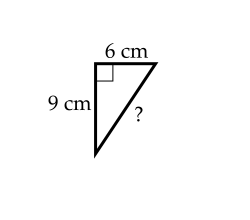
In a right triangle, the lengths of the two legs are \(6\) cm and \(9\) cm.
What is the length of the hypotenuse of the triangle?
Solution
We start by assigning a variable \(h\) to represent the length of the hypotenuse.
You can imagine a square being drawn on each side of the right triangle, and we know because of the Pythagorean Relationship that there is a relationship between the areas of these three squares.
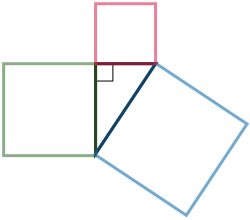
First, note that the area of the square on the hypotenuse would be \(h^2\). The area of the squares on the two legs would be \(6^2\) and \(9^2\).
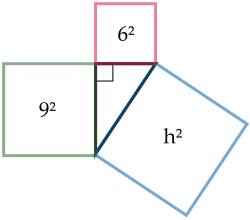
Using the Pythagorean Relationship, we know that the area of the square on the hypotenuse is equal to the sum of the area of the squares on the other two sides. So we write
\(\begin{align*} h^2 &= 6^2 + 9^2 \\ h^2 &= 36 + 81 \\ h^2 &= 117 \end{align*}\)
We need to find a side length that squares to \(117\). Since \(117\) is not a perfect square, then \(h\) is not an integer. So what are some perfect squares that are near \(117\)?
Perhaps you'll recall that \(10^2\) is equal to \(100\) is a perfect square, and \(11^2\) equals \(121\) is also a perfect square. We have that
\(100 \lt 117 \lt 121\)
Therefore,
\(10 \lt h \lt 11\)
Using our knowledge of square roots, we can determine that
\(\begin{align*} h^2 &= 6^2 + 9^2 \\ h^2 &= 36 + 81 \\ h^2 &= 117 \\ h &\approx10.8 \end{align*}\)
Therefore, the length of the hypotenuse is approximately \(10.8\) cm.
Notice that in this example, we represented the area of each square in terms of its side length. The result is an equation that represents a relationship between the three side lengths of a right triangle.
The Pythagorean Theorem
We can restate the Pythagorean Relationship using algebra, and we're now going to call it the Pythagorean Theorem.
The Pythagorean Theorem
In a right triangle where \(c\) represents the length of the hypotenuse, and \(a\) and \(b\) represent the lengths of the two legs, the following equation is true:
\(c^2 = a^2 + b^2 \)
I want you to remember that this statement is not really any different from the Pythagorean Relationship that we have been working with throughout the lesson.
To convince yourself of this, start by drawing the right triangle, where \(c\) represents the length of the hypotenuse and \(a\) and \(b\) represent the lengths of the two legs.
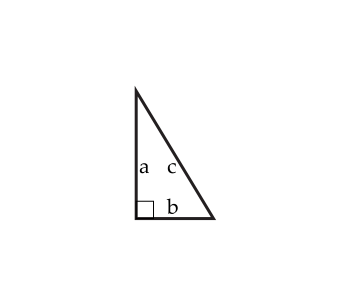
You can draw a square on each side of the triangle.
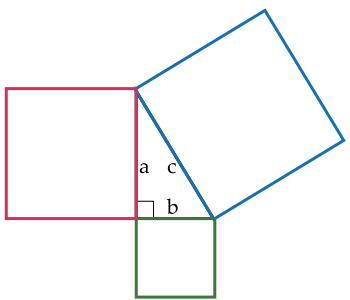
The area of the square on the hypotenuse is \(c^2\), since the side length is \(c\).
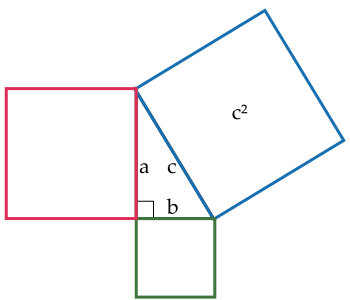
Similarly, the areas of the squares on the two legs are \(a^2\) and \(b^2\) because the side lengths are \(a\) and \(b\) respectively.
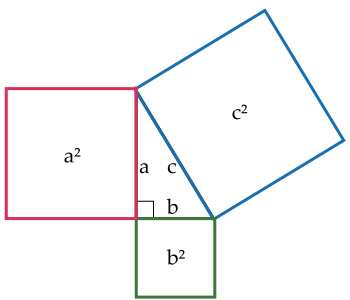
Notice that the equation \(c^2 = a^2 + b^2 \) is simply saying that the square of the hypotenuse is equal to the sum of the squares of the other two sides.
Example 6
In a right triangle, the length of the hypotenuse is \(17\) cm and the length of one leg is \(3\) cm.
What is the length of the other leg of the right triangle?
Take a moment and try this problem on your own.
Solution
Let's start by letting \(a\) represent the length of the unknown leg.
By the Pythagorean Theorem,
\(\begin{align*} 17^2 &= a^2 + 3^2 \\ 289 &= a^2 + 9 \end{align*}\)
To solve for \(a^2\), our first step is to subtract \(9\) from both sides. We get that
\(\begin{align*} 17^2 &= a^2 + 3^2 \\ 289 &= a^2 + 9 \\ 289 \class{hl2}{-9} &= a^2 + 9 \class{hl2}{-9} \\ 280 &= a^2 \end{align*}\)
We need to find a side length that squares to \(280\). Since \(280\) is not a perfect square, then \(a\) is not going to be an integer. But we can find perfect squares that are close to \(280\). Specifically, \(16^2=256\) and \(17^2 = 289\) are both perfect squares.
We have that
\(256 \lt 280 \lt 289\)
Therefore
\(16 \lt a \lt 17\)
Using our knowledge of square roots, we can determine that
\(\begin{align*} 17^2 &= a^2 + 3^2 \\ 289 &\;= a^2 + 9 \\ 289 \class{hl2}{-9} &\;= a^2 + 9 \class{hl2}{-9} \\ 280 &\;= a^2 \\ 16.7 &\;\approx a \end{align*}\)
Therefore, the length of the missing leg is approximately \(16.7\) cm.
Check Your Understanding 3
Question
The length of one leg of a right triangle is \(10\) mm. The length of the hypotenuse is \(12\) mm. What is the length of the remaining leg of the right triangle? Round your answer to 1 decimal place.
Answer
\(6.6\) mm
Feedback
Let \(a\) represent the length of the remaining leg.
By the Pythagorean Theorem,
\(\begin{align*} 12^2 &= a^2 + 10^2 \\ 144 &= a^2 + 100 \\ 144 \class{hl2}{-100} &= a^2 +100 \class{hl2}{-100} \\ 44 &=a^2\end{align*}\)
We need to find a number that squares to \(44\). Since \(44\) is not a perfect square, we know that \(a\) is not going to be an integer.
We can start by finding perfect squares that are close to \(44\).
\(\begin{align*} 36 \lt 44 &\lt 49 \\ 6^2 \lt a^2 &\lt 7^2 \\ 6 \lt a &\lt 7 \end{align*}\)
We know the value of \(a\) is going to be between \(6\) and \(7\). Using our knowledge of square roots, we can determine that the value of \(a\) is approximately \(6.6\).
Therefore, the length of the remaining leg is approximately \(6.6\) mm.
Take It With You
The side lengths of a triangle are \(20\) cm, \(25\) cm, and \(35\) cm.
Can you determine whether or not this is a right triangle? Explain.