Horizontal and Vertical Distances
Horizontal Distance
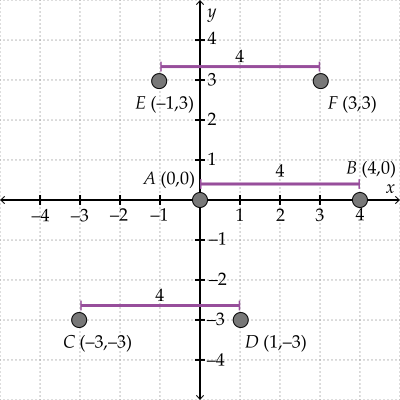
We can find the horizontal distance between any two points by counting the number of units between them.
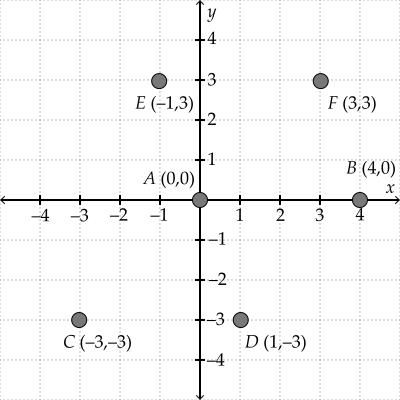
For example, on the following Cartesian plane, the horizontal distance between each pair of points is \(4\) units.
Explore This 2
Description
Explore the horizontal distance between two points.
Consider the points \((-3,4)\) and \((4,4)\).
Using the Grid

Created with GeoGebra. Author: University of Waterloo. CC BY-NC-SA 4.0. https://ggbm.at/CepwkKU4
There is a distance of \(7\) units between the points.
Using Coordinates
Subtract the \(x\)-coordinates of each point.
\(4 - (-3) = 7\)
Online Version
https://ggbm.at/CepwkKU4
Example 2
Find the horizontal distance between \((-8,6)\) and \((3,6)\).
Solution
The horizontal distance between two points is equal to the positive difference between their
\(x\)-coordinates.
The difference between the \(x\)-coordinates can be calculated in two possible ways:
\((-8) - 3 = -11 \)
tells us that to get from \(3\) to \(-8\), we must go \(11\) units left.
Or, we have the following.
\(3 - (-8) = 11\)
tells us that to get from \(-8\) to \(3\), we must go \(11\) units to the right.
The sign of the result tells us the direction we travel to get from one value to the other. But regardless, the difference between \(-8\) and \(3\) is \(11\) units.
Therefore, the horizontal distance between the points \((-8,6)\) and \((3,6)\) is \(11\) units.
Vertical Distance
The vertical distance between two points is equal to the positive difference between their
\(y\)-coordinate values.
Find the vertical distance between \((-4,7)\) and \((-4,-1)\).
Solution
The \(y\)-coordinates of the points are \(7\) and \(-1\). We know that we can subtract the values in either order, but subtracting smaller value from the larger value will result in the positive difference.
\[7 - (-1) = 8\]
Therefore, the vertical distance between the points \((-4,7)\) and \((-4,-1)\) is \(8\) units.
Check Your Understanding 5
Description
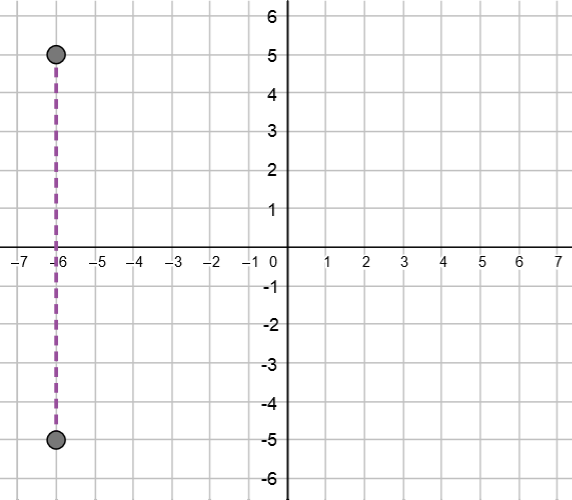
Find the vertical distance between the points \((-6,-5)\) and \((-6,5)\).

Feedback
To find the vertical distance between the two points, subtract their \(y\)-coordinates.
Answer
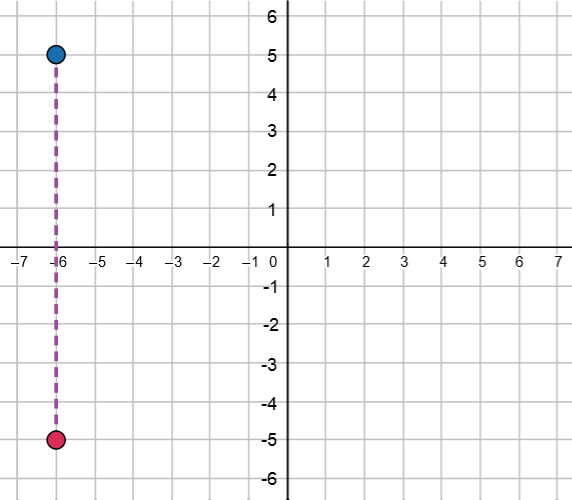
To find the vertical distance between the two points, we can subtract their \(y\)-coordinates.
\(5 - (-5) =10\)
Thus, the vertical distance between the points is \(10\) units.
Created with GeoGebra. Author: University of Waterloo. CC BY-NC-SA 4.0. https://ggbm.at/Vt4XmfnY
Online Version
https://ggbm.at/Vt4XmfnY
Try This Problem Revisited
The following triangle has an area of \(30\) square units.
How might you describe the location of the other two vertices of this triangle?
Solution
We can start by doing some rough work to figure out the dimensions of the triangle that we are looking to draw before we work on the Cartesian plane.
If a triangle has an area of \(30\) square units, then
\[\begin{align*} \dfrac{b \times h}{2} &=30 \\ \class{timed in5}{b \times h} &\; \class{timed in5}{= 60} \end{align*}\]
Some possibilities include the following:
- \(b=10\) and \(h=6\)
- \(b=5\) and \(h=12\)
- \(b=4\) and \(h=15\)
As an example I will find the coordinates of the triangle where the height is \(6\) units and the base is \(10\) units.
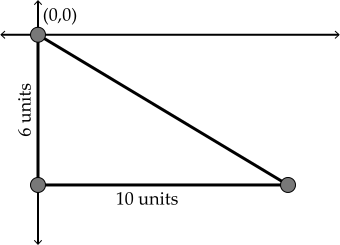
For ease I'm going to label the two unknown points \(A\) and \(B\).
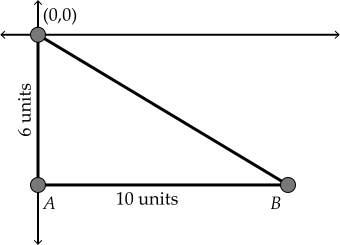
We have that the point \(A\) is \(6\) units below the point with coordinates \((0, 0)\), or the origin. The coordinates of this point are \((0, -6)\).
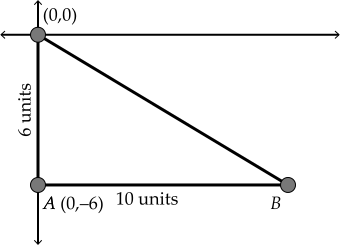
Next, we have that the point \(B\) is \(10\) units to the right of point \(A\). The coordinates of this point are \((10, -6)\).
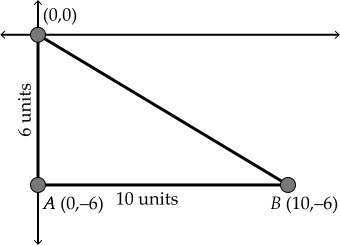
Therefore, \(A\) at \((0, -6)\) and \(B\) at \((10, -6)\) could describe the location of the other two vertices.
As an exercise try finding the coordinates of the triangle if the height and the base are different than the \(6\) units and \(10\) units, respectively.
Check Your Understanding 6
Question
A right triangle has an area of \(4\). If one of its vertices has the coordiantes \((-1,6)\), and another vertex has the coordinates \((1,6)\), write possible coordinates for the third vertex.
Answers
- \((-1,10)\)
- \((1,10)\)
- \((-1,2)\)
- \((1,2)\)
Feedback
The distance between the points \((-1,6)\) and \((1,6)\) is \(2\) units.
We will consider this side to be the base of the triangle. That mean
\[\begin{align*} 4 & = \dfrac{2\times h}{2} \\ 8 & = 2 \times h\end{align*}\]
Thus, \(h=4\).
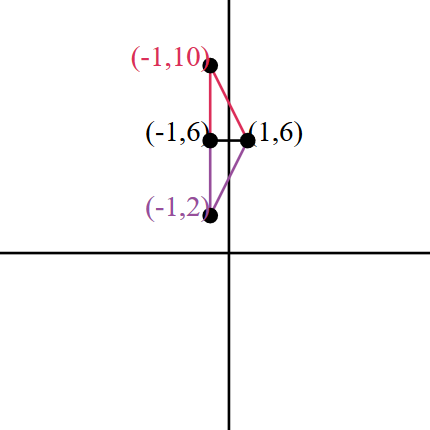
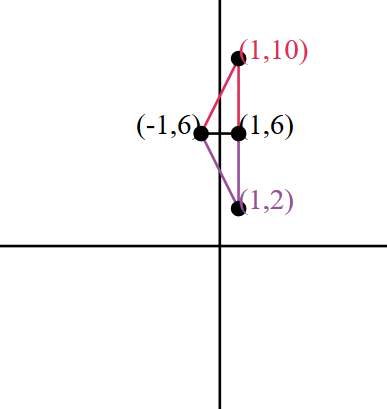
There are four possibilities that would give a triangle with a height of \(4\) units.
This gird shows the point \((-1,10)\) and the point \((-1,2)\).
This grid show the point \((1,10)\) and the point \((1,2)\).
Take It With You
The diagonals of a rectangle intersect at \((0,0)\).
The dimensions of this rectangle are \(10\) units and \(6\) units.
What are the possible coordinates of the four corners of the rectangle?