Exercises


  1. Identify each of the following images as a translation, reflection, or rotation of \(ABCD\).
    Explain how you can tell by inspection.
  2. True or False. Label each statement as true or false. If a statement is false explain how you know.
    1. In a rotation, the image and the original figure are congruent.
    2. Rotations can only move in a clockwise direction.
    3. Rotations are transformations that turn shapes around a fixed point.
    4. A rotation must always have its centre of rotation on a polygon's vertex.
  3. Graph the image of each polygon under the rotation described. State the coordinates of the vertices of the image.
    1. Rotate \(\triangle FGH\) \(90^\circ\) clockwise about the origin. 

    2. Rotate \(\triangle UVW\) \(180^\circ\) clockwise about the vertex \(U\) . 

    3. Quadrilateral \(JKLM\) has vertices \(J\ (-5,-3)\), \(K\ (1,1)\), \(L\ (1,-3)\), and \(M\ (-5,-4)\). Rotate this quadrilateral \(90^\circ\) counterclockwise about the origin. 
  4. Graph the image of each polygon under the transformations.
    State the coordinates of the vertices of the image.
    1. Rotate \(\triangle ABC\) \(90^\circ\) counterclockwise about the vertex \(C\), and then translate that image \(5\) units in the \(x\)-direction and \((-3)\) units in the \(y\)-direction.

    2. Rotate quadrilateral \(DEFG\) 
      \(180^\circ\) clockwise about the origin, then reflect that image across the \(x\)-axis.

    3. Triangle \(EFG\) has vertices  \(E(5,6)\), \(F(5,-2)\), and \(G(-1,3)\). Translate this triangle \((-2)\) units in the \(x\)-direction and \((-4)\) units in the \(y\)-direction, rotate the image  \(90^\circ\) clockwise about the origin, and then reflect that image in the horizontal line \(2\) units above the \(x\)-axis.
  5. The angle of rotation can be any measure and is not limited to \(90^\circ\) or \(180^\circ\) as the examples might suggest. Explain how you would rotate a point by any angle, for example \(109^\circ\).
  6. Consider quadrilaterals \(PQRS\) and \(ABCD\). 

    The vertices of \(PQRS\) are \(P(-5,5)\), \(Q(-1,5)\), \(R(-1,3)\), and \(S(-5,3)\).

    The vertices of  \(ABCD\) are \(A(3,-1)\), \(B(5,-1)\), \(C(5,-5)\), and \(D(3,-5)\).

    1. Find one transformation that moves \(PQRS\) onto \(ABCD\).
    2. Find two transformations that move \(PQRS\) onto \(ABCD\).
    3. Find three transformations that move \(PQRS\) onto \(ABCD\).
  7. Draw a triangle on the Cartesian plane. 
    1. Rotate the triangle \(180^\circ\) clockwise about the origin. What are the coordinates of the image?
    2. Reflect the original triangle in the \(x\)-axis and then in the \(y\)-axis. What are the coordinates of the image?
    3. Explain why reflecting a polygon in the \(x\)-axis and then the \(y\)-axis produces the same image as rotating the polygon \(180^\circ\) clockwise about the origin. 
  8. Polygons can be rotated around any point, not just the origin. For example, if \(\triangle ABC\) is rotated \(180^\circ\) clockwise about the point \((-1,-2)\) then its image is \(\triangle A'B'C'\), as shown.

    The coordinates of \(\triangle ABC\) are \(A(-3,0)\), \(B(-1,3)\), and \(C(-7,4)\).

    The coordinates of the image are \(A'(1,-4)\), \(B'(-1,-7)\), and \(C'(5,-8)\).
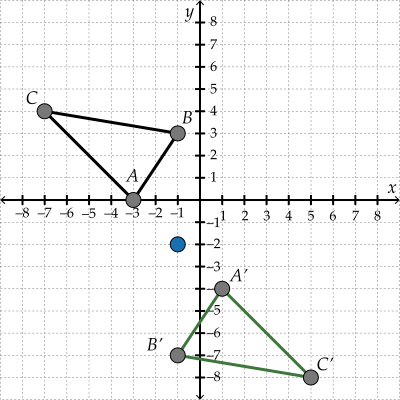
    1. Describe two reflections that transform \(\triangle ABC\) onto its image.
    2. If \(\triangle ABC\) is rotated \(180^\circ\) around any point \((a,b)\), show that the triangle can also be transformed onto its image by two reflections.