Alternative Format


Try This

Formulas for Area

Why might we need many different formulas for calculating area? 

To answer this question, consider the following polygon. We cannot find the area of this polygon using rectangles and squares alone. 

The outline of a shape composed of rectangles, triangles, parallelograms, and trapezoids.

Knowing how to calculate the areas of other shapes — like triangles, parallelograms, and trapezoids — will help us here.

The same shape decomposed into simpler shapes such as rectangles, triangles, parallelograms, and trapezoids.

In general, we realize that the more formulas we have, the more options we have for decomposing a complex shape into simpler shapes.

Lesson Goals

  • Review the definition of area.
  • Develop and apply the formulas for finding the areas of parallelograms, triangles, and trapezoids. 

Now you may already know some of these. But it's always good to remind ourselves.

Try This!

Consider the following parallelogram and trapezoid with side lengths labelled.

A parallelogram with side lengths 11 cm and 5 cm and a height of 3 cm

A trapezoid with bottom 8 cm, top 3 cm, a side length of 5 cm, and height of 3 cm.

If the area of the parallelogram is \(33\) cm\(^2\), can you find the area of the trapezoid without using a formula?

Think about this problem, then move on to the next part of the lesson.


Area of a Rectangle

Units of Area

Recall: Area is a measure of the space enclosed by a 2D shape.

The basic unit of measurement is a square. And keep in mind that any square can be used. Common units in the metric system include the square millimetre, square centimetre, and square metre:

One millimeter square.

1 centimetre square.

1 metre square.

From a unit square, we can build rectangles.

The area of this rectangle is \(4\) mm\(^2\), because it is made up of \(4\) squares, each with an area of \(1\) mm\(^2\).

\(4\) mm\(^2\)

Similarly, the area of this rectangle is 8 mm\(^2\), because it is made up of \(8\) squares, each with an area of \(1\) mm\(^2\).

\(8\) mm\(^2\)

Knowing this, how can we use the size lengths of a rectangle to find its area?

Area of a Rectangle

Consider the following rectangle with length \(5\) cm and width \(4\) cm. Recall that a square centimetre has side lengths that are \(1\) cm in length. So notice that this rectangle is formed from \(4\) rows of \(5\) square centimetres.

As before, you can count the number of square centimeters in the rectangle to determine that the area is \(20\) cm\(^2\). But, you can also calculate the area by multiplying the length by the width of the rectangle. 

\(\begin{align*} A &= \text{ length } \times \text{ width } \\ & \; \class{timed in3}{= 5 \times 4} \\ & \; \class{timed in4}{= 20 } \end{align*}\)

Notice that to make our calculations simpler, we have omitted the units and we will put those back in in the concluding statement. From our calculation, we conclude that the area of the rectangle is \(20\) cm\(^2\).

The area of the rectangle with length \(l\) and width \(w\) can be calculated using the equation

\(A=l\times w\)

A rectangle with length l and width w.


Example 1

Calculate the area of the following rectangle.

A rectangle with side lengths of 2.5 cm and 5 cm.

Solution

We can calculate the area of this rectangle by multiplying the length by the width. So start with the formula \(A=l\times w\) and substitute the information we are given.

\[\begin{align*} A &= l \times w \\ & \; \class{timed in3}{= 5 \times 2.5} \\ & \; \class{timed in4}{= 12.5} \end{align*}\]

Therefore, the area of the rectangle is \(12.5\) cm\(^2\).

Check Your Understanding 1

Question

Calculate the area, in mm\(^2\), of the rectangle shown below.

A rectangle with width 15 mm and height 18.2 mm.

Answer

\(273\) mm\(^2\)

Feedback

Use the formula for the area of a rectangle,

\(\begin{align*} A & = l \times w \\  & = 15 \times 18.2 \\ & = 273\end{align*}\)

Therefore, the area of the rectangle is \(273\) mm\(^2\).

Example 2

Calculate the area of the following rectangle. 

A rectangle with side lengths 80 centimetres and 1.5 metres.

Solution

 I want you to first notice that the width is given in centimetres and the length in metres. Before we can calculate the area, we need to convert all of our measurements to the same unit. 

Step 1: Convert all measurements to the same unit

We can rewrite \(80\) cm as \(0.8\) m.

Step 2: Calculate the area

\(\begin{align*} A &= l \times w \\ & \; = 1.5 \times 0.8 \\ & \; =1.2 \end{align*}\)

Therefore, the area of the rectangle is \(1.2\) m\(^2\). 

Check Your Understanding 2

Question

Calculate the area, in mm\(^2\), of the rectangle shown below.

A rectangle with width 1.5 cm and height 9 mm.

Answer

\(135\) mm\(^2\)

Feedback

Step 1: Convert all measurements to the same unit

We can rewrite \(1.5\) cm as \(15\) mm.

Step 2: Calculate the area

\(\begin{align*}A & = l \times w \\ & = 15 \times 9 \\ & = 135\end{align*}\)

Therefore, the area of the rectangle is \(135\) mm\(^2\).


Area of a Parallelogram

What Is a Parallelogram?

To determine the formula for the area of a parallelogram, we first recall that a parallelogram is a quadrilateral in which pairs of opposite sides are parallel and equal in length. 

Base
The length of any side of the parallelogram.
Height
The perpendicular distance from the base to the opposite side.

Given this definition, every parallelogram can have two base/height combinations. 

Consider a parallelogram with one side longer than the other. If the long side is b, then h is perpendicular to that side.

Consider a parallelogram with one side longer than the other. If the shorter side is b, then h is perpendicular to that side.

Rearranging the Area of a Parallelogram

Notice that we can cut any parallelogram into two pieces by cutting along the perpendicular distance from the base to the opposite side. The sum of the areas of these ‌\(2\) pieces is equal to the area of the parallelogram. Thus, if we rearrange these two pieces, the resulting shape will always have the same area as the original parallelogram.

It looks like the rearranged pieces form a rectangle. We already know how to calculate the area of a rectangle!

That would be really nice if they did because we already know how to calculate the area of a rectangle. But we have to be careful because appearances can sometimes be deceptive. How do we convince ourselves that this new polygons is, in fact, a rectangle?

Explore This

Description

Convince yourself that a parallelogram can be transformed into a rectangle.

A parallelogram with based 12 units and height 5 units.

Decompose the parallelogram into two equal shapes by cutting along the height of the parallelogram.

Slide one of the pieces over to form a rectangle with length 12 units and height 5 units.

Created with GeoGebra. Author: University of Waterloo. CC BY-NC-SA 4.0. https://ggbm.at/x6VYxpHp

Online Version

https://ggbm.at/x6VYxpHp

Formula for Area of a Parallelogram

From the investigation, you should have convinced yourself that when you rearrange the two pieces of a parallelogram as shown, the resulting polygon has the properties of a rectangle. That is that it has all \(90^\circ\) angles and the opposite sides are equal in length.

Next, we notice that the base and height of the rectangle are the same as the base and height of the original parallelogram. We know the formula for the area of a rectangle. In this case, it's base times height. So, the area of the parallelogram has to be the same.

The area of the parallelogram with base \(b\) and height \(h\)
can be calculated using the equation

\(A=b \times h\)

Example 3

What is the area of the parallelogram?

A parallelogram with side lengths 3 cm and 6 cm and perpendicular height 4 cm.

Solution

To calculate the area, we start with the formula for the area of a parallelogram, \(A=b\times h\). But what are the base and height in this diagram? We need to identify the important information.

Remember that the base and the height must be perpendicular to each other. That means that the base is \(b =3\) cm and the height is \(h =4 \) cm. 

Putting this information into the formula, we have

\[\begin{align*} A &= b \times h \\ & \; \class{timed in2}{= 3 \times 4} \\ & \; \class{timed in3}{= 12} \end{align*}\]

The area of the given parallelogram is \(12\) cm\(^2\). 

Check Your Understanding 3

Question

Calculate the area, in cm\(^2\), of the parallelogram shown below.

A parallelogram with base 12 cm and other side length 12.4 cm. The height is marked as 10.3 cm.

Answer

\(123.6\) cm\(^2\)

Feedback

Using the formula for the area of a parallelogram with a base of \(12\) cm and a height of \(10.3\) cm, we have:

\(\begin{align*} A & = b\times h \\ & = 12\times 10.3 \\ & = 123.6\end{align*}\)

Therefore, the area of the parallelogram is \(123.6\) cm\(^2\).

Example 4

The area of the given parallelogram is \(21\) m\(^2\).

What is the height, \(h\)?

A parallalogram with sides 4 cm and 5 cm, and height h. h is perpendicular to the 4 cm side.

Solution

Notice that the height \(h\) is perpendicular to the side that is \(7\) m in length. Therefore, the \(7\) meter side is what we need to use as our base.

We have that the area of this parallelogram is equal to \(A=b\times h\).

\(\begin{align*} A &= b \times h \\ 21 & \; = 7 \times h \\ 3 & \; = h \end{align*}\)

The height of the given parallelogram is \(3\) m. 

Check Your Understanding 4

Question

The area of a parallelogram is \(112\) m\(^2\). If the height of the parallelogram is \(16\) m, what is the base?

Answer

\(7\) m

Feedback

Using the formula for the area of a parallelogram, we have:

\(\begin{align*} A & = b\times h \\ 112 & = b\times 16 \\  7 & = b\end{align*} \)

Therefore, the base of the parallelogram is \(7\) m.


Area of a Triangle

Decomposing a Parallelogram

Knowing how to find the area of a parallelogram can help us to find the area of a triangle. Notice that if you take any parallelogram and cut along one of its diagonals, two identical triangles are created.

A paralallogram with base b and height h, where we cut along a diagonal to create two identical triangles.

The area of one triangleh is \(\dfrac{1}{2}\) the area of the corresponding parallelogram. Since the area of the parallelogram is base times height, the area of the triangle is \(\dfrac{1}{2}(b\times h)\). 

A paralallogram with base b and height h, where we cut along a diagonal to create two identical triangles.

The area of the triangle can be calculated using the equation

\(A=\dfrac{1}{2}(b \times h)\)

Example 5

Calculate the area of the following triangle. 

A triangle with base 10 mm, a side length of 5 mm and a vertical height of 4 mm.

Solution

We must use the base and the height of the triangle that are perpendicular to each other to calculate the area. So we start with the formula \(A = \dfrac{1}{2}(b\times h) \) and substitute \(b =10\) and \(h =4\) into the equation.

\(\begin{align*} A &= \dfrac{1}{2}(b\times h) \\ & \; \class{timed in3}{= \dfrac{1}{2}(10 \times 4)} \\ & \; \class{timed in4}{= \dfrac{1}{2}(40)} \\ & \; \class{timed in5}{= 20} \end{align*}\)

Therefore, the area of the triangle is \(20\) mm\(^2\).

Check Your Understanding 5

Question

Calculate the area, in cm\(^2\), of the triangle shown below.

A triangle with base 14 cm, and other side lengths 12.2 cm and 8.1 cm. The triangle's height is marked as 7.1 cm.

Answer

\(49.7\) cm\(^2\)

Feedback

Notice the base of the triangle is \(14\) cm and height is \(7.1\) cm. Using the formula for the area of a triangle, we have:

\(\begin{align*} A & = \dfrac{1}{2} (b\times h ) \\ & = \dfrac{1}{2} (14\times 7.1) \\ & = \dfrac{1}{2} (99.4)\\ & = 49.7\end{align*}\)

Therefore, the area of the triangle is \(49.7\) cm\(^2\).

Example 6

In \(\triangle PQR\), what is the length of \(\overline{RS}\)?

Triangle PQR, where PR is 3 cm, RS is 6 cm and RS is perpendicular to PQ.  A perpendicular line is dropped from Q measuring 5 cm to meet PR at a right angle.

Strategy

Let's start by coming up with a strategy for how we might solve this problem.

To solve for the length of \(\overline{RS}\), need to be able to look at triangle \(PQR\) from two different perspectives. If we look at this diagram as it is drawn, then we can say that the triangle has a base measuring \(3\) cm and a height measuring \(5\) cm.

Highlighting the 3 cm base and 5 cm perpendicular height.

Alternatively, if we rotate this triangle and look at it from a different perspective, then we can say that this triangle has a base measuring \(6\) cm and the height is the length of the line segment \(\overline{RS}\). 

After rotating now, 6 cm is the base and the perpendicular height is RS.

What is important to recognize is that no matter how we choose the base and the height, the area of the triangle will always be the same.

Highlighting the 3 cm base and 5 cm perpendicular height.

\[A = \dfrac{1}{2}(3 \times 5)\]

After rotating now, 6 cm is the base and the perpendicular height is RS.

\[A = \dfrac{1}{2}(6 \times \overline{RS})\]

So we can use the first base height pair to find the area of the triangle. Then we can use the area to find the length of \(\overline{RS}\). Using this strategy, take a moment to try and find the length of \(\overline{RA}\) for yourself before I go through the solution.

Let's now take the strategy that we started with and put the ideas together into a solution. 

Solution

Highlighting the 3 cm base and 5 cm perpendicular height.

Step 1:  Find the area of the \(\triangle PQR\)

Using the formula for the area of a triangle and the base and the height highlighted in the first diagram, we have

\[\begin{align*} A&= \dfrac{1}{2}(3 \times 5) \\ &\; = \dfrac{1}{2}(15) \\ &\; = 7.5 \end{align*}\]

The area of \(\triangle PQR\) is \(7.5\) cm\(^2\).

After rotating now, 6 cm is the base and the perpendicular height is RS.

Step 2:  Determine the length of \(\overline{RS}\) 

To do this, we now want to use the second diagram and the area of \(7.5\) cm\(^2\) that we just calculated. Again, using the formula for the area of a triangle, we have

\[\begin{align*} 7.5 &= \dfrac{1}{2} (6 \times \overline{RS}) \\ 15 & \; = 6 \times \overline{RS} \\ 2.5 & \; = \overline{RS} \end{align*}\]

Therefore, the length of \(\overline{RS}\) is \(2.5\) cm.


Area of a Trapezoid

Try This Problem Revisited


If the area of the parallelogram is \(33\) cm\(^2\), can you find the area of the trapezoid without using a formula?

Solution

First, we now know how the area of the parallelogram, which is \(33\) cm\(^2\), was calculated. We did so by multiplying the base, which is \(11\) cm, by the height, which is \(3\) cm. 
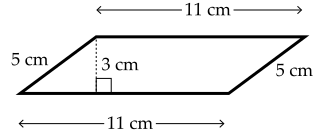
The parallelogram

Now to get back to the question, you may have noticed that the trapezoid has a lot in common with the left side of the parallelogram. So much so that it makes sense that we might try superimposing the two images as shown.
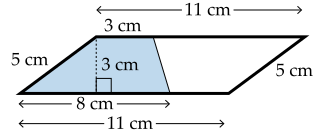
The parallelogram with the trapezoid superimposed on top, we notice it takes up half of the shape.

When we do this, we notice that the part of the parallelogram that's left unshaded is actually a second copy of the given trapezoid, just upside down.

The area of the given trapezoid is \(\dfrac{1}{2}\) the area of the parallelogram.

The area of the parallelogram is \(33\) cm\(^2\).

Therefore, the area of the trapezoid is

\(\dfrac{1}{2} \text{ of } 33 = 16.5 \text{ cm}^2\)

Formula for the Area of a Trapezoid

To determine the formula for the area of any trapezoid, we generalize the observation from the Try This problem. To determine the area of a trapezoid, we must know the perpendicular height, labelled \(h\), and the lengths of the two parallel sides labelled \(a\) and \(b\).
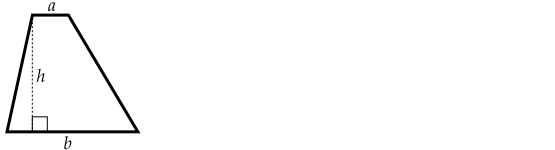
When we place two identical trapezoids together as shown, we get a parallelogram.
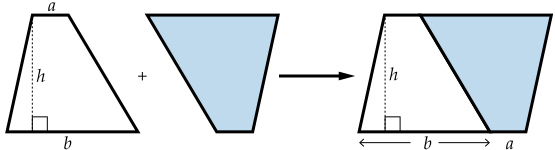
A trapezoid with the same trapezoid rotated 180 degrees and combined creates a parallelogram.

The area of the trapezoid is \(\dfrac{1}{2}\) the area of the corresponding parallelogram.

To calculate the area of this parallelogram, we would multiply the length of the base, which is \(a+b\), by the height \(h\).

Area of the parallelogram \(= (a+b)\times h\) 

A trapezoid has two parallel sized of lengths \(a\) and \(b\) and a height \(h\). The area of the trapezoid can be calculated using the equation

\(A=\dfrac{1}{2}(a +b) h\)

Example 7

Calculate the area of the following trapezoid. 
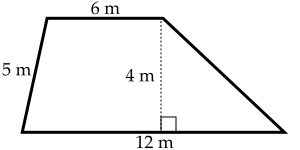
A trapezoid with parallel sides of 6 m and 13 m.  Another side is 5 m and the vertical height is 4 m.

Solution

The two parallel sides are \(6\) m and \(12\) m in length. The perpendicular distance between them is \(4\) m.

\(\begin{align*} A &= \dfrac{1}{2}(a+b)h \\ &\; = \dfrac{1}{2}(6+12)(4) \\ & \; = \dfrac{1}{2}(18)(4) \\ & \; = (9)(4) \\ & \; = 36 \end{align*}\)

Therefore, the area of the trapezoid is \(36\) m\(^2\).

Check Your Understanding 6

Question

Calculate the area, in mm\(^2\), of the trapezoid shown below.
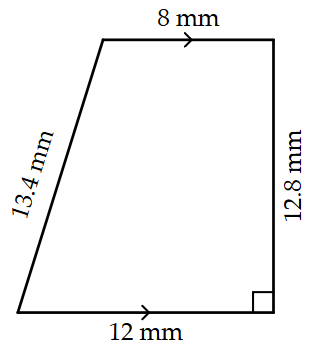
A right trapezoid with parallel sides measuring 12 mm and 8 mm each. The right-angled side is 12.8 mm and the other side is 13.4 mm.

Answer

\(128\) mm\(^2\)

Feedback

Notice the two parallel sides are \(8\) mm and \(12\) mm in length, and the height is \(12.8\) mm. Using the formula for the area of a trapezoid, we have:

\(\begin{align*} A & = \dfrac{1}{2} (a+b)h \\ & = \dfrac{1}{2} (8+12)(12.8) \\ & = \dfrac{1}{2} (20)(12.8) \\ & = (10)(12.8) \\ & = 128\end{align*}\)

Therefore, the area of the trapezoid is \(128\) mm\(^2\).

Summary of Area Formulas

Let's now take a moment to recap all of the formulas that we saw in this lesson. We begin by reviewing the formula for the area of a rectangle.

Rectangle

\(A=l\times w\)
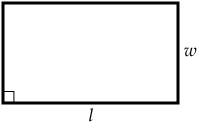
A rectangle with length l and width w.

Then we showed that the area of a parallelogram can be calculated by multiplying its base by its height.

Parallelogram

\(A = b\times h\)
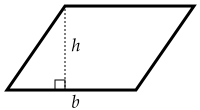
A parallelogram with base b and height h.

Triangle

\(A= \dfrac{1}{2}(b\times h)\)
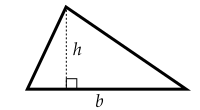
A triangle with base b and height h.

We also learned how to find the area of a trapezoid if we know the lengths of the parallel sides and the height.

Trapezoid

\(A = \dfrac{1}{2}(a+b)\times h\)

A trapezoid with base b, top a, and height h.          

In the following Check Your Understanding, practice using all of these formulas to solve area problems.

Check Your Understanding 7

Question

Calculate the area, in m\(^2\), of the triangle shown below.
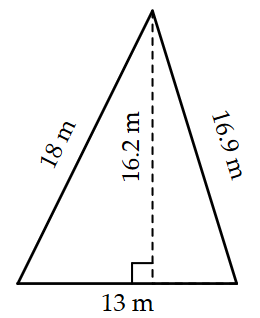
A triangle with base 13 m and other sides measuring 16.9 m and 18 m. The height is marked as 16.2 m.

Answer

\(105.3\) m\(^2\)

Feedback

Notice the base of the triangle is \(13\) m and the height is \(16.2\) m. Using the formula for the area of a triangle, we have:

\(\begin{align*} A & = \dfrac{1}{2} (b\times h) \\ & = \dfrac{1}{2} (13\times 16.2) \\ & = \dfrac{1}{2} (210.6) \\ & = 105.3 \end{align*}\)

Therefore, the area of the triangle is \(105.3\) m\(^2\).

Take It With You

The following pair of parallel lines are drawn so that they are \(4\) cm apart.
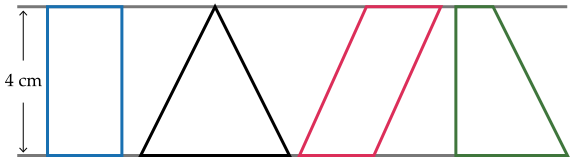
A rectangle, triangle, parallelogram, and trapezoid are drawn so that every vertex is on a parallel line.

If they are all equal in area, what do you know about the dimensions of each polygon?