Word Problems
Try This Problem Revisited
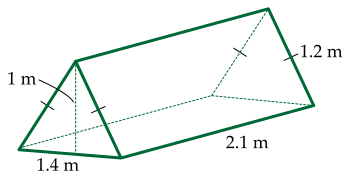
A tent has the shape of a triangular prism.
If \(1\) can of waterproofing spray covers \(3\) m\(^2\), how many cans are needed to spray all surfaces of the tent (including the bottom)?
Solution
Step 1: Calculate the Surface Area of Tent
To determine the quantity of waterproofing spray needed, we must determine the surface area of the tent using the following equation.
\(\begin{align*} SA &= 2\times A_{front} + 2 \times A_{side} + A_{bottom} \\ &\; \class{timed in3}{= 2 \times (0.7) } \class{timed in4}{\;+\; 2 \times (2.52)} \class{timed in5}{ \;+\; 2.94} \\ &\; \class{timed in6}{= 9.38} \end{align*}\)
The total surface area of the tent is \(9.38\) m\(^2\).
Step 2: Determine Number of Cans of Spray
\(1\) can of waterproofing spray covers \(3\) m\(^2\), and
\(9.38 \div 3 \approx 3.13 \)
What this tells us is that we need \(3.13\) cans. But clearly, we can't buy a partial can.
Therefore, \(4\) cans of waterproofing spray would need to be purchased.
Example 4
The cost of materials to build a composter is \($9.98\)/m\(^2\).
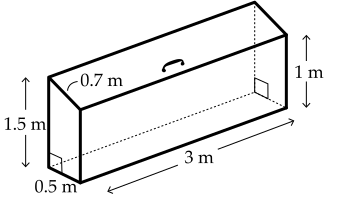
What is the total cost of materials to build the following composter, which has a bottom, top, and four sides?
Solution
Step 1: Calculate the Surface Area of Composter
To determine the total cost of the materials, we must first determine the surface area of the composter. Notice that the sides of the composter are trapezoids, and so this composter can be thought of as a trapezoidal prism. As such, we can use the following equation to calculate the surface area.
\(SA = 2\times A_{side} + A_{top} + A_{bottom} + A_{front} + A_{back}\)
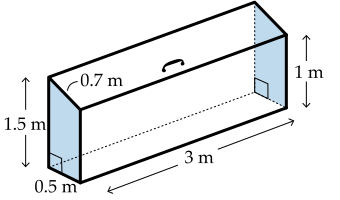
Calculating, we get that the area of the trapezoid sides are \(0.625\) m\(^2\).
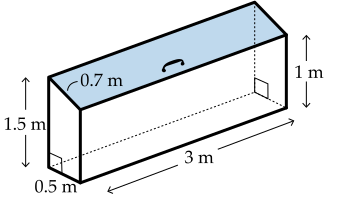
The area of the top rectangle is \(2.1\) m\(^2\).
The area of the bottom rectangle is \(1.5\) m\(^2\).
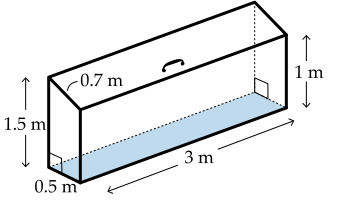
The area of the front rectangle is \(3\) m\(^2\).
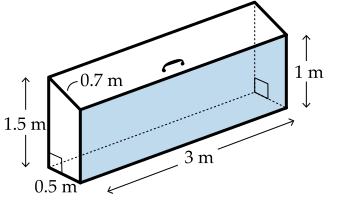
The area of the back rectangle is \(4.5\) m\(^2\).
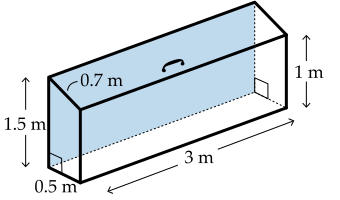
We summarize this as follows:
\[\begin{align*} SA &= 2\times A_{side} + A_{top} + A_{bottom} + A_{front} + A_{back} \\ & \;\class{timed in3}{= 2 \times 0.625} \class{timed in4}{\;+\; 2.1} \class{timed in5}{ \;+\; 1.5 } \class{timed in6}{ \;+\; 3} \class{timed in7}{ \;+\; 4.5} \\ &\; \class{timed in8}{= 12.35} \end{align*}\]
The total surface area of the composter is \(12.35\) m\(^2\).
Step 2: Determine Cost of Materials
We know that materials cost \($9.98\) per m\(^2\).
Since
\[12.35 \times 9.98 = 123.253\]
We can conclude that it will cost approximately \($123.26\) in materials to build the composter.
Check Your Understanding 3
Question
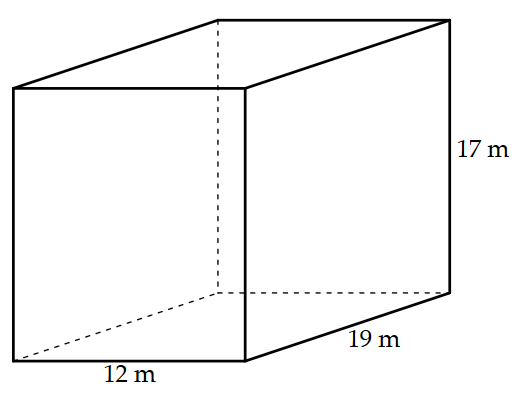
One type of paint requires \(1\) L of paint to cover \(10\) m\(^2\). How much paint, in L, is needed to paint the outside of the following structure?
Answer
\(151\) L
Feedback
Step 1: Calculate the surface area of the rectangular prism
This rectangular prism has \(2\) identical rectangular faces on the ends, \(2\) identical rectangular faces on the sides, and \(2\) identical rectangular faces on the top and bottom.
The surface area of the rectangular prism is
\(SA = 2 \times A_{rec1}+2\times A_{rec2} + 2\times A_{rec3}\)
Calculating the area of each face gives us
\(\begin{align*}A_{rec1} & = 12 \times 17 \\ & = 204 \end{align*}\)
\(\begin{align*}A_{rec2} & = 17 \times 19 \\ & = 323 \end{align*}\)
\(\begin{align*}A_{rec3} & = 12 \times 19 \\ & = 228 \end{align*}\)
Therefore,
\(\begin{align*}SA & = 2 \times 204 + 2 \times 323 + 2 \times 228 \\ & = 1510 \end{align*}\)
Thus, the surface area of the rectangular prism is \(1510\) m\(^2\).
Step 2: Calculate the amount of paint needed
\(\begin{align*}\text{amount of paint needed } & = 1510 \div 10 \\ = 151 \end{align*}\)
Therefore, you would require \(151\) L of paint.
Take It With You
The length, width, and height of a rectangular prism are all that we require to calculate the surface area.
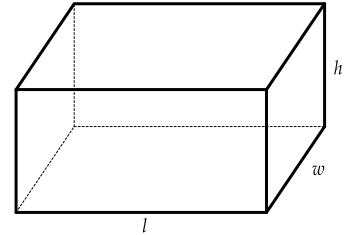
How does the surface area of a rectangular prism change in the following cases?
- One dimension is doubled or tripled?
- Two dimensions are doubled or tripled?
- All three dimensions are doubled or tripled?