Example 4
There are many shapes that are composed of partial circles.
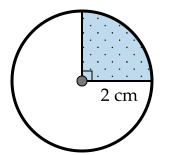
Calculate the perimeter and area of the shaded region.
Solution
First, we notice that the shaded region is \(\dfrac{1}{4}\) of the entire circle.
The perimeter of the shaded region is the distance around it. This is equal to the radius plus the radius plus \(\dfrac{1}{4}\) of the circumference.
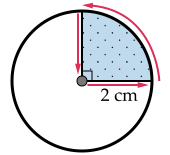
\(\begin{align*} \text{Perimeter} &= r + r + \dfrac{1}{4} (2\pi r) \\ \class{timed in7}{\text{Perimeter} } &\;\class{timed in7}{\approx 2 + 2 + \dfrac{1}{4}(2(3.14)(2))} \\ \class{timed in8}{ \text{Perimeter}}&\; \class{timed in8}{\approx 7.14} \end{align*}\)
Therefore, the perimeter of the shaded region is approximately \(7.14\) cm.
\(\begin{align*} \text{Area} &= \dfrac{1}{4} \pi r^2 \\ \class{timed in11}{ \text{Area}}& \; \class{timed in11}{\approx \dfrac{1}{4} (3.14)(2)^2} \\ \class{timed in12}{ \text{Area}}&\; \class{timed in12}{\approx 3.14} \end{align*}\)
Therefore, the area of the shaded region is approximately \(3.14\) cm\(^2\).
Try This Problem Revisited
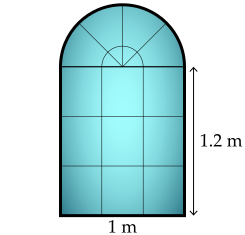
This window, called a Norman window, is built by adjoining a semicircle to the top of a regular rectangular window.
What is the area of the glass in the following window?
Solution
Notice that the total area of the glass is equal to the sum of the area of the glass forming the interior of the semicircle and the area of the glass forming the interior of the rectangle. We write that the area of the glass is equal to the area of the semicircle plus the area of the rectangle.
\(A = A_{semicircle} + A_{rec} \)
We now need to calculate the area of each part. The area of the semicircle can be calculated by halving the area of the corresponding circle:
\(\begin{align*} A_{semicircle} &\; \class{timed in5}{= \dfrac{1}{2} \pi r^2} \\ \class{timed in6}{ A_{semicircle}} &\; \class{timed in6}{\approx \dfrac{1}{2} (3.14)(0.5)^2} \\ \class{timed in7}{A_{semicircle}}&\; \class{timed in7}{\approx 0.3925} \end{align*}\)
The area of the rectangle can be calculated using the equation area equals length times width.
\(\begin{align*} A_{rec} &\; \class{timed in8}{= l \times w} \\ \class{timed in9}{A_{rec}}& \; \class{timed in9}{= 1 \times 1.2} \\ \class{timed in10}{ A_{rec}}&\; \class{timed in10}{= 1.2} \end{align*}\)
We now have the area of all parts of the window. To approximate the total area of the glass, we add the area of the semicircle and the area of the rectangle together.
\(\begin{align*} A &= A_{semicircle} + A_{rec} \\ \class{timed in11}{ A }&\; \class{timed in11}{\approx 0.3925 + 1.2} \\ \class{timed in12}{ A} &\; \class{timed in12}{\approx 1.5925} \end{align*}\)
Thus, the area of the glass in the window is approximately \(1.5925\) m\(^2\). It might be helpful to round this answer and say that the area of the glass in the window is approximately \(1.6\) m\(^2\).
Check Your Understanding 4
Question
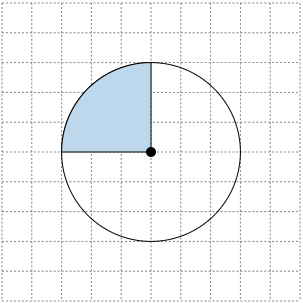
Find the area of the shaded region, in units\(^2\). Round your answer to two decimal places.
Answer
\(7.07\) units\(^2\)
Feedback
\(\begin{align*} A & = \dfrac{1}{4} \pi r^2 \\ & \approx \dfrac{1}{4} (3.14)(3)^2 \\ & \approx 7.07\end{align*}\)
Thus, the area of the shaded region is \(7.07\) units\(^2\).
Note: We used \(3.14\) as an approximation for \(\pi\). Your answer might be slightly different if you used a more accurate approximation.
Example 5
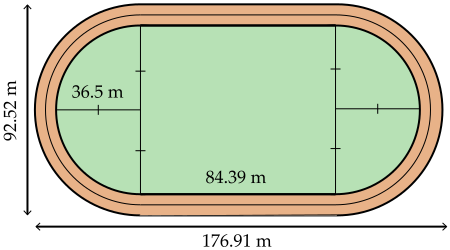
An Olympic \(400\) metre track is composed of two straight sides and two semi-circular curves. Notice that the entire track is composed of lanes that go around an interior grass region.
Approximately what area is covered by the lanes?
Solution
To calculate the area covered by the lanes, we can calculate the area of the entire track and subtract the area of the inner grass region.
The area of the entire track is the area of \(2\) semicircles plus the area of a rectangle. If you use \(3.14\) as an approximation for the number \(\pi\), then you can work out this area to be approximately \(14~527\) m\(^2\).
The area of the inner grass is also equal to the area of \(2\) semicircles plus the area of a rectangle. Using the same approximation for \(\pi\), you can calculate the area of this region to be approximately \(10~344\) m\(^2\).
Subtracting the two areas, we get
\(\begin{align*} A_{lanes} &\; \class{timed in3}{= A_{track}} \class{timed in4}{- A_{grass}} \\ \class{timed in5}{A_{lanes}} &\; \class{timed in5}{\approx 14~527} \class{timed in6}{-\; 10~344} \\ \class{timed in7}{A_{lanes}} &\; \class{timed in7}{\approx 4183} \end{align*}\)
Therefore, the area covered by the lanes is approximately \(4183\) m\(^2\).
Now, if you use more digits of \(\pi\) in your calculation, then you will find that the answer to the nearest square meter is actually \(4185\) m\(^2\).
Information such as the area of the lanes can be used to calculate the cost of materials. For example, it can be used to calculate the cost of resurfacing all of the running lanes.
Check Your Understanding 5
Question
A lawn sprinkler rotates and sprays water in a circle. It sprays an area of \(37\) m\(^2\).
How far does the lawn sprinkler spray? Round your answer to two decimal places.
Answer
\(3.43\) m
Feedback
The distance that the lawn sprinkler sprays is equal to the radius of the circular area that the sprinkler waters.
Find the radius of the circle.
\(\begin{align*} A & = \pi r^2 \\ 37 & \approx (3.14) r^2 \\ 11.78 & \approx r^2 \\ 3.43 & \approx r \end{align*}\)
Therefore, the lawn sprinkler sprays approximately \(3.43\) m.
Note: We used \(3.14\) as an approximation for \(\pi\). Your answer might be slightly different if you used a more accurate approximation.
Take It With You
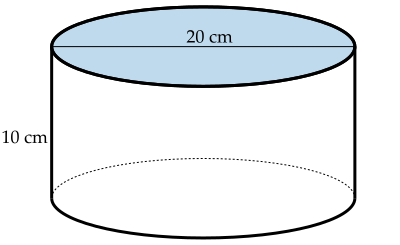
The following cylinder was created by sweeping the circular base vertically through space.
The circle has a diameter of \(20\) cm and it was swept a vertical distance of \(10\) cm.
- Explain how you might calculate the volume of this cylinder.
- Explain how you might calculate the surface area of this cylinder.
A quick note: you might find it helpful to think back about how we found the volume and the surface area of prisms.