Alternative Format


Try This

Volume by Displacement

Recall that we can determine the volume of an object by submerging it in water and measuring the volume of the water that it displaces. 

A rock placed in the cylinder causes the water to rise. The volume of water that rose is called volume displaced.

Source: Rock - Yevhenii Dubinko/iStock/Getty Images

The volume of water the object displaces must be equal to the volume of the object.

A graduated cylinder is a standard piece of laboratory equipment that can be used to measure the volume of water that an object displaces.

Graduated Cylinder

A cylinder with tick marks showing volume.

Source: Graduated Cylinder - jauhari1/iStock/Getty Images

Have you ever wondered how they determine where to place the measurement lines? For example, how would you place the \(100\) mL line?

  • Put \(100\) mL of water into the cylinder and mark its height, or
  • Use the dimensions of the cylinder to calculate volume.

Lesson Goals

  • Determine the formula for the volume of a cylinder.
  • Solve problems involving the volume and capacity of cylinders.

Try This!

A cylindrical container of diameter \(4\) cm is partially filled with water. When a stone is submerged in the water in the cylinder, the water level rises by \(3\) cm.

What is the volume, in cm\(^3\), of the stone?
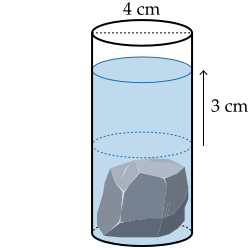
Think about this problem, then move on to the next part of the lesson.

Source: Rock - Yevhenii Dubinko/iStock/Getty Images


Cylinders

You have probably seen many examples of objects that are cylindrical in shape. Everyday items such as paper towel rolls, batteries, and cans are just a few of the many examples.

A roll of paper towel.

Cylindrical double A batteries.

Cylindrical aluminum food cans.

You can create a cylinder by taking a circle and moving it straight up. The shape traced out by the circle is a cylinder. 

The distance you raise the circle is the height of the cylinder.

Now this process might sound familiar because we constructed prisms in a very similar way.

Sources: Paper Towel - JohnGollop/E+/Getty Images; Batteries - pearleye/E+/Getty Images;
Cans - chengyuzheng/iStock/Getty Images

Properties of Prisms and Cylinders

Recall that we defined prisms using two important properties

Properties of Prisms

  • Two parallel end faces that are identical in shape
  • Sides that are shaped like parallelograms

Here are two examples of prisms with their bases highlighted.

A rectangular prism with a rectangular base.

A triangular prism with a triangular base.

In comparison, the important properties of a cylinder are that it has two parallel identical end faces that are circular and one curved side.

Properties of Cylinders

  • Two parallel, identical end faces that are circular
  • One curved side

A cylinder.

You can think of a cylinder being like a prism, except with circles for bases.

Calculating the Volume of a Cylinder

Now, the volume of a cylinder is the amount of space that it occupies. How do we calculate the volume of a cylinder?

As with prisms, It can be calculated by multiplying the area of the base by the height of the cylinder.

\(V = A_{base} \times h\)

The height is the distance between the faces. Since the two faces of a cylinder are always circular, we can do better than this general formula and replace the area of the base with the area of the circle

\(V = A_{circle} \times h\)

The cylinder has height, h, and radius, r.

The volume of the cylinder with a height of \(h\) units and circular bases with radius \(r\) units can be calculated using the equation

\(V = \class{timed add6-hl2 remove7-hl2}{\pi r^2} \times \class{timed add7-hl2 remove8-hl2}{ h}\)

Notice the two parts to this equation. \(\pi r^2\) represents the area of the circle, and we are multiplying this area by the height of the cylinder.

Example 1

Calculate the volume of the cylinder.

A cylinder with radius 8 cm and height 10 cm.

Solution

The volume of this cylinder can be calculated by multiplying the area of the circular base by the height of the cylinder.

\(\begin{align*} V &= \pi r^2 \times h \\ & \; \class{timed in2}{= \pi (8)^2 \times 10} \\ &\; \class{timed in3}{\approx 3.14(8)^2 \times 10} \\ & \; \class{timed in4}{\approx 2009.6} \end{align*}\)

Therefore, this cylinder has a volume of approximately \(2009.6\) cm\(^3\).

Check Your Understanding 1

Question

Find the volume of the cylinder, in mm\(^3\).

A cylinder with diameter 7 mm and height 2.4 mm.

Answer

\(92.32\) mm\(^3\)

Feedback

\(\begin{align*} V & = \pi r^2 \times h \\ & = \pi (3.5)^2 \times 2.4 \\ &\approx 3.14 (3.5)^2 \times 2.4 \\ & \approx 92.32 \end{align*}\)

Therefore, the volume of the cylinder is approximately \(92.32\) mm\(^3\).

Note: We used \(3.14\) as an approximation for \(\pi\). Your answer might be slightly different if you used a more accurate approximation.

Example 2

The volume of the given cylinder is \(186\) cm\(^3\). Determine the height of the cylinder. 

A cylinder with diameter 8 cm.

Solution

We know that the volume of a cylinder is calculated using the formula \( V = \pi r^2 \times h \). Since the diameter is \(8\) cm, the radius is \(4\) cm. Notice that the height is not indicated, but we are given the volume. What height, \(h\), would produce a volume of \(186\) cm\(^3\)?

To figure this out, we substitute the information we know into the equation:

\(\begin{align*} V &= \pi r^2 \times h \\ 186 &\; = \pi (4)^2 \times h \\ 186 &\; \approx 3.14(4)^2 \times h \\ 186 &\; \approx 50.24 \times h \\ 3.70 &\; \approx h \end{align*}\)

Therefore, the height of the cylinder is approximately \(3.7\) cm. 

Check Your Answer

Now, you can check your answer by calculating the volume of a cylinder using this height and the radius we were given. 

\(\begin{align*} V &= \pi r^2 \times h \\ &\approx 3.14(4)^2 \times 3.7 \\ &\; \approx 185.888 \end{align*}\)

Notice that this is not exactly \(186\), because that height is an approximation. But it's close, so we can be confident that \(3.7\) cm is a good approximation for the height.

Check Your Understanding 2

Question

The volume of the given cylinder is \(152.83\) cm\(^3\). Determine the height of the cylinder, in cm, to two decimal places.

A cylinder with radius 3.9 cm.

Answer

\(3.2\) cm

Feedback

\(\begin{align*} V & = \pi r^2 \times h \\ 152.83 & = \pi (3.9)^2 \times h \\ 152.83 &\approx 3.14(3.9)^2 \times h \\ 152.83 & \approx 47.76 \times h \\ 3.2 & \approx h \end{align*}\)

Therefore, the height of the cylinder is approximately \(3.2\) cm.

Note: We used \(3.14\) as an approximation for \(\pi\). Your answer might be slightly different if you used a more accurate approximation.


Cylindrical Containers

Paint cans, swimming pools, and storage tanks are all containers designed to hold liquids that are often cylindrical in shape. 

A cylindrical paint can.

A cylindrical swimming pool.

Oil storage tank shaped like cylinders.

Some advantages to using cylinders and not prisms is that cylinders are easier to pour from, they are strong, and they are cost efficient to build in terms of materials. Some of these properties, we're going to explore in detail in later lessons.

Now, since these containers are designed to hold liquids, we are often interested in their capacity.

The capacity of a container is the maximum amount of liquid that it can hold.

Let's do an example to calculate the capacity of a cylindrical container.

Sources: Paint Can - Lightboxx/iStock/Getty Images; Pool - RossHelen/iStock/Getty Images; 
Storage Tanks - Opla/E+/Getty Images

Example 3

How many millilitres of orange juice can this can hold?

A cylindrical can of orange juice has a diameter of 6 cm and height of 12 cm.

Solution

Now, we don't have a formula to calculate the number of millilitres directly. But if we think about the container as a cylinder, we do have the formula to calculate its volume: \(V = \pi r^2 \times h \). So we can substitute in \(r =3\) and \(h =12 \) and then approximate the result using \(\pi\) is approximately \(3.14\):

\(\begin{align*} V &= \pi r^2 \times h \\ &\; \class{timed in3}{= \pi(3)^2 \times 12} \\ &\; \class{timed in4}{\approx 3.14(3)^2 \times 12} \\ &\; \class{timed in5}{\approx 339.12} \end{align*}\)

Therefore, the volume of the cylinder is approximately \(339.12\) cm\(^3\).

Now, we've found the volume of the cylinder. But we are asked for its capacity. How many millilitres will fill this volume?

Since \(1\) mL \(=1\) cm\(^3\), it would take about \(339\) mL to fill the can. Remember that the actual number will depend on the thickness of the materials used to make the can.

Source: Orange - paggiest/iStock/Getty Images

Check Your Understanding 3

Question

How many mililitres of tomato sauce does a can with a radius of \(5.3\) cm and a height of \(14.1\) cm hold?

Round your answer to the nearest whole number.

Answer

\(1244\) mL

Feedback

First, find the volume of the can.

\(\begin{align*} V & = \pi r^2\times h \\ & = \pi (5.3)^2\times 14.1 \\ & \approx 3.14(5.3)^2 \times 14.1 \\ & \approx 1243.66 \end{align*}\)

Therefore, the volume of the can is approximately \(1243.66\) cm\(^3\).

How many mililitres will fill this volume?

Since \(1\) mL \( = 1\) cm\(^3\), the can holds about \(1244\) mL of tomato sauce.


Try This Problem Revisited

A cylindrical container of diameter \(4\) cm is partially filled with water.

When a stone is submerged in the water in the cylinder, the water level rises by \(3\) cm.

What is the volume, in cm\(^3\), of the stone?

Solution

This is an example of how the method of displacement can be used to calculate the volume of irregular-shaped objects, such as a stone. A submerged object displaces a volume of water equal to the volume of the object. And so the volume of the stone is equal to the volume of displaced water.
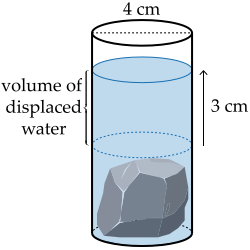
The volume of water displaced is equal to the difference in volume between the two cylinders, i.e., before and after the stone was submerged. Notice that the volume of displaced water is a cylinder with diameter \(4\) cm and height \(3\) cm.
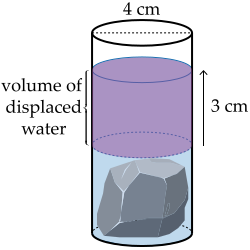
We can calculate the volume of water displaced by the stone by calculating the volume of this cylinder. We start with the formula for the volume of the described cylinder and substitute in the given information.

\(\begin{align*} V_{stone} &\; \class{timed in4}{= V_{displaced~water}} \\ &\; \class{timed in6}{= \pi (2)^2 \times 3} \\ &\; \class{timed in7}{ \approx 3.14(2)^2 \times 3} \\ &\; \class{timed in7}{\approx 37.68} \end{align*}\)

Thus, the volume of the stone is approximately \(37.68\) cm\(^3\).

Example 4

A cylindrical swimming pool has a diameter of \(10\) m and a height of \(1.5\) m. The pool is being filled with water at a rate of \(45\) L/min.

How long will it take the water to reach a depth of \(1.3\) m?

Solution

We're going to need to complete this problem in multiple steps. Let's start by determining the total volume of water required to fill the pool to \(1.3\) m. We start with the formula for the volume of a cylinder, substitute \(r=5\) and \(h =1.3\) into the equation:

\(\begin{align*} V_{water} &= \pi r^2 \times h \\ &\; \class{timed in3}{= \pi (5)^2 \times 1.3} \\ &\; \class{timed in4}{\approx 3.14(5)^2 \times 1.3} \\ &\; \class{timed in5}{\approx 102.05} \end{align*}\)

Therefore, the volume of water in the pool at a depth of \(1.3\) m is about \(102\) m\(^3\).

Now, notice that since \(102.05\) is already an approximation, I've rounded this value to the nearest cubic meter to simplify all of our calculations moving forward.

Next we want to determine how long it will take to fill the pool with \(102\) m\(^3\) of water at a rate of \(45\) L/min.

Notice that we're measuring amounts of water in two different ways here: first, in metres cubed and then using litres. And so we need to change one of them to match the other.

We could change the rate from litres per minute to metres cubed per minute, but, in this case, it's easier for us to change the volume from metres cubed to litres. 

Using conversions, we can work out that

\(1 \text{ m}^3 = 1000 \text{ L}\)

Therefore,

\(102 \text{ m}^3 = 102~000 \text{ L}\)

We can rewrite the volume of water in the pool as \(102~000\) litres.

Now that the rate and the volume are both represented using litres, we can use these values to determine how long it will take to fill the pool to a depth of \(1.3\) metres. To start, you might try using a table.

At a rate of \(45\) L/min, after \(1\) minute, the volume of water in the pool should be \(45\) L. After \(2\) minutes, the volume would be \(90\) L. Remember that these values are obtained by multiplying the time in minutes by \(45\). We can increase the time more rapidly and determine that after \(60\) minutes, the volume of water in the pool would be \(2700\) L.

Time (min) Volume (L)
\(1\) \(45\)
\(2\) \(90\)
\(\vdots\) \(\vdots\)
\(60\) \(2700\)
\(\vdots\) \(\vdots\)

Now, already, we can tell that using a table could take us some time to get to the desired result. So alternatively, remember that from the table, we can come up with an equation.

Let \(t\) represent the time, in minutes, and \(V\) the volume in litres, then

\(\begin{align*} V &= 45t\\ \class{timed in8}{ 102~000} &\; \class{timed in8}{= 45t} \\ \class{timed in9}{ 2266.\overline{6}} & \;\class{timed in9}{= t} \end{align*}\)

Therefore, it would take approximately \(2267\) minutes (\(37\) hours and \(47\) minutes) to fill the pool to a depth of \(1.3\) m.

Check Your Understanding 4

Question

A cylindrical container of radius \(10\) mm is partially filled with water. When a toy is submerged in the water in the cylinder, the water rises by \(4\) mm.

What is the volume, in mm\(^3\), of the toy? Round your answer to two decimal places.

Answer

\(1256\) mm\(^3\)

Feedback

Find the volume of the toy.

\(\begin{align*} V_{toy} & = V_{displaced~water} \\ & = \pi (10)^2\times 4 \\ & \approx 3.14(10)^2 \times 4 \\ &\approx 1256  \end{align*}\)

Therefore, the toy has a volume of approximately \(1256\) mm\(^3\).

Note: We used \(3.14\) as an approximation for \(\pi\). Your answer might be slightly different if you used a more accurate approximation.

Take It With You

A cylinder has a radius, \(r\), and a height, \(h\).
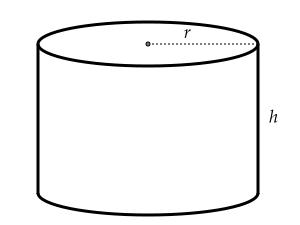
  1. How does the volume of the cylinder change when its radius is doubled?
  2. How does the volume of the cylinder change when its height is doubled?
  3. Explain which dimension, the radius or the height, has a greater impact on the volume of a cylinder.