Alternative Format


Try This

Two Intersecting Lines

When two lines intersect, exactly four angles are formed and the resulting angles have specific relationships. Let's look at some properties of these angles.   

Two intersecting lines.

Two intersecting lines.

Lesson Goals

  • Explore the properties of angles formed by intersecting lines.
  • Define supplementary, complementary, and opposite angles.
  • Find unknown angles in a diagram using angle relationships.

Try This!

Two intersecting lines always form exactly \(4\) angles.

Two lines intersecting.

Can you determine any relationships between angles in the diagram?

To answer this question, you might find it helpful to draw many different pairs of intersecting lines and measure the \(4\) angles that are formed by each.

Think about this problem, then move on to the next part of the lesson.


Try This Problem Revisited

Two intersecting lines always form exactly \(4\) angles.

Can you determine the relationships between angles in the diagram?

Solution

Two intersecting lines always form exactly four angles

Two intersecting lines.

Two intersecting lines.

We can measure the angles and then include these measurements on our diagram.

The four angles starting at the top left and rotating clockwise are 145 degrees, 35 degrees, 145 degrees, and 35 degrees.

 The four angles starting at the top left and rotating clockwise are 110 degrees, 70 degrees, 110 degrees, and 70 degrees.

  • The angles opposite to one another are equal in measure, and
  • any two adjacent angles add to \(180^\circ\). 

If you repeat this activity and draw any two intersecting lines and measure the angles, you will make the same observations. We will use our observations to motivate two properties of intersecting lines.

Angles on a Straight Line

A straight angle is an angle that measures \(180^\circ\). In other words, it's a straight line.

Consider a straight line with a point labelled \(O\) on the line. If you draw a ray from \(O\), you will form two angles. 

The combination of the two angles gives the straight line, and, therefore, they must have a sum of \(180^\circ\).

Two or more angles on a line add to \(180^\circ\).

Example 1

\(\overleftrightarrow{BD}\) and \(\overleftrightarrow{ EC}\) intersect at \(A\) such that \(\angle BAE\) is equal to \(43^\circ\).

Find the measures of the other three angles.

Solution

The combination of the two angles \(\angle EAB\) and \(\angle BAC\) form the straight angle, \(\angle EAC\), and, therefore, they must add to \(180^\circ\). As a result, \(\angle  BAC\) is equal to \(137^\circ\). 

\(\angle BAC=180^\circ-43^\circ \class{timed in5}{=137^\circ}\)

Similarly, the combination of \(\angle BAE\) and \(\angle EAD\) form the straight angle \(\angle BAD\), and, therefore, they must also add to \(180^\circ\). As a result, \(\angle EAD\) is equal to \(137^\circ\).

\(\angle EAD=180^\circ-43^\circ=137^\circ\)

Similar reasoning will give that \(\angle CAD\) is equal to \(43^\circ\).

\(\angle CAD=180^\circ-137^\circ=43^\circ\)

And we now have the measure of all four angles formed by the intersecting lines. In this example, we exploited the fact that different pairs of angles added to \(180^\circ\). This type of pair is given a special name.

Two angles that add to \(180^\circ\) are called supplementary angles.

Check Your Understanding 1

Question

Select an angle that is supplementary to \(\angle COB\) (the shaded angle) and determine the angle of the supplementary angle.

Line AB intersects line CD at 0. Angle COB is 91 degrees.

Answer

\(\angle AOC\) and \(\angle BOD\) are supplementary to \(\angle COB\). The supplementary angle is \(89^\circ\).

Angle AOC and angle COB form a straight line.Angle COB and angle BOD form a straight line.

Created with GeoGebra. Author: University of Waterloo. CC BY-NC-SA 4.0. https://ggbm.at/gjrVECbQ

Feedback

Supplementary angles are two angles that add to \(180^\circ\).

Online Version

https://ggbm.at/gjrVECbQ

Opposite Angles

Consider two intersecting lines. 

 Two lines intersecting create four angles. Angles opposite one another are equal.

Two angles that are opposite to each other when two lines intersect are called opposite angles.

It should be pretty clear why we call these angles opposite. But I should note that you might also see angles of this type being called vertically opposite angles or just vertical angles. We will only use the term opposite angles in our lessons.

So when two lines intersects, exactly two pairs of opposite angles are formed. In the Try This problem, we made an observation about these opposite angles, specifically that the angles opposite to one another were equal in measure.

Two intersecting line with angles of 145 degrees and 35 degrees.

This observation is true for any two intersecting lines, and so we summarize this as an important fact.

Opposite angles are equal. 

Check Your Understanding 2

Question

Select an angle that is opposite to \(\angle BOD\) (the shaded angle) and determine the measure of the opposite angle.

Line AB intersects line CD at O. Angle BOD is 70 degrees.

Answer

\(\angle AOC\) is opposite to \(\angle BOD\) and measure \(70^\circ\).

Line AB intersects line CD at O. Angle BOD and angle AOC are 70 degrees.

Created with GeoGebra. Author: University of Waterloo. CC BY-NC-SA 4.0. https://ggbm.at/xJjHYmG8

Feedback

Opposite angles are two angles that are opposite to each other when two lines intersect.

Online Version

https://ggbm.at/xJjHYmG8

Example 2

\(\overleftrightarrow{PQ}\) and \(\overleftrightarrow{MN}\) intersect at \(O\), such that \(\angle POM\) is equal to \(67^\circ\). 

Find the measures of the other \(3\) angles and explain how you know their measure.

Two lines PQ and MN that intersect at O. Angle POM measures 67 degrees.
Solution

Notice that \(\angle NOQ\) and \(\angle POM\) are opposite angles. We often say that \(\angle  NOQ\) is opposite to \(\angle POM\). We know that \(\angle NOQ\) has to be equal to \(67^\circ\), since it is opposite to \(\angle POM\). 

Next, notice that \(\angle POM\) and \(\angle PON\) together form a straight line or, in other words, add to \(180^\circ\). We say that \(\angle PON\) is supplementary to \(\angle POM\). Therefore, we know that \(\angle PON = 113 ^\circ\), since it is supplementary to \(\angle POM\). 

Similarly, \(\angle MOQ = 113 ^\circ\), since it is supplementary to \(\angle POM\).

In summary, we have the following:

  • \(\angle NOQ = 67^\circ \) (opposite to \(\angle POM\))
  • \(\angle PON = 113^\circ \) (supplementary to \(\angle POM\))
  • \(\angle MOQ = 113^\circ \) (supplementary to \(\angle POM\))

Check Your Understanding 3

Question

Find the measure of the unknown angles in the diagram below and determine if the angle is supplementary or opposite to \(\angle DOA\). 

Line AC intersects line BD at O. Angle DOA is 123 degrees.

Answer
  • \(\angle AOB = 57^\circ\), since \(\angle AOB\) is supplementary to \(\angle DOA\).
  • \(\angle COD = 57^\circ\), since \(\angle COD\) is supplementary to \(\angle DOA\).
  • \(\angle BOC = 123^\circ\), since \(\angle BOC\) is opposite to \(\angle DOA\).

Angles in Right Triangles and Rectangles

Another common angle pairing occurs in right triangles and rectangles.

One angle in a right triangle is \(90^\circ\). What is the relationship between the remaining two angles in a right-angled triangle?

What is the relationship between the four angles created when we draw a diagonal of the rectangle?

To help you explore these two questions further, you can use the following investigation.

Explore This 1

Description

What is the relationship between the remaining two angles in a right-angled triangle?

Angle C is 90 degrees, angle A is 30 degrees, and angle B is 60 degrees.

Angle C is 90 degrees, angle A is 36 degrees, and angle B is 54 degrees.

Angle C is 90 degrees, angle A is 45 degrees, and angle B is 45 degrees.

What is the relationship between the angles created by the diagonal of the rectangle?

Rectangle ABCD has angle DAB equal to 28 degrees and angle CAB equal to 62 degrees.Rectangle ABCD has angle DAB equal to 48 degrees and angle CAB equal to 42 degrees.

Rectangle ABCD has angle DAB equal to 39 degrees and angle CAB equal to 51 degrees.

Created with GeoGebra. Author: University of Waterloo. CC BY-NC-SA 4.0. https://ggbm.at/NPY2JYEp

Online Version

https://ggbm.at/NPY2JYEp

Complementary Angles

Recall that the three angles in a triangle must sum to \(180^\circ\). As such, in our right triangle, one angle is \(90^\circ\). And so the remaining two angles must add to \(90^\circ\). 

 Right triangle ABC with angle C equal to 90 degrees.

\(\angle ABC + \angle BAC = 90^\circ\)

Look specifically at the top left corner. When we draw a diagonal of the rectangle from this corner, we create two angles that together form the \(90^\circ\) corner. As a result, these two angles must also add to \(90 ^\circ\).

Rectangle ADBC with diagonal AB drawn in.

\(\angle CAB + \angle BAD = 90^\circ\)

Angle pairs of this type are given a special name. 

Two angles that add to \(90^\circ\) are called complementary angles.

Check Your Understanding 4

Question

What is the measure of an angle supplementary to \(87^\circ\)?

Answer

\(93^\circ\)

Feedback

Supplementary angles add to \(180^\circ\).

\(87^\circ + 93^\circ = 180^\circ\)

Therefore, \(93^\circ\) is supplementary to \(87^\circ\).

Example 3

\(\overleftrightarrow{EC}\) and \(\overleftrightarrow{AD}\) intersect at \(F\) such that \(\angle AFE\) is acute. \(\overrightarrow{FB}\) is drawn so that \(\angle AFB\) is equal to \(90^\circ\). 

Identify a pair of supplementary, opposite, and complementary angles in the diagram.

Requires More -- On the horizontal line AD, A is to the left and the points B through E are labelled clockwise alphabetically.

Solution

Let's start by looking for supplementary angles. Recall that supplementary angles are two angles that add to \(180^\circ\), which is the measure of a straight line. 

The combination of \(\angle AFB\) and \(\angle BFD\) gives the straight line \(AFD\). And therefore, they must have a sum of \(180^\circ\) and are supplementary angles. 

By similar reasoning, \(\angle AFE\) and \(\angle AFC\), \(\angle AFE\) and \(\angle EFD\), \(\angle CFD\) and \(\angle CFA\), and \(\angle CFD\) and \(\angle DFE\) are also supplementary angles.

Supplementary Angles

  • \(\angle AFB\) and \(\angle BFD\)
  • \(\angle AFE\) and \(\angle AFC\)
  • \(\angle AFE\) and \(\angle EFD\)
  • \(\angle CFD\) and \(\angle CFA\)
  • \(\angle CFD\) and \(\angle DFE\)

Opposite angles are formed when two lines intersect.

Notice, in this diagram, the only two lines are \(\overleftrightarrow{AD}\) and \(\overleftrightarrow{CE}\). Therefore, \(\angle AFE\) and \(\angle CFD\) are opposite angles, as are \(\angle AFC\) and \(\angle DFE\).

Opposite Angles

  • \(\angle AFE\) and \(\angle CFD\)
  • \(\angle AFC\) and \(\angle DFE\)

Complementary angles are two angles that add to \(90^\circ\). 

Since \(\angle AFB\) is equal to \(90^\circ\) degrees and because \(\angle AFB\) and \(\angle BFD\) are supplementary, we know that \(\angle BFD\) must also be equal to \(90^\circ\).

Next, notice that the combination of \(\angle BFC\) and \(\angle CFD\) gives the \(90^\circ\) angle \(\angle BFD\). And therefore, \(\angle BFC\) and \(\angle CFD\) are complimentary.

Now, there's actually a second pair of complementary angles that is more difficult to see. Since \(\angle AFE\) and \(\angle CFD\) are opposite angles, we know that they are equal in measure. As a result, \(\angle BFC\) and \(\angle AFE\) also have a sum of \(90^\circ\). And we say that \(\angle BFC\) and \(\angle AFE\) are complimentary.

Complementary Angles

  • \(\angle BFC\) and \(\angle CFD\)
  • \(\angle BFC\) and \(\angle AFE\)

Now, I have listed all pairs of supplementary, opposite, and complementary angles that can be found in this diagram. In the question, I only asked you for one of each. So you just need to be sure that the pair you listed is included in my list.

Remember that an angle can be written in two ways. So instead of writing \(\angle AFB\), you may have written \(\angle BFA\), which is okay.

Check Your Understanding 5

Question

Identify a pair of complementary angles in the diagram.

Line AB  intersects ray DF at point I. Line segment DC has point C on line AB, where angle D is 90 degrees.

Created with GeoGebra. Author: University of Waterloo. CC BY-NC-SA 4.0. https://ggbm.at/JYS8gtMX

Answer

Complementary angles add to \(90^\circ\).

  • \(\angle DCI\) and \(\angle CID\) are complementary.
  • \(\angle DCI\) and \(\angle FIB\) are complementary.
Online Version

https://ggbm.at/JYS8gtMX


Example 4

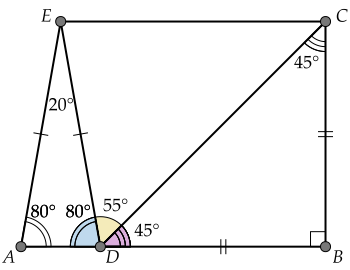
In the following diagram, \(\overline{AB}\) is a line segment with the point \(D\) on the segment. Triangle \(AED\) and triangle \(DBC\) are isosceles. As well, \(\angle AED\) is equal to \(20^\circ\), and \(\angle CBD\) is equal to \(90^\circ\).

What is the measure of \(\angle EDC\)?
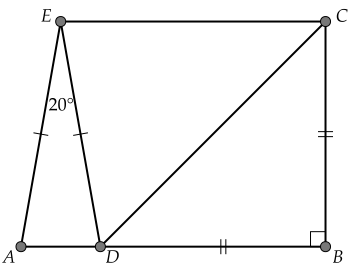
AB and EC are parallel horizontal lines

Solution

I want to start by looking at the diagram. Specifically, let's note \(\angle EDC\), which is the angle that we're trying to find the measure of.
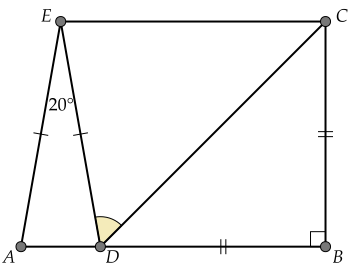
Notice that this angle is one of three angles in \(\triangle EDC\). Since we do not know any information about this specific triangle, we must look to the rest of the diagram to help us find the measure of \(\angle EDC\).
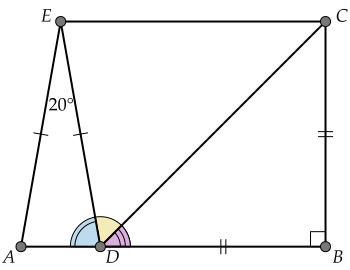
So the next observation that we want to make is that \(\angle ADE\), \(\angle EDC\), and \(\angle CDB\) combine to form the straight angle \(\angle ADB\), which we know has a measure of \(180^\circ\). What this tells us is that if we can determine the measure of these other two angles, then we can use that information to find the measure of \(\angle EDC\).

Consider \(\triangle AED\)

\(\triangle AED\) is isosceles,

\(\angle EAD = \angle EDA\)
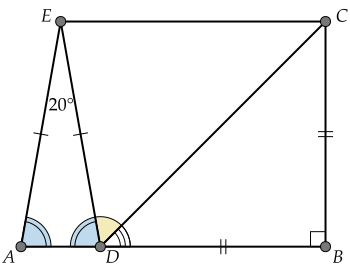
We also know that the sum of the angles in a triangle is equal to \(180^\circ\). Since \(\angle AED=20^\circ\),

\(\angle EAD + \angle EDA = 160^\circ\)

Therefore, \(\angle EAD = \angle EDA = 80^\circ\). 
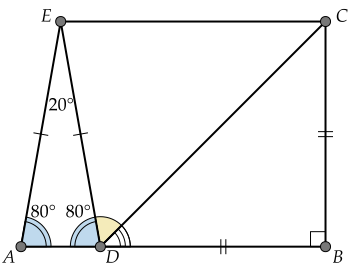
Notice that we have found one of the angles that we need.

Consider \(\triangle DBC\)

Since this triangle is also isosceles,  

\(\angle BCD = \angle BDC\)
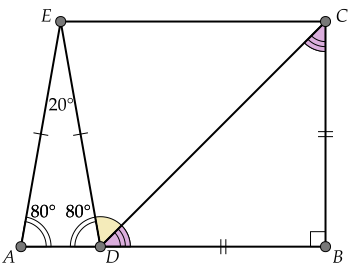
\(\triangle DBC\) is a right triangle, so we know that \(\angle BCD\) and \(\angle BDC\) are complimentary. 

\(\angle BCD = \angle BDC = 45^\circ\)
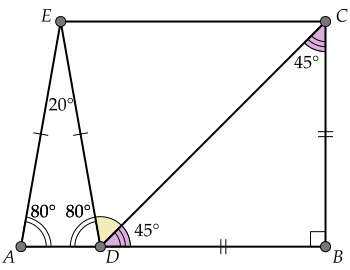
We can now return to finding the measure of \(\angle EDC\).
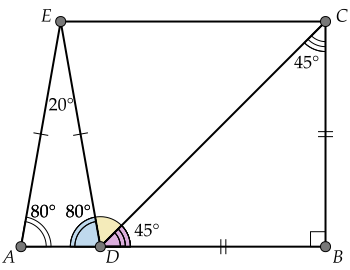
Find  \(\angle EDC\)

\(\begin{align*} 80^\circ + \angle EDC + 45^\circ &= 180^\circ \\ \class{timed in21}{ \angle EDC} & \class{timed in21}{= 55^\circ} \end{align*}\)

Thus, \(\angle EDC\) has a measure of  \(55^\circ\).
Example 5

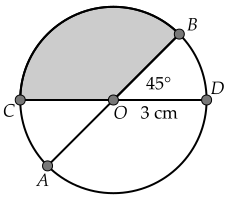
In the following diagram, line segments \(\overline{AB}\) and \(\overline{CD}\) are both diameters of the circle with a radius of \(3\) cm. \(\angle BOD\) is equal to \(45^\circ\). 

What is the area of the shaded section of the circle?
Solution

Notice that the combination of \(\angle COB\) and \(\angle BOD\) gives the straight angle \(\angle COD\). Therefore, \(\angle COB \) and \(\angle BOD\) are supplementary angles.

\(\angle COB = 180^\circ - 45^\circ \class{timed in13}{ = 135^\circ}\)
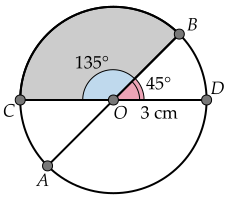
What fraction of the circle does the shaded region represent? ? We know that there are \(360^\circ\) in a full circle.

\(\dfrac{135^\circ}{360^\circ} = \dfrac{3}{8}\)

The shaded region represents ‌\(\dfrac{3}{8}\) of the area of the entire circle. 

Now the area of the entire circle can be calculated:

\(\begin{align*} A_{shaded} &= \dfrac{3}{8} A_{circle} \\ &\; \class{timed in6}{= \dfrac{3}{8} \pi r^2} \\ &\; \class{timed in7}{= \dfrac{3}{8} \pi (3)^2} \\ &\; \class{timed in8}{= \dfrac{27}{8} \pi} \\ &\; \class{timed in10}{\approx 10.6} \end{align*}\)

Thus, the area of the shaded region is approximately \(10.6\) cm\(^2\).

Check Your Understanding 6

Question

What is the area of the shaded section of the circle, in cm\(^2\)?
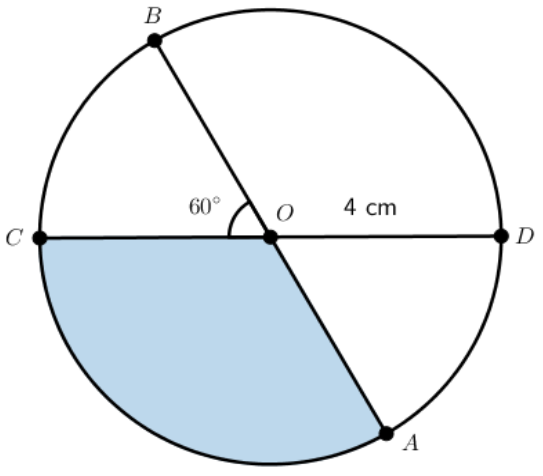
Diameters AB and CD intersect at point O, the centre of a circle. Angle BOC is 60 degrees and the radius is 4 cm. The section between angle COA is highlighted.

Answer

\(16.75\) cm\(^2\)

Feedback

Notice that the combination of \(\angle BOC\) and \(\angle COA\) gives the straight angle \(\angle BOA\). Therefore, \(\angle BOC\) and \(\angle COA\) are supplementary angles.

We use this to find the angle of the shaded segment.

\(\begin{align*} \angle COA & = 180^\circ - 60^\circ\\ & = 120^\circ \end{align*}\)

What fraction of the circle does the shaded region represent?

\(\dfrac{120^\circ}{360^\circ}  = \dfrac{1}{3}\)

The shaded region represents \(\dfrac{1}{3}\) of the area of the entire circle.

\(\begin{align*} A_{shaded} & = \dfrac{1}{3} A_{circle} \\& = \dfrac{1}{3} \pi r^2 \\ & = \dfrac{1}{3} \pi (4)^2 \\ & = \dfrac{16}{3} \pi \\ & \approx \dfrac{16}{3} (3.14) \\ & \approx 16.75 \end{align*}\)

Thus, the area of the shaded region is approximately \(16.75\) cm\(^2\).

Example 6

\(\overleftrightarrow{MN}\) and \(\overleftrightarrow{PQ}\) intersect at \(O\) such that \(\angle MOP\) is equal to \(y^\circ\), and \(\angle QON\) is equal to \((3y -70)^\circ\).

What is the value of \(y\)?
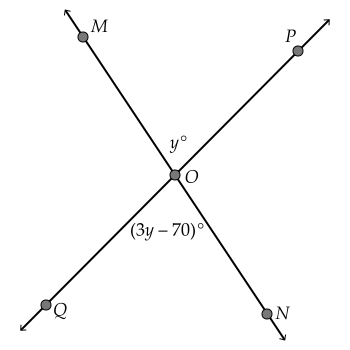
Two intersecting lines MN and QP meet at O. They form two opposite angle, y, and 3 times y minus 70.

Solution

In this diagram, we have two intersecting lines, and the two given angles are opposite to each other, which means that they must be equal.

\(\begin{align*} y & = 3y-70 \\ \class{timed in3}{y + 70} &\; \class{timed in3}{= 3y} \\ \class{timed in4}{70} &\; \class{timed in4}{= 2y} \\ \class{timed in5}{ 35} &\; \class{timed in5}{= y} \end{align*}\)

Check Your Understanding 7

Question

What is the value of \(y\)?
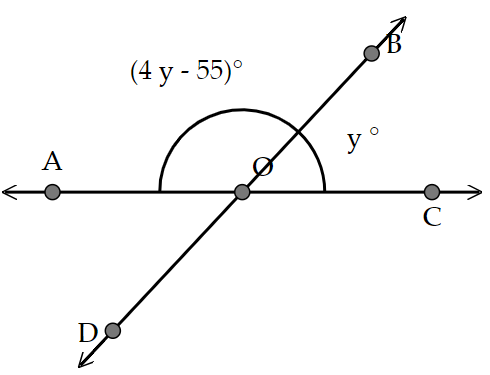
Lines AC and BC intersect at point O. Angle BOC is y degrees and angle BOA is 4 times y minus 55 degrees.

Answer

\(y=47\)

Feedback

Supplementary angles add to \(180^\circ\).

\(\begin{align*} 180 & = y + 4y -55 \\ 180 & = 5y-55 \\ 180+55 & = 5y \\ 235 & = 5y \\ 47 & = y \end{align*}\)

Take It With You

An exterior angle of a triangle is formed when any side is extended.

For example, \(\angle ACD\) is an exterior angle of \(\triangle ABC\). 
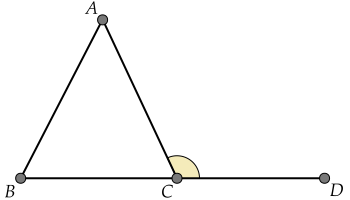
Point D is on the line BC extended.

  1. If \(\angle CAB = 40^\circ\) and \(\angle CBA=75^\circ\), what is the measure of \(\angle ACD\)?
  2. If \(\angle CAB = x^\circ\) and \(\angle CBA=y^\circ\), what is the measure of \(\angle ACD\)?
    Explain how you know.