Probability of Independent Events
Example 3
Recall all possible outcomes when Sarah rolls a standard die and tosses a fair coin.
- \(1\), heads
- \(1\), tails
- \(2\), heads
- \(2\), tails
- \(3\), heads
- \(3\), tails
- \(4\), heads
- \(4\), tails
- \(5\), heads
- \(5\), tails
- \(6\), heads
- \(6\), tails
What is the probability of rolling a \(2\) and tossing heads?
Solution
Again, we assume that the roll and the toss are independent. Since both the die and the coin are fair, meaning that all outcomes of both are equally likely to occur, we know that all of the possible outcomes listed are also equally likely.
There is exactly \(1\) outcome where a \(2\) is rolled and a head is tossed.
There are \(12\) possible outcomes.
The probability of rolling a \(2\) and tossing heads is \( \dfrac{1}{12}\).
Check Your Understanding 3
Question
A fair coin is tossed and a standard die is rolled.
What is the probability of tossing tails and rolling a \(3\)?
Answer
\(\dfrac{1}{12}\)
Feedback
There are \(12\) possible outcomes.
- heads, \(1\)
- tails, \(1\)
- heads, \(2\)
- tails, \(2\)
- heads, \(3\)
- tails, \(3\)
- heads, \(4\)
- tails, \(4\)
- heads, \(5\)
- tails, \(5\)
- heads, \(6\)
- tails, \(6\)
There is \(1\) favourable outcome. It is tails, \(3\).
Therefore, the probability of tossing tails and rolling a \(3\) is \(\dfrac{1}{12}\).
Example 4
A fair coin is tossed two times. What is the probability of tossing \(2\) heads?
Solution
You may think there are three possible outcomes:
- Two heads
- A head and a tail
- Two tails
This is definitely true. This might suggest that the probability of getting two heads is \(\dfrac{1}{3}\) because there's \(3\) possibilities, and \(1\) of them is two heads. Unfortunately, this answer is incorrect because these three outcomes are not actually equally likely. So let's analyze this experiment.
As usual, we will assume that these two tosses are independent of each other. Using a tree diagram, the possible outcomes for the first toss are heads or tails.
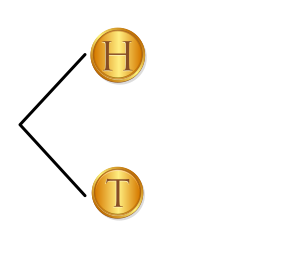
And independent of the result of the first toss, we have two equally likely possibilities for the second toss, heads or tails.
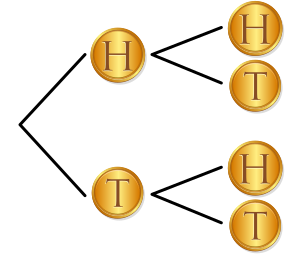
From this tree, we see that there are actually four possible outcomes. Now, since the tosses are independent and the likelihood of tossing heads or tails on each is 50/50, these \(4\) outcomes are equally likely.
By drawing this tree diagram, we are reminded that there are actually two ways that we can get one head and one tail. Either we toss ahead first and then a tail or we toss a tail first and then a head.
Now for the probability calculation. We have \(4\) equally likely outcomes.
Outcomes
Exactly one has the outcome in our event, which is two heads.
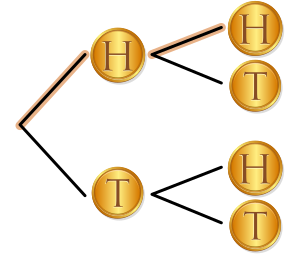
As a result, the probability of tossing two heads must be \( \dfrac{1}{4}\).
Try This Problem Revisited
Two friends, Deepak and Ty, are tossing a fair coin three times to play a "best of three" game. If the coin shows heads, Deepak wins the toss, and if the coin shows tails, Ty wins the toss.
- What is the probability that Deepak wins the "best of three" after just two coin tosses?
- What is the probability that exactly two tosses are heads?
Solution
Let's start by creating a tree diagram to determine all of the possible outcomes. Here all three of the coin tosses are independent of one another. The first coin toss can be heads or tails as usual.
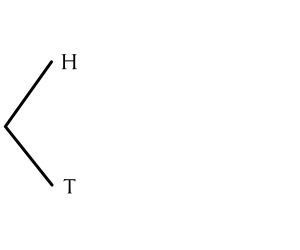
And independent of the result of the first toss, we have two equally likely possibilities for the second toss, heads or tails.
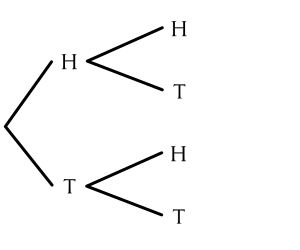
Independent of the result of the first two tosses, we have the same two possibilities for the third toss. So, we get the following tree diagram.
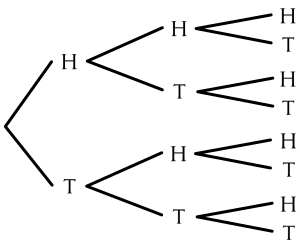
We can list all of the possible outcomes by following each path along the branches of the tree from left to right. Here we see that there are \(8\) different possibilities.
Outcomes
- HHH
- HHT
- HTH
- HTT
- THH
- THT
- TTH
- TTT
There are \(8\) equally likely outcomes.
Now, it may seem strange to toss the coin a third time after one player has already won with two tosses. But we will assume we'll toss all three no matter what. So these are really the true outcomes of the experiment.
We can now use our list of possible outcomes to answer the probability questions. Note that since each toss has an equal chance of landing on heads or tails the \(8\) outcomes must be equally likely.
-
For part a), we determine the probability that Deepak wins after just two coin tosses. Here we need to determine the probability that the first two tosses are heads.
Out of the \(8\) possible outcomes we have listed, there are exactly \(2\) outcomes in which the two first tosses are heads.
Therefore, the probability of Deepak winning after just two coin tosses is \(\dfrac{2}{8} = \dfrac{1}{4} \).
-
In part b), we want to calculate the probability that exactly two heads are tossed in any order. What this means is that we are looking for outcomes that include two heads and one tail in any order.
Out of the \(8\) possible outcomes that we have listed there are \(3\) outcomes in which exactly two heads and one tail occurs.
Therefore the probability of getting exactly two heads is \( \dfrac{3}{8} \).
Check Your Understanding 4
Question — Step 1
A spinner divided into equal yellow, blue, and red sections is spun and a four-sided die is rolled.
Represent the outcomes of the experiment using a tree and determine the number of outcomes of the spinner and the die.
Answer — Step 1
Number of outcomes of the spinner: \(3\)
Number of outcomes of the die: \(4\)
Feedback — Step 1
Notice that the number of branches corresponds to the number of outcomes at each level.
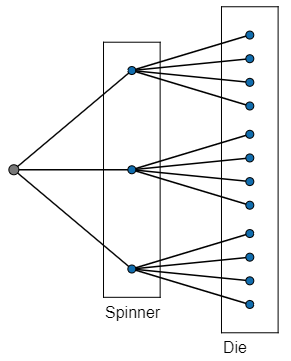
Created with GeoGebra. Author: University of Waterloo. CC BY-NC-SA 4.0. https://ggbm.at/typzegar
Question — Step 2
Using Step 1, identify the number of equally-likely outcomes.
Answer — Step 2
\(12\)
Feedback — Step 2
There are \(12\) possible paths in the tree. Since the events are independent these \(12\) outcomes are equally likely.
Therefore, there are \(12\) equally-likely outcomes.
Online Version
https://ggbm.at/typzegar
Take It With You
\(5\) fair coins are tossed at the same time.
- How many possible outcomes are there?
- Are all possible outcomes equally likely? Explain.
- What is the probability of tossing exactly \(3\) heads?
So think about the tools we've learned in this lesson, things like systematic lists and tree diagrams and independence. For this question you might not want to use a tree diagram or a list to come up with all of the possible outcomes.
But can you use the examples from the lesson to come up with a strategy for solving larger scale problems like this one?