Recall that an exponent has a base that is found directly to its left.
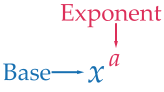
For example, in \(5\) to the exponent \(4\), the exponent \(4\) has a base of \(5\), which means that \(5\) is being multiplied by itself \(4\) times to get a value of \(625\).
\[\begin{align*} 5^4&=5\times 5\times 5\times 5\\ &=625 \end{align*}\]
Consider \((-4)^3\). What is the base, and what is the exponent this time? Take a moment to think about this.
Solution
Directly to the left of the exponent \(3\) is a bracket, which means that \(3\) applies to everything inside that bracket. So \(-4\) is the base.
Base: \(-4\)
Exponent: \(3\)
Remember
\[\begin{align*} (-4)^3&=-4\times -4\times -4\\ &=-64 \end{align*}\]
This means that \(-4\) is being multiplied by itself \(3\) times, resulting in a value of \(-64\).
Brackets
Are brackets really that important? Let's look at a few examples before we answer that question.
Solution 1
Directly to the left of the exponent \(3\) is a bracket, which means that the exponent of \(3\) applies to the base of \(-8\).
\[\begin{align*} (-8)^3&=-8\times -8\times -8\\ &=-512 \end{align*}\]
\(-8\) is multiplied by itself \(3\) times, resulting in a value of \(512\).
Solution 2
If you remember in the previous lesson, you might think of this exponent as having a base of \(-1\) times \(8\), all being raised to the power \(3\). The exponent \(3\) applies to both the \(-1\) and the \(8\).
\[\begin{align*} (-8)^3&=(-1\times 8)^3\\ &=(-1)^3(8)^3\\ &=-1(512)\\ &=-512 \end{align*}\]
What if there are no brackets around \(-8\)? Directly to the left of the exponent \(3\) this time is an \(8\), not a bracket as we saw in the last example.
Solution
Since we can think of \(-8\) as \(-1 \times 8\), \(-8\) to the exponent \(3\) is \(-1\) times \(8\) to the exponent \(3\), which means that \(3\) has a base of \(8\). When multiplication is performed, the end result is \(-512\).
\(\begin{align*} -8^3& \; =-1\times 8^3\\ & \; =-1\times 8\times 8\times 8\\ & \; =-512 \end{align*}\)
We started with the base of \(-8\), with and without brackets around it, and ended up the same result.
At this point, you may be thinking that it doesn't matter if brackets are there or not. But let's try another example before we answer that question.
Notice that \((-8)^3\) and \(-8^3\) have the same value!
Solution 1
The exponent is \(4\) and the base is \(-2\).
\[\begin{align*} (-2)^4&=-2\times -2\times -2\times -2\\ &=16 \end{align*}\]
When we multiply \(-2\) by itself \(4\) times, we get a value of \(16\).
Solution 2
Alternatively, think of the exponent of \(4\) as applying to both a base of \(-1\) and \(2\).
\[\begin{align*} (-2)^4&=(-1\times 2)^4\\ &=(-1)^4(2)^4\\ &=1(16)\\ &=16 \end{align*}\]
Solution
This time, the base is not \(-2\). It is just \(2\) because \(-2\) is not written in brackets.
\(\begin{align*} -2^4&=-1\times 2^4\\ &=-1\times 2\times 2\times 2\times 2\\ &=-16 \end{align*}\)
So this means that we are taking \(-1\times 2^4\), which has a value of \(-16\).
Notice that \((-2)^4=16\) and \(-2^4 = -16\) do NOT have the same value!
Although these two examples have a lot in common, they do NOT produce the same value … so the brackets really do matter … sometimes!
When Do Brackets Matter?
We just determined that brackets did not matter around the \(-8\) but did matter around the \(-2\).
\((-8)^3=-8^3\) and \((-2)^4\neq-2^4\)
Using expanded form (as in the previous examples) or your calculator, convince yourself of the following:
- \((-5)^5=-5^5\)
- \((-3)^6\neq-3^6\)
Do you see a pattern to determine if the brackets are necessary?
When do we get the same answer regardless of whether or not brackets are there?
Notice that:
- \((-5)^5=-5^5=-3125\)
- \((-3)^6=729\) while \(-3^6=-729\)
Take a closer look at the exponents. If the exponent is odd, then it doesn't seem to matter if the base is in brackets. But if the exponent is even, it certainly does. We can use this rule moving forward.
Rule
\((-x)^a=-x^a\) if \(a\) is a positive odd integer.
\((-x)^a=x^a\) if \(a\) is a positive even integer.