Recall that repeated multiplication of the same number can be represented by an exponent.
If \(2\) is being multiplied by itself \(4\) times, it is written as follows:
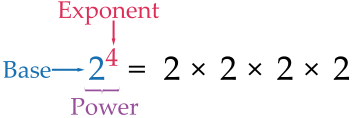
There are many ways to say a power. In these lessons, we will say this power as "\(2\) to the exponent \(4\)." In this example, we can evaluate the expression to get a value of \(16\) by performing the operation of multiplication.
Any number or expression is expressed in such a way that it has an exponent is said to be in exponential form.
Repeated multiplication is referred to as expanded form.
Similarly, we can express repeated multiplication in expanded form if we replace the constant base of \(2\) with an unknown base of \(m\):
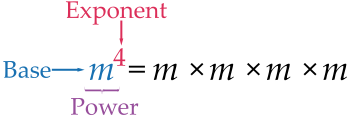
Unlike a numerical base, when the base is a variable, we are unable to evaluate.