Distributive Property


Slide Notes

Glossary

All Slides

Distributive Property

Recall

The distributive property states that multiplication distributes over addition and subtraction. Multiply each term in the brackets by the term in front.
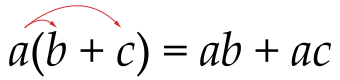
a times open bracket b plus c closed bracket equals a times b plus a times c.

where \(a\), \(b\), and \(c\) can be any monomials.

Distributive Property for Binomials


Example 1

Expand and simplify \((x+4)(x+1)\).


Example 2

Expand and simplify \((x-3)(3x-5)\).


Example 3

Expand and simplify \((x^2-2)(x^2+x)\).


Example 4

Expand and simplify \((5-a)(a+3)\).


Paused Finished
Slide /

Check Your Understanding 1


Expand and simplify the following expression.

\((((((p)*(o))*(l))*(y))*1.0)(((((p)*(o))*(l))*(y))*2.0)\)

Enter \(a^b\) as "\(a^{\wedge} b\)".

There appears to be a syntax error in the question bank involving the question field of this question. The following error message may help correct the problem:

null

Example 5

Expand and simplify \((3r+4)(2z-1)\).

Solution

Use the following Distributive Property steps:

  • Expand by multiplying each term in the first set of brackets by each term in the second set of brackets.
  • Add these products.
  • There are no like terms to collect in this example.

\(\begin{align*} (\class{hl1}{3r}+\class{hl2}{4})(\class{hl3}{2z}\class{hl4}{-1})&=\class{hl1}{3r}(\class{hl3}{2z})+\class{hl1}{3r}(\class{hl4}{-1})+\class{hl2}{4}(\class{hl3}{2z})+\class{hl2}{4}(\class{hl4}{-1})\\ &=6rz-3r+8z-4 \end{align*}\)

Example 6

Expand and simplify \((a+b)(2a-3b)\).

Solution

Use the following Distributive Property steps:

  • Expand by multiplying each term in the first set of brackets by each term in the second set of brackets.
  • Add these products by collecting like terms.
  • Remember that \(ab\) and \(ba\) are like terms.

\(\begin{align*} (\class{hl1}{a}+\class{hl2}{b})(\class{hl3}{2a}\class{hl4}{-3b})&=\class{hl1}{a}(\class{hl3}{2a})+\class{hl1}{a}(\class{hl4}{-3b})+\class{hl2}{b}(\class{hl3}{2a})+\class{hl2}{b}(\class{hl4}{-3b})\\ &=2a^2-3ab+2ba-3b^2\\ &=2a^2-3ab+2ab-3b^2\\ &=2a^2-ab-3b^2 \end{align*}\)

Example 7

Expand and simplify  \(5(2x-1)(x+1)\).

Solution

Notice the \(5\) in front of the two sets of brackets.

Approach 1

Use the Distributive Property between the two sets of brackets first, then distribute \(5\) into the simplified expression.

\(\begin{align*} & \quad \; 5(2x-1)(x+1)\\ &=5\Big((2x)(x)+2x(1)-1(x)-1(1)\Big)\\ &=5(2x^2+2x-x-1)\\ &=5(2x^2+x-1)\\ &=5(2x^2)+5(x)+5(-1)\\ &=10x^2+5x-5 \end{align*}\)

Approach 2

Distribute \(5\) into the first set of brackets, then use the Distributive Property between the two sets of brackets.

\(\begin{align*} & \quad \; 5(2x-1)(x+1)\\ &=\Big(5(2x)+5(-1)\Big)(x+1)\\ &=(10x-5)(x+1)\\ &=10x(x)+10x(1)-5(x)-5(1)\\ &=10x^2+10x-5x-5 \\ &=10x^2+5x-5 \end{align*}\)

Notice that we end up with the same simplified expression in both solutions. It is your choice which approach you use moving forward. It is often preferred to use Approach 1, where the Distributive Property is first used between the sets of brackets. Once like terms have been collected, the constant term can be multiplied in. This approach often makes the numbers and terms friendlier to work with.


Check Your Understanding 2


Expand and simplify the following expression.

\(((((c)*(o))*(n))*(s))*(tan(t))(((((p)*(o))*(l))*(y))*1.0)(((((p)*(o))*(l))*(y))*2.0)\)

Enter \(a^b\) as "\(a^{\wedge} b\)".

There appears to be a syntax error in the question bank involving the question field of this question. The following error message may help correct the problem:

null


Example 8

Expand and simplify \((m^2p+m)(mp-2p)\).

Solution

Use the following Distributive Property steps:

  • Expand by multiplying each term in the first set of brackets by each term in the second set of brackets. Remember to add exponents when multiplying powers with the same base.
  • Add these products. There are no like terms to collect in this example.

\(\begin{align*} (\class{hl1}{m^2p}+\class{hl2}{m})(\class{hl3}{mp}\class{hl4}{-2p})&=\class{hl1}{m^2p}(\class{hl3}{mp})+\class{hl1}{m^2p}(\class{hl4}{-2p})+\class{hl2}{m}(\class{hl3}{mp})+\class{hl2}{m}(\class{hl4}{-2p})\\ &=m^3p^2-2m^2p^2+m^2p-2mp \end{align*}\)

Example 9

Determine an expression for the area of the parallelogram using the formula \(A=bh\).

A parallelogram has a base of 7r+2v. The height is 3r+5v.

Solution

Use the Distributive Property to expand the brackets, then add these products by collecting like terms. Remember that \(rv \) and \(vr\) are like terms!

\(\begin{align*} A&=bh\\ &=(\class{hl1}{7r}+\class{hl2}{2v})(\class{hl3}{3r}+\class{hl4}{5v})\\ &=\class{hl1}{7r}(\class{hl3}{3r})+\class{hl1}{7r}(\class{hl4}{5v})+\class{hl2}{2v}(\class{hl3}{3r})+\class{hl2}{2v}(\class{hl4}{5v})\\ &=21r^2+35rv+6vr+10v^2\\ &=21r^2+41rv+10v^2 \end{align*}\)

The area of the parallelogram can be represented by the expression \(21r^2+41rv+10v^2\).  

We are familiar with area calculations that result in a numerical value.  In the previous example, we were given the base and the height written in terms of variables \(r\) and \(v\) so it follows that the area will be represented in terms of the same variables.


Check Your Understanding 3


Determine a simplified expression for the area of the parallelogram using the formula \(A=bh\).

(((((h)*(e))*(i))*(g))*(h))*(t) (((b)*(a))*(s))*2.718281828459045

Enter \(a^b\) as "\(a^{\wedge} b\)".

There appears to be a syntax error in the question bank involving the question field of this question. The following error message may help correct the problem:

null