Radicals
Recall
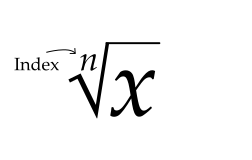
Recall from a previous lesson, when we have \(\sqrt[n]{x}\), the positive integer \(n\) (\(n\geq2\)), is called the index. When \(n=2\), we typically omit or don't write the index. And rather than say "square root," we often just say "root."
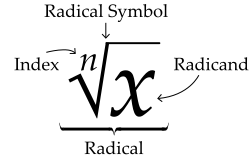
The number \(x\) is called the radicand. The symbol between the index and the radicand is called a radical symbol. And the whole expression, \(\sqrt[n]{x}\), is called a radical.
Mixed and Entire Radicals
There are two different ways that we can represent a radical.
An Entire Radical is a radical in the form \(\sqrt{x}\), where \(x\) is a positive integer.
A Mixed Radical is a radical in the form \(a\sqrt{x}\), where \(x\) is a positive integer and \(a\) is an integer where \(a\ne0,1\).
A mixed radical contains an integer part, not \(0\) or \(1\), and a radical part. The operation between \(a\) and \(\sqrt{x}\) is multiplication. You can think of an entire radical as being a mixed radical where \(a=1\).
How do we know that we have completely simplified a square root?
A radical has been simplified when it is written as a mixed radical.
We have simplified it when there is no perfect square (other than \(1\)) which is a factor of the radicand.
Simplifying Radicals
So far, the questions considered have evaluated nicely to whole-number answers like \(\sqrt{25} = 5.\)
You have likely realized that this will not always be possible.
While a radical such as \(\sqrt{18} \) does not evaluate to a whole number, it can be simplified. Before we learn how to do that, we need to recall two important facts.
Important Facts
Let's look at rules for power of a product and power of a quotient.
Recall
If \(x\) and \(y\) are positive real numbers, and \(n\) is any real number, then we having the following:
- The power of a product is the product of the powers. That is, the exponent \(n\) is applied to both the \(x\) and the \(y\). We get\[(xy)^n=x^ny^n \]
- Likewise, for the power of a quotient, we have\[\left(\dfrac{x}{y}\right)^n=\dfrac{x^n}{y^n}\]
Look specifically at the following example with an exponent of \(\dfrac{1}{2}\), which we know can be expressed as a square root.
Since \((xy)^{\frac{1}{2}}=x^{\frac{1}{2}}y^{\frac{1}{2}}\) and \(x^{\frac{1}{2}}=\sqrt{x}\), then \(\sqrt{xy}=\sqrt{x}\times\sqrt{y}\).
Let's return to the example of simplifying \(\sqrt{18} \) to see why the two exponent rules are useful in simplifying radicals.
Example 3
Solution
Approach 1
First, we recall that square root is equivalent to writing the exponent \(\dfrac{1}{2}\).
\( \sqrt{18} = 18^{\frac{1}{2}}\)
Next, we express \(18\) as the product of \(9 \times 2\). Why \(9\) and \(2\)? Why not \(3\) and \(6\)? The answer should become clear as we progress.
\(\begin{align*} \sqrt{18} &= 18^{\frac{1}{2}}\\ &= (9 \times 2)^{\frac{1}{2}} \end{align*}\)
Now we apply the power of a product exponent rule. Then, rewriting the exponent form back as square roots, we get
\(\begin{align*} \sqrt{18} &= 18^{\frac{1}{2}}\\ &= (9 \times 2)^{\frac{1}{2}} \\ &= 9^{\frac{1}{2}} \times 2^{\frac{1}{2}} \\ &= \sqrt{9} \times \sqrt{2} \\ &= 3 \times \sqrt{2} \\ &= 3\sqrt{2} \end{align*}\)
So why did we choose to express \(18\) as \(9 \times 2\) and not, say, \(6 \times 3\)?
The key to simplifying square roots is to find a factor of the radicand, \(18\) in our example, which is a perfect square and take the principal square root of this value.
Now that we have seen how the exponent rule helps us to simplify the radical, we can streamline our solution as seen in Approach 2.
Approach 2
\(\begin{align*} \sqrt{18} &= \sqrt{9 \times 2} \\ &= \sqrt{9} \times \sqrt{2} \\ &= 3 \sqrt{2} \end{align*}\)
In this example, \(\sqrt{18}\) is an entire radical and \(3\sqrt{2}\) is a mixed radical.
Example 4
Solution
The word simplify indicates that we need to express this entire radical as a mixed radical.
Approach 1
We could think of \(192\) as \(4 \times 48\). Take the principal square root of \(4\), and we have
\(\begin{align*} \sqrt{192} &= \sqrt{4 \times 48} \\ &= \sqrt{4} \times \sqrt{48} \\ &= 2 \sqrt{48} \end{align*}\)
But we can write \(48\) as \(4 \times 12\), which means we will have
\(\begin{align*} 2 \sqrt{48} &= 2\sqrt{4 \times 12} \\ &= 2 \times 2 \sqrt{12} \\ &= 4 \sqrt{12} \end{align*}\)
We can keep going, since \(12\) can be written as \(4 \times 3\). Therefore, we have
\(\begin{align*} 4 \sqrt{12} &= 4 \sqrt{4 \times 3} \\ &= 4 \times 2\sqrt{3}\\ &= 8\sqrt{3} \end{align*}\)
Is there a more efficient way to simplify this radical? Yes. We can find the largest perfect square that is a factor of \(192\).
Consider Approach 2, where we start by rewriting \(192\) as \(64 \times 3\).
Approach 2
Take the principal square root of \(64\) and get
\(\begin{align*} \sqrt{192} &= \sqrt{64 \times 3} \\ &= \sqrt{64} \times \sqrt{3} \\ &= 8\sqrt{3} \end{align*}\)
We can see from these two solutions that it is in our best interests to take a little time to try to find the largest perfect square that is a factor of the radicand.
How do we know we have completely simplified the square root?
We have simplified it when there is no perfect square (other than \(1\)) which is a factor of the radicand.
Example 5
Simplify \(\sqrt[3]{54}\).
Solution
Just as perfect square factors are key to simplifying square roots, perfect cube factors are key to simplifying cube roots. In this example, we are hoping to find a factor of \(54\), which is a perfect cube.
We might begin by trying \(2^3 = 8\) and recognize that it is not a factor of \(54\).
The next largest perfect cube is \(3^3 = 27\), which is a factor of \(54\).
We proceed by applying our exponent rules as before to separate the principle cube root of \(27\) and the cube root of \(2\). We can simplify cube root \(54\) to
\(\begin{align*} \sqrt[3]{54} &= \sqrt[3]{27\times2}\\ &=\sqrt[3]{27}\times\sqrt[3]{2} \\ &=3\sqrt[3]{2} \end{align*}\)
We may use this same technique to simplify fourth roots, fifth roots, and any \(n\)th root.
Check Your Understanding 1
Question
Simplify \(\sqrt{343}\)
Answer
\(7 \sqrt{7}\)
Feedback
\(\begin{align*} \sqrt{343} &= \sqrt{49 \times 7} \\ &= \sqrt{49} \times \sqrt{7} \\ &= 7\sqrt{7} \end{align*}\)
Example 6
Express \(5\sqrt{3}\) as an entire radical.
Solution
In this example, we need to change the mixed radical to an entire radical. It is sometimes useful to represent radicals as an entire radical, in particular when we are comparing their values, as you'll see in a later example.
To do this, we can take the steps that we have been following to write an entire radical as a mixed radical and use them in reverse.
Begin by writing \(5\) as \(\sqrt{25}\). We then can write \(\sqrt{25 \times 3}\) under the root sign and multiply to get
\(\begin{align*} 5\sqrt{3} &=\sqrt{25}\times\sqrt{3}\\ &=\sqrt{25\times3} \\ &=\sqrt{75} \end{align*}\)
\(5\sqrt{3}\) and \(\sqrt{75}\) are equivalent radicals. They have just been represented in different forms.