Prime Factorization


Slide Notes

Glossary

All Slides

Factor Trees 

We will now look at writing composite numbers as a product of primes.


Example 5 — Part A

Write each of the following as a product of primes.

  1. \(24\)
  2. \(72\)
  3. \(250\)


Example 5 — Part A Continued

Write each of the following as a product of primes.

  1. \(24\)
  2. \(72\)
  3. \(250\)

Solution 2 — Part A

Create a factor tree.


Example 5 — Part B

Write each of the following as a product of primes.

  1. \(24\)
  2. \(72\)
  3. ​​​​\(250\)

Solution — Part B

Create a factor tree.


Example 5 — Part C

Write each of the following as a product of primes.

  1. \(24\)
  2. \(72\)
  3. \(250\)

Solution — Part C

Create a factor tree.

Paused Finished
Slide /

Check Your Understanding 2


There appears to be a syntax error in the question bank involving the question field of this question. The following error message may help correct the problem:
null


Try This Revisited

Determine the values of the integers \(x\), \(y\), and \(z\) such that \(2^x\times3^y\times7^z=49~392\).

Solution

Since \(2\), \(3\), and \(7\) are all prime, we can look for the prime factorization of \(49~392\). Begin by creating a factor tree for \(49~392\). Since \(49~392\) is even, it is divisible by \(2\).

See adjacent alternative format.

  • \(49~392\) can be written as \(2\) times \(24~696\).
  • \(24~696\) can be written as \(2\) times \(12~348\).
  • \(12~348\) can be written as \(2\) times \(6174\).
  • \(6174\) can be written as \(2\) times \(3087\).
  • \(3087\) can be written as \(3\) times \(1029\).
  • \(1029\) can be written as \(3\) times \(343\).
  • \(343\) can be written as \(7\) times \(49\).
  • \(49\) can be written as \(7\) times \(7\).

The prime factorization is \(49~392=2^4\times3^2\times7^3\). We are asked to find values of the integers \(x\), \(y\), and \(z\) such that \(2^x\times3^y\times7^z=49~392\). We can see that

\(2^x\times3^y\times7^z=2^4\times3^2\times7^3\)

Therefore, \(x=4\), \(y=2\), and \(z=3\).


Check Your Understanding 3


What is the prime factorization of the integer \(((((((((n)*(N))*(o))*(C))*(o))*(m))*(m))*(a))*(s)\)?

Enter \(a^b \times c^d \times e^f\) as "\(a^{\wedge} b ^{\ast} c^{\wedge} d ^{\ast} e^{\wedge} f\)".

The prime factorization of \(((((((((n)*(N))*(o))*(C))*(o))*(m))*(m))*(a))*(s)\) is There appears to be a syntax error in the question bank involving the question field of this question. The following error message may help correct the problem:

null

.

Prime Factors of Perfect Squares

Let's turn our focus to the prime factorization of perfect squares.

Example 6

Determine the prime factorization of the following perfect squares:

  1. \(16\)
  2. \(25\)
  3. \(400\)

Solution — Part A

Create a factor tree.
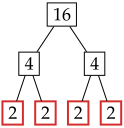
A factor tree is given with 16 is written as 4 times 4. Each 4 is written as 2 times 2.

The prime factorization is

\( 16=2\times2\times2\times2\)

or

\(16=2^4\)

Solution — Part B

Create a factor tree.

A factor tree is given with 25 written as 5 times 5.

The prime factorization is

\( 25=5\times5\)

or

\(25=5^2\)

Solution — Part C

Create a factor tree.
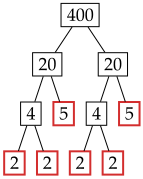
A factor tree is constructed. 400 is written as 20 times 20. Each 20 is written as 4 times 5. Each 4 is written as 2 times 2.

The prime factorization is

\( 400=2\times2\times5\times2\times2\times5\)

or

\(400=2^4\times5^2\)

Let's take a closer look at the prime factorization of these perfect squares:

\(16=2^4\)

\(25=5^2\)
\(400=2^4\times5^2\)

What do you notice about the exponents of the prime factors?

The prime factors of a perfect square occur an even number of times.

This makes sense because perfect squares are made up of two identical numbers multiplied together, so whatever prime factors occur in the square root of the perfect square, will appear again when the root is multiplied by itself.

Example 7

Determine the smallest value of the positive integer \(k\) so that \(N=3^3\times5\times k\) is a perfect square.

Solution

We know that the exponents of the prime factors of a perfect square must be even.

For \(N=3^3\times5\times k\) to be a perfect square, the exponent having a base of \(3\) and the exponent having a base of \(5\) must each be even.

\(N\) includes \(3^3\), therefore \(k\) must include one factor of \(3\) so that \(N\) has a factor of \(3^4\).

Similarly, \(k\) must include one factor of \(5\).

Therefore, \(k=3\times5 \) or \(k=15\).

Example 8

Determine the smallest value of the positive integer \(m\) so that \(N=2400m\) is a perfect square.

Solution

We know that the exponents of the prime factors of a perfect square must be even. In this example, we cannot see the prime factors of \(2400\). Begin by rewriting \(N\) using the prime factors of \(2400\):

\(N=2^5\times3\times5^2\times m\)

For \(N=2^5\times3\times5^2\times m\) to be a perfect square, the exponents having bases of \(2,\) \(3\) and \(5\) must be even. We are given \(2^5\), so \(m\) must include one factor of \(2\) so that \(N\) contains \(2^6\). It must also contain one factor of \(3\) so that \(N\) contains \(3^2\).

Therefore, \(m=2\times3 \) or \(m=6\).


Check Your Understanding 4