- This is Problem 3a from the 2007 Euclid Contest.
The first term of a sequence is \(2007\). Each term, starting with the second, is the sum of the cubes of the digits of the previous term. What is the \(2007\)th term?
- Consider the type of sequence known as a Hailstone sequence.
The first term in the sequence, \(t_1\), can be any positive whole number.
The rest of the terms in the sequence are generated as follows (based on the preceding term):
- If \(t_n=1\), the sequence ends.
- If \(t_n\) is even, the next term in the sequence is \(t_{n+1}=\dfrac {t_n}2\).
- If \(t_n\) is odd, the next term in the sequence is \(t_{n+1}=3t_n+1\).
- Generate the Hailstone sequence that begins with \(t_1=12\).
- Generate the Hailstone sequence that begins with \(t_1=113\).
- Generate the shortest Hailstone sequence that begins with an odd number (other than \(1\)).
- This is Problem B2 from the 2011 Canadian Intermediate Mathematics Contest.
A pattern of figures is shown below. Figure 1 is a regular pentagon with side length \(\)\(1\). Figure 2 is a regular pentagon of side length \(2\) drawn around Figure 1 so that the two shapes share the top vertex, \(T\), and the sides on either side of \(T\) overlap.
Figure 1 — Ink length: 5
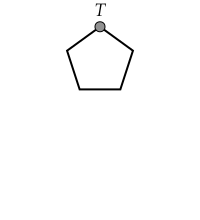
Figure 2 — Ink length: 13
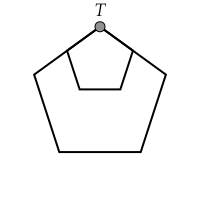
Figure 3 — Ink length: 24
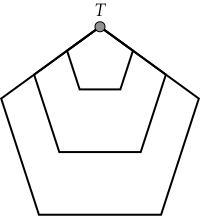
The pattern continues so that for each \(n \gt 1\), Figure \(n\) is a regular pentagon of side length \(n\) drawn around the previous figure so that the two shapes share the top vertex, \(T\), and the sides on either side \(T\) overlap.
The ink length of each figure is the sum of the lengths of all of the line segments in the figure.
- Determine the ink length of Figure 4.
- Determine the difference between the ink length of Figure 9 and the ink length of Figure 8.
- Determine the ink length of Figure 100.
- This is Problem B2 from the 2016 Canadian Intermediate Mathematics Contest.
In the list of positive integers \(1,~3,~9,~4,~11\), the positive differences between each pair of adjacent integers in the list are \(3-1=2\), \(9-3=6\), \(9-4=5\), and \(11-4=7\). In this example, the smallest positive difference between any two adjacent integers in the list is \(2\).
- Arrange the integers \(1,~2,~3,~4,~5\) so that the smallest positive difference between any two adjacent integers is \(2\).
- Suppose that the twenty integers \(1,~2,~3,\ldots,18,~19,~20\) are arranged so that the smallest positive difference between any two adjacent integers is \(N\).
- Explain why \(N\) cannot be \(11\) or larger.
- Find an arrangement with \(N=10\). Note: Parts i) and ii) together prove that the maximum possible value of \(N\) is \(10\).
- Suppose that the twenty-seven integers \(1,~2,~3,\ldots,25,~26,~27\) are arranged so that the smallest positive difference between any two adjacent integers is \(N\). What is the maximum possible value of \(N\)? Prove that your answer is correct.
- This is Problem A5 from the 2014 Canadian Intermediate Mathematics Contest.
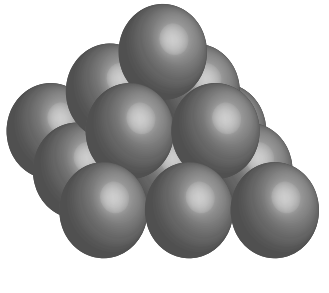
Scott stacks golf balls to make a pyramid. The first layer, or base, of the pyramid is a square of golf balls and rests on a flat table. Each golf ball, above the first layer, rests in a pocket formed by four golf balls in the layer below (as shown in Figure 1). Each layer, including the first layer, is completely filled. For example, golf balls can be stacked into a pyramid with \(3\) levels, as shown in Figure 2. The four triangular faces of the pyramid in Figure 2 include a total of exactly \(13\) different golf balls. Scott makes a pyramid in which the four triangular faces include a total of exactly \(145\) different golf balls. How many layers does this pyramid have?
Figure 1
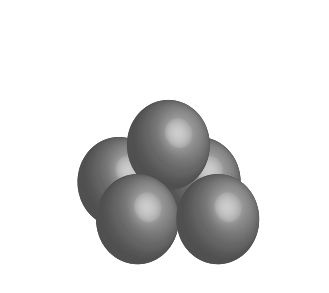
Figure 2
- This is Problem 7a from the 2006 Euclid Contest.
The sequence \(2, ~5, ~10, ~50, ~500, \ldots\) is formed so that each term after the second is the product of the two previous terms. The \(15\)th term ends with exactly \(k\) zeros. What is the value of \(k\)?