Let's do another example involving the general term of a sequence.
Example 9
Determine and graph the first five terms of the sequence \(t_n=7-3n\).
Solution
We can determine the first five terms of the sequence by substituting the term numbers 1 to 5 into the general term, \(t_n=7-3n\).
\(\begin{align*}t_1 &= 7-3(1) \\ &= 4\end{align*}\)
\(\begin{align*} t_2 &= 7-3(2) \\ &= 1 \end{align*}\)
\(\begin{align*} t_3 &= 7-3(3) \\ &= -2 \end{align*}\)
\(\begin{align*} t_4 &= 7-3(4) \\ &= -5 \end{align*}\)
\(\begin{align*} t_5 &= 7-3(5) \\ &= -8 \end{align*}\)
These five terms produce a graph consisting of five points:
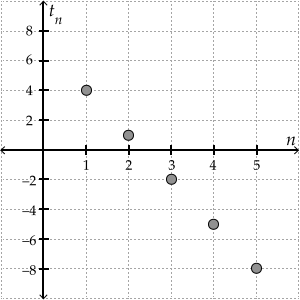
Note that if we were to graph the entire sequence, the graph would consist of infinitely many more points.
Comparing \(t_n\) and \(f(x)\)
Here is a more extended look at the graph of the sequence \(t_n=7-3n\). Let's compare it to the graph of the linear function \(f(x)=7-3x\).
Graph of \(t_n=7-3n\)
-1.svg)
Graph of \(f(x)=7-3x\)
-2.svg)
Both algebraic representations are almost identical. And the graphs are very similar, as well. You may notice that all of the points that lie on the graph of the sequence also lie on the graph of the line. In fact, the graph of the sequence is just a subset of the graph of the linear function, where the values of \(x\) can only be positive whole numbers or natural numbers. That is, \(x \in \mathbb{N}\). So, in fact, we can represent the sequence \(t_n=7-3n\) with the function \(f(x)=7-3x\), as long as we restrict the domain to the natural numbers.
Graph of \(t_n=7-3n\)
\(f(x)=7-3x\), with domain \(x \in \mathbb{N}\)
Graph of \(f(x)=7-3x\)
Domain: \(x \in \mathbb{R}\)
The graph of \(f(x)=7-3x\) appears different because, for the linear function, the domain has not been restricted. It consists of all the real numbers. The other function, \(f(x)=7-3x\), \(x \in \mathbb{N}\), is an example of a discrete function.
Discrete Functions
A discrete function is a function whose domain consists of a particular set of numbers that can be listed, such as the set of natural numbers \(\mathbb{N}\).
Graphs of discrete functions consist of distinct points (that are not connected).
Another example of a discrete function is the function \(f(x)=2(x-1)(x-3)\), where \(x \in \mathbb{N}\). Here we can see the points on its graph, which are limited to points with positive whole number values of \(x\). Compare this to the graph of a function that is not discrete, the function \(f(x)=2(x-1)(x-3)\), where \(x \in \mathbb{R}\).
Discrete Function
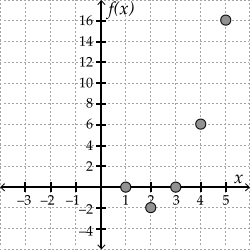
\(f(x)=2(x-1)(x-3)\), where \(x \in \mathbb{N}\)
Not a Discrete Function
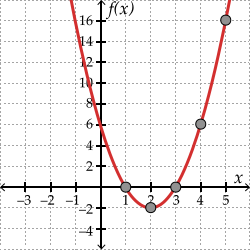
\(f(x)=2(x-1)(x-3)\), where \(x \in \mathbb{R}\)
All of the points on the discrete function are part of the graph of \(f(x)=2(x-1)(x-3)\) as well, but a parabola is drawn through them since there are no restrictions on \(x\).
Sequences as Discrete Functions
As we saw earlier, sequences can be represented as discrete functions where \(x\) represents the term number and \(f(x)\) represents the corresponding term in the sequence.
The domain of the function will be the set of natural numbers, \(\mathbb{N}=\{1, 2, 3, 4, \dots \}\) (for an infinite sequence) or a sub-set of the natural numbers (for a finite sequence).
This gives us another way to represent a sequence algebraically, in addition to a recursion formula or a general term. Although the discrete function is directly related to the general term, in fact, it's quite straightforward to represent a sequence in function notation, if we already know or are given the general term, \(t_n\).
To represent a sequence in function notation, given the general term, \(t_n\):
- Replace \(n\) with \(x\) and replace \(t_n\) with \(f(x)\).
- Remember to restrict the domain of \(f(x)\) to the natural numbers. \(\)
For example, the sequence represented by \(t_n=\dfrac n{n+7}\) can also be represented by \(f(x)=\dfrac x{x+7}\), \(x \in \mathbb{N}\).
Example 10
Represent each sequence algebraically, using both a general term and function notation.
- \(1,~\sqrt 2,~\sqrt 3,~2,~\sqrt 5,\dots\)
- \(5,~\dfrac52,~\dfrac53,~\dfrac54,~1,~\dfrac56,\dots\)
Solution — Part A
To write a general term, we need to be able to relate each term directly to the term number. When looking at the numbers in the sequence, we notice that some of the terms include square roots. It would be nice to write all of the terms with the square root for consistency. And in fact, we can do this.
The first term, \(1\), is equal to \(\sqrt{1}\). And the fourth term, \(2\), is equal to \(\sqrt{4}\).
The sequence can be rewritten with these square roots included:
\(\sqrt1,~\sqrt 2,~\sqrt 3,~\sqrt4,~\sqrt 5,\dots\)
Each term is obtained by taking the square root of the term number. This means that the general term is
\(t_n=\sqrt n\)
We can also write this as the discrete function
\(f(x)=\sqrt x\), where \(x \in \mathbb{N}\)
Solution — Part B
Again, we need to find a relationship between each term and the term number. In this sequence, many of the terms are fractions with a \(5\) in the numerator. It turns out that we can write the other terms in this form as well.
The first term, \(5\), is equal to \(\dfrac{5}{1}\), and the fifth term, \(1\), is equal to \(\dfrac{5}{5}\).
So we can rewrite the sequence so that every term is a fraction, and we notice that the sequence can be re-written as
\(\dfrac51,~\dfrac52,~\dfrac53,~\dfrac54,~\dfrac55,~\dfrac56,\dots\)
Each term is \(5\) divided by the term number.
The general term is
\(t_n=\dfrac5n\)
Using function notation, we represent this as
\(f(x)=\dfrac5x\), where \(x \in \mathbb{N}\)