Explore This 1 Summary
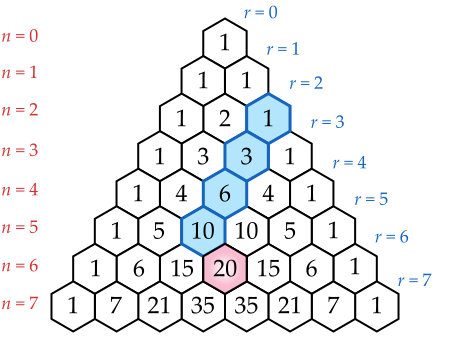
In Explore This 1, perhaps you were able to discover the Hockey Stick pattern. Here is one example of the Hockey Stick pattern (so named because the highlighting resembles a hockey stick):
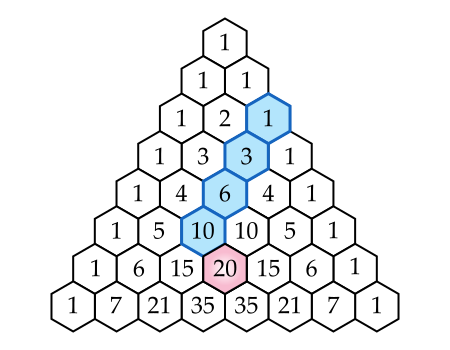
If you add the first four entries in column \(r=2\) (recall that the column numbering starts at \(r=0\)), then the sum is equal to the value of the entry that completes the shape of a hockey stick. In this case \(1+3+6+10=20\).
The Hockey Stick Pattern
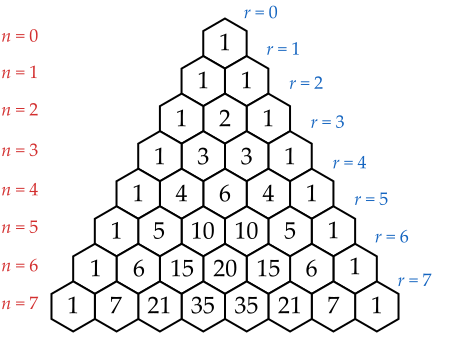
Previously, we have written the entries of Pascal's triangle as \(C(n,r)\) where \(n\) is the row number (beginning at \(n=0\)) and \(r\) is the column number (beginning at \(r=0\)).
The Hockey Stick pattern states that for any non-negative integers \(r \) and \(n\) with \(n \ge r\):
\(C(r,r)+C(r+1,r)+C(r+2,r)+\cdots+C(n,r) = C(n+1,r+1)\)
For example, with \(r=2\) and \(n=5\), we have:
\(\begin{align*} C(2,2)+C(3,2)+C(4,2)+C(5,2)&=C(6,3)\\[5px] 1+3+6+10&=20 \end{align*}\)
These terms appear in Pascal's triangle in a pattern resembling a hockey stick: