Example 5
Compare the amount of interest earned on a \($20~000\) investment at an annual interest rate of \(4.5\%\) over \(10\) years, if interest is compounded:
- annually
- semi-annually
- quarterly
- monthly
Solution
For all four of the scenarios, the principal invested is \(P=20~000\).
Part A — Compounded Annually
The investment has an accumulated value of \($31~059.39\).
- Interest earned over \(10\) years:
\(31~059.39-20~000= 11~059.39\)
- The total amount of interest is \($11~059.39\).
Part B — Compounded Semi-Annually
The investment has an accumulated value of \($31~210.18\).
- Interest earned over \(10\) years:
\(31~210.18-20~000= 11~210.18\)
- The total amount of interest is \($11~210.18\).
Part C — Compounded Quarterly
The investment has an accumulated value of \($31~287.54\).
- Interest earned over \(10\) years:
\(31~287.54-20~000= 11~287.54\)
- The total amount of interest is \($11~287.54\).
Part D — Compounded Monthly
The investment has an accumulated value of \($31~339.86\).
- The total amount of interest is \($11~339.86\).
Here is a summary of the total interest earned on an investment of \($20~000\) at an annual interest rate of \(4.5\%\) over \(10\) years, at different compounding periods:
| Compounding Frequency |
Annually |
Semi-Annually |
Quarterly |
Monthly |
| Interest Rate per Compounding Period |
\(4.5\%\) |
\(2.25\%\) |
\(1.125\%\) |
\(0.375\%\) |
| Number of Compounding Periods |
\(10\) |
\(20\) |
\(40\) |
\(120\) |
| Total Interest Earned |
\($11~059.39\) |
\($11~210.18\) |
\($11~287.54\) |
\($11~339.86\) |
The investment will earn the least interest if interest is compounded annually, and it will earn the most interest if interest is compounded monthly.
When interest is compounded more frequently at the same annual rate over the same length of time, more interest is earned in total.
Example 6
What annual interest rate, compounded annually, is equivalent to an annual interest rate of \(6\%\), compounded monthly? Check your answers by graphing.
Solution
If the two interest rates are equivalent, the same amount of principal, \(P\), invested for the same length of time, should accumulate to the same value under both compounding periods.
Consider a one-year investment.
For an investment at \(6\%\), compounded monthly:
- \(\dfrac{6\%}{12}=0.5\%\), so \(i=0.005\).
- There are \(12\) compounding periods, so \(n=12\).
- \(A=P(1.005)^{12}\)
For an investment at the unknown interest rate, \(i\), compounded annually:
- There is only one compounding period, \(\)so \(n=1\) and the interest rate \(i\) is not divided.
- \(A=P(1+i)^1\), or \(A=P(1+i)\)
Since both investments should accumulate to the same value:
\[P(1.005)^{12}=P(1+i)\]
This equation can be solved for \(i\). Divide both sides of the equation by \(P\):
\((1.005)^{12}=1+i\), or \(1+i=(1.005)^{12}\)
So \(i=(1.005)^{12}-1\), or \(i \approx 0.0617\).
Therefore, an annual interest rate of approximately \(6.17\%\), compounded annually, is equivalent to an annual interest rate of \(6\%\), compounded monthly.
Check by Graphing
Let's compare these two interest rates by comparing the graphs of these two investments.
Consider a principal investment of \($100\) at both of these interest rates: \(6\%\) compounded monthly and \(6.17\%\) compounded annually.
Here is the graph of the exponential function \(f(x)=100(1.005)^x\).
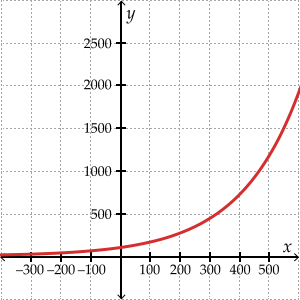
\(f(x)=100(1.005)^x\) represents an investment of \($100\), at an annual interest rate of \(6\%\) compounded monthly, where \(x\) represents the number of months.
Here is the graph of the exponential function \(g(x)=100(1.0617)^x\).
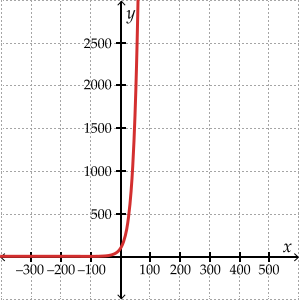
\(g(x)=100(1.0617)^x\) represents an investment of \($100\), at an annual interest rate of \(6.17\%\) compounded annually, where \(x\) represents the number of years.
Although these monthly and annual interest rates are equivalent, these graphs are very different. However, remember that for \(f(x)\), \(x\) represents the number of months, while for \(g(x)\), \(x\) represents the number of years. \(x=100\) on the first graph does not represent the same time period as \(x=100\) on the second graph. Let's adjust the scales and compare the graphs again, keeping in mind that \(12\) months is equal to \(1\) year.
Here is the graph of the exponential function \(f(x)=100(1.005)^x\).
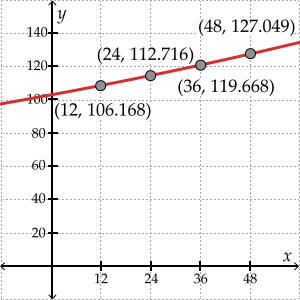
\(f(x)=100(1.005)^x\) represents an investment of \($100\), at an annual interest rate of \(6\%\) compounded monthly, where \(x\) represents the number of months.
Here is the graph of the exponential function \(g(x)=100(1.0617)^x\).
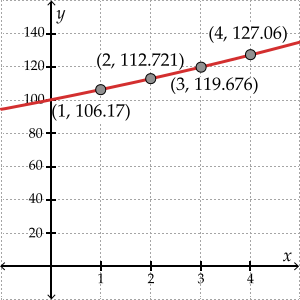
\(g(x)=100(1.0617)^x\) represents an investment of \($100\), at an annual interest rate of \(6.17\%\) compounded annually, where \(x\) represents the number of years.
For \(f(x)\), the value of the investment after one year is given by \(f(12)\) (since \(x\) is in months). From the graph, we can see that \(f(12)=106.17\), meaning the investment has a value of \($106.17\) after \(1\) year.
For \(g(x)\), the value of the investment after one year is given by \(g(1)\) (since \(x\) is in years). From the graph, we can see that \(g(1)=106.17\), meaning that the investment also has a value of \($106.17\) after \(1\) year with this interest rate.
Similarly, \(f(24)=112.72\) and \(g(2)=112.72\). Both represent the value of the investment after \(2\) years (or \(24\) months). The same type of comparison can be made for \(f(36)\) and \(g(3)\), and for \(f(48)\) and \(g(4)\). The values are almost identical, although they are not exactly the same because the interest rate \(6.17\%\) has been rounded.
However, we can see from the graphs that an annual interest rate of \(6\%\), compounded monthly, is approximately equivalent to an annual interest rate of \(6.17\%\), compounded annually.