In addition to all of the techniques discussed in this lesson, problems involving compound interest can also be solved using a TVM Solver.
Using a TVM Solver
A TVM Solver (or "Time Value of Money" Solver) is a feature found on some graphing calculators, on financial calculators, or online. It can be used to solve problems involving compound interest.
The TVM solver we will use in this lesson looks similar to those found on a graphing calculator. There are typically seven values to consider - if you enter six of them, the TVM solver will be able to calculate the seventh. A TVM solver is typically used for calculations relating to annuities (which you will see in a later lesson); however, we can also use it for simpler compound interest questions.
For compound interest, use the TVM solver as follows:
- \(N\) represents the number of years (note the difference from \(n\)).
- \(I\%\) represents the yearly interest rate. It is entered as a percent, not as a decimal.
- \(PV\) represents the present value.
- \(PMT\) is left equal to \(0\) for this lesson.
- \(FV\) represents the future value.
- \(P/Y\) is left equal to \(1\).
- \(C/Y\) represents the number of compounding periods in a year.
On a TVM solver:
For an investment, \(PV\) is entered or displayed as a negative value, while \(FV\) is entered or displayed as a positive value. This is because at the start of an investment, you are paying money into an investment, while at the end of the investment you are receiving money back.
For a loan, \(PV\) is entered or displayed as a positive value, while \(FV\) is entered or displayed as a negative value. This is because at the start of a loan, the lender pays you, while at the end of the loan, you pay the lender.
In this last example, we will solve for the number of compounding periods, both by graphing, and by using a TVM solver.
Example 11
How long does it take for an investment to triple, at an annual interest rate of \(7.2\%\), compounded monthly?
Solution
- The investment triples if \(A=3P\).
- \(\dfrac{7.2\%}{12}=0.6\%\), so \(i=0.006\).
- \(n\) is unknown.
Method 1: Set up an equation and solve by graphing
Substitute into the compound interest formula:
\(\begin{align*} A &= P(1+i)^n \\ 3P &= P (1.006)^n\end{align*}\)
Dividing both sides by \(P\) gives \((1.006)^n=3\). This is an equation that we can solve by graphing.
Consider the graph of \(f(x)=(1.006)^x\) and find the point that has a \(y\)-coordinate of \(3\). Remember that any points found using graphing technology will likely have been rounded.
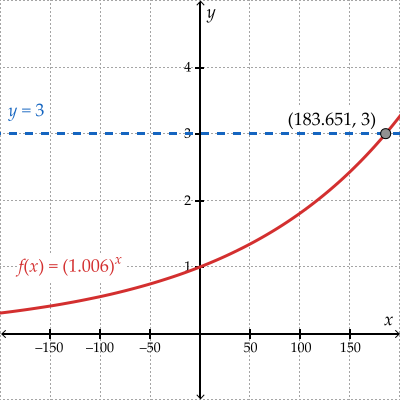
The point \((183.651, 3)\) approximately lies on \(f(x)=(1.006)^x\), which means that \((1.006)^{183.651}\approx3\).
Thus, the solution to the equation \((1.006)^n=3\) is \(n \approx 183.651\). This is the number of months it takes for the investment to triple.
Divide by \(12\) to determine the number of years: \(\dfrac{183.651}{12}\approx 15.3\)
Therefore, it takes approximately \(15.3\) years (or \(15\) years, \(4\) months) for an investment to triple at an annual interest rate of \(7.2\%\), compounded monthly.
\(\)Method 2: Use a TVM solver
We need to decide which values to enter into the TVM solver.
We are not given a present value, but the solution will be the same for any size of investment.
So let's pick an amount of principal, say \($100\), and calculate how long it takes for it to triple to \($300\).
Then, here are the values that need to be entered into the solver:
- Nothing for \(N\), since that is what we are trying to find.
- \(I\%=7.2\) (Recall that this input is always the annual interest rate).
- \(PV=-100\) (Negative, since we would pay \($100\) into the investment).
- \(FV=300\) (Positive, since at the end of the investment we would receive \($300\) back).
- \(C/Y=12\) (Interest is compounded monthly, so \(12\) times per year).
\(PMT\) and \(P/Y\) are not used, so the values in the solver should not be changed.
- \(\texttt{N=0}\)
- \(\texttt{I%=7.2}\)
- \(\texttt{PV=-100}\)
- \(\texttt{PMT=0}\)
- \(\texttt{FV=300}\)
- \(\texttt{P/Y=1}\)
- \(\texttt{C/Y=12}\)
- \(\texttt{PMT: }\class{PMT}{\texttt{END}} \texttt{ BEGIN}\)
Now we use the TVM solver to determine the value for \(N\). The calculator will now display that value.
- \(\texttt{N=15.3}\)
- \(\texttt{I%=7.2}\)
- \(\texttt{PV=-100}\)
- \(\texttt{PMT=0}\)
- \(\texttt{FV=300}\)
- \(\texttt{P/Y=1}\)
- \(\texttt{C/Y=12}\)
- \(\texttt{PMT: }\class{PMT}{\texttt{END}} \texttt{ BEGIN}\)
The display indicates that \(N=15.3\). Recall that this is the number of years, and it is consistent with the answer we obtained by graphing.
It turns out that a TVM solver can help us find any of \(PV\), \(FV\), \(N\), or \(I\%\) if we know the values of the other three (and the number of compounding periods per year). Although it is important to know how to use the algebraic or graphical techniques discussed in this lesson, a TVM solver is a quick way to check your answers!