Alternative Format — Lesson 4: Compound Interest

Let's Start Thinking

Compound Interest

Compound interest is something that you've likely already encountered and will certainly continue to deal with throughout your life.

Compound interest applies to:

  • bank accounts,
  • investments,
  • loans, and
  • credit card balances.

Like simple interest, compound interest increases the value of sums of money over time. However, this is more desirable in some situations than others. We're typically happy when we earn more interest on our bank accounts and investments, and less happy when we are charged a lot of interest on loans and on our credit card bills.

Understanding how compound interest works helps us with the following

  • Use compound interest to our advantage.
  • Make better, more informed decisions regarding investments and loans.

In this lesson, we'll try to gain a better understanding of compound interest by investigating its effect in many different contexts.


Lesson Goals

  • Define compound interest and compare it to simple interest.
  • Develop and use a formula for compound interest.
  • Connect compound interest, geometric sequences, and exponential growth.
  • Calculate the future value, present value, or interest rate algebraically, in contexts with varying compounding periods.
  • Calculate the number of compounding periods graphically.

Try This

\($10~000\) is invested at a rate of \(5\%\) per year. At the end of each year, the interest is added to the account and the total amount is re-invested for the next year (still at a rate of \(\)\(5\%\)). What is the value of the investment after four years? 


Introduction to Compound Interest


Compound interest is earned when interest is re-invested.  That is, interest is earned on both the principal (i.e., the amount that was originally invested) and any interest that has already accumulated.

This can be contrasted with simple interest, in which interest is earned on the principal only. 


Explore This 1

Description

The following examples show how much money accumulates over time when \($500\) is invested at various interest rates using simple and compound interest.  A graph and table of values are provided to show the accumulated values over time. From this, consider what is the difference between simple and compound interest?

Example 1: \(i=1.5\%\)

Graph of \(A=500(1.015)^n\):

A graph with Time in years along the x-axis and Accumulated value in dollars along the y with an interest rate of 1.5%.

Table of \(A=500(1.015)^n\):

Year \((n)\) Compound Interest (\($\)) Accumulated Value (\($\)) Simple Interest Accumulated Value
\(0\)   \(500\)   \(500\)
\(5\) \(530.68(0.015)=7.96\) \(538.64\) \(500(0.015)=7.50\) \(537.50\)
\(10\) \(571.69(0.015)=8.58\) \(580.27\) \(500(0.015)=7.50\) \(575.00\)
\(15\) \(615.88(0.015)=9.24\) \(625.12\) \(500(0.015)=7.50\) \(612.50\)
\(20\) \(663.48(0.015)=9.24\) \(673.43\) \(500(0.015)=7.50\) \(650.00\)
\(25\) \(714.75(0.015)=10.72\) \(725.47\) \(500(0.015)=7.50\) \(687.50\)

Example 2: \(i=6\%\)

Graph of \(A=500(1.06)^n\):

A graph with Time in years along the x-axis and Accumulated value in dollars along the y with an interest rate of 1.5%.

Table of \(A=500(1.06)^n\):

Year \((n)\) Compound Interest (\($\)) Accumulated Value (\($\)) Simple Interest Accumulated Value
\(0\)   \(500\)   \(500\)
\(5\) \(631.24(0.06)=37.87\) \(669.11\) \(500(0.06)=30.00\) \(650.00\)
\(10\) \(844.74(0.06)=50.68\) \(895.42\) \(500(0.06)=30.00\) \(800.00\)
\(15\) \(1130.45(0.06)=67.83\) \(1198.28\) \(500(0.06)=30.00\) \(950.00\)
\(20\) \(1512.80(0.06)=90.77\) \(1603.57\) \(500(0.06)=30.00\) \(1100.00\)
\(25\) \(2024.47(0.06)=121.47\) \(2145.94\) \(500(0.06)=30.00\) \(1250.00\)

Interactive Version

Simple Versus Compound Interest


Explore This Summary

Here are some things you may have noticed while completing the Explore This activity:

  • After the first year (or compounding period), compound interest always produces more interest than simple interest (at the same interest rate for the same length of time). In the first year (or compounding period), the interest earned is the same for both simple and compound interest. 
  • Under compound interest, the amount of interest added increases every year.
  • The longer the investment, the greater the difference between simple interest and compound interest at the same interest rate.

Let's take a look at the Try This problem from the beginning of the lesson.

Try This Revisited

\($10~000\) is invested at a rate of \(5\%\) per year. At the end of each year, the interest is added to the account and the total amount is re-invested for the next year (still at a rate of \(\)\(5\%\)). What is the value of the investment after four years? 

Solution

Here's some terminology we can use for this question.

Recall

Compounding is when interest is earned on both the principal (i.e., the amount that was originally invested) and any interest that has already accumulated.

When compound interest is added each year, we say that it is compounded annually.

That's exactly what's happening here. Later, we'll see that compound interest can also be earned at different frequencies, such as monthly. 

Let's examine this investment more closely. 

  • At the beginning of the first year, which we'll call year \(0\), no interest has been earned. The value of the investment is \($10~000\).
  • After the first year, the interest is calculated to be \(5\%\) of \($10~000\), or \($500\). This amount is added to the principal for a new value of \($10~500\).
  • After the second year, the interest is \(5\%\) of \($10~500\), which is \($525\). This interest is added to the total, so the investment has a value of \($11~025\) after the first \(2\) years.
  • Similarly after the third year, add \($551.25\) to the total accumulated value to get \($11~576.25\).
  • Again after the fourth year, add \($578.81\) to get \($12~155.06\). This last amount was rounded since money can only be paid out in dollars and cents.

We can summarize our calculations in the following table.

Year (\(n\)) Interest (\($\)) Accumulated Value (\($\))
\(0\)   \(10~000\)
\(1\) \(10~000(0.05)=500\) \(10~500\)
\(2\) \(10~500(0.05)=525\) \(11~025\)
\(3\) \(11~025(0.05)=551.25\) \(11~576.25\)
\(4\) \(11~576.25(0.05)\approx578.81\) \(12~155.06\)

Therefore, after four years, the investment has a value of \($12~155.06\).

Writing an Investment as a Sequence

Recall the following table which shows the total accumulated value after \(4\) years. 

Year (\(n\)) Accumulated Value (\($\)), \(t_n\)
\(0\) \(10~000\)
\(1\) \(10~500\)
\(2\) \(11~025\)
\(3\) \(11~576.25\)
\(4\) \(12~155.06\)

We can represent the investment in the Try This problem as a sequence, where \(t_n\) represents the value of the investment after \(n\) years.

This sequence begins with \(t_0=10~000\). This is the amount of principal that was invested.

If we examine the ratios of consecutive terms, we can identify a pattern.

\(\begin{align*} \dfrac{t_1}{t_0} &= \dfrac{10~500}{10~000} \\ &= 1.05 \end{align*}\)

\(\begin{align*} \dfrac{t_2}{t_1} &= \dfrac{11~025}{10~500} \\ &= 1.05 \end{align*}\)

\(\begin{align*} \dfrac{t_3}{t_2} &= \dfrac{11~576.25}{11~025} \\ &= 1.05 \end{align*}\)

\(\begin{align*} \dfrac{t_4}{t_3} &= \dfrac{12~155.06}{11~576.25} \\ &\approx 1.05 \end{align*}\)

The only reason the ratio \(\dfrac{t_4}{4_3}\) isn't exactly \(1.05\) is because we rounded \(t_4\) to two decimal places.

So for the sequence representing the accumulated values of the investment, the ratio between consecutive terms is constant, \(r=1.05\).

This means that the sequence is geometric. So we can write \(t_n=ar^{n-1}\). Since \(a\) represents \(t_1\), we get 

\(t_n=10~500(1.05)^{n-1}\)

This general term represents the investment accurately. But it's based on the value of the investment after the first year. It would be nice to have another representation that relates the accumulated value directly to the amount of money that was originally invested.

Another representation: \(r=1.05\)
Let's see if we can find this type of formula. Since the sequence is geometric, we get that 

\(\begin{align*} t_1 &= 1.05t_0 \\ &\;= 1.05(10~000) \\ & \end{align*}\)

\(\begin{align*} t_2 &= 1.05t_1 \\ &\;= 1.05(10~000(1.05)) \\ &\;= 10~000(1.05)^2 \end{align*}\)

\(\begin{align*} t_3 &= 1.05t_2 \\ &\;= 1.05(10~000(1.05)^2) \\ &\;= 10~000(1.05)^3 \end{align*}\)

\(\begin{align*} t_4 &= 1.05t_3 \\ &= 1.05(10~000(1.05)^3) \\ &= 10~000(1.05)^4 \end{align*}\)

Instead of evaluating eacg term, we have left the expressions as is.

Each value in the sequence can be calculated by multiplying \(10~000\) by a power of \(1.05\). And the exponent on the \(1.05\) is the same as the term number.

In general, \(t_n=10~000(1.05)^n\). 

This particular formula can be used to calculate the accumulated value of this particular investment after \(n\) years and can be related to the general formula for compound interest.

Formula for Compound Interest

The formula \(A=P(1+i)^n\) gives the accumulated value of an investment or loan, \(A\),  after compound interest is applied to the principal, \(P\). 

  • \(i\) represents the interest rate per compounding period.
  • \(n\) represents the number of compounding periods.

The compounding period of an investment or loan is the length of time between interest payments.  

Recall the formula for Compound Interest: \(A=P(1+i)^n\)

In our example, we have the following

  • The principal, \(P=10~000\).
  • Interest is compounded annually, so \(n\) is measured in years.
  • Interest rate per compounding period or per year is \(5\%\), so \(i=0.05\) (Notice how we write \(5\%\) as a decimal. Note that \(i \ne 5\) since that would actually represent an interest rate of \(500\%\)).
  • \(A=10~000(1.05)^n\) represents the accumulated value after \(n\) years. 
    The base of the power is \(1.05\) since the formula states that we need to add \(1\) to the interest rate, \(i\). This is because each time interest is added to the account, the investment or loan maintains \(100\%\) of its previous value plus the interest. \(1.05\) represents \(100\%\) plus \(5\%\).

Alternate Representations of Compound Interest

We saw earlier that the accumulated value under compound interest can be represented by a geometric sequence.

It can also be represented by an exponential function: \(f(x)=P(1+i)^x\). 

\(P\) represents the principal invested, \(i\) represents the interest rate per compounding period, and \(x\) represents the number of compounding periods. 

When compound interest is earned,  \(i \gt 0\). This means that \(f(x)=P(1+i)^x\) is an exponential function with a base, \(1+i\), that is greater than \(1\).

Therefore, compound interest is an example of exponential growth.


Graphing an Investment

Consider an investment of \($10~000\) at an annual interest rate of \(5\%\), compounded annually.

According to the compound interest formula, the accumulated value after \(n\) years is given by \(A=10~000(1.05)^n\).

This table contains some of these accumulated values after the first few years.

Table of \(A=10~000(1.05)^n\)

Year, \(n\) Accumulated Value (\($\)), \(A\)
\(0\) \(10~000\)
\(1\) \(10~500\)
\(2\) \(11~025\)
\(3\) \(11~576.25\)
\(4\) \(12~155.06\)
\(\ldots\) \(\ldots\)

These values can then be displayed as points on a graph.

Graph of \(A=10~000(1.05)^n\)

Five points are plotted at (0,10000), (1,10500), (2,11025), (3,11576.25), and (4,12155.06). A curve is drawn that crosses all five points.

It's possible to draw a curve through these points. Note that the quantities on the curve that lie between the marked points represent the accumulated value of the investment partway through a year. It's a little bit difficult to see that this graph represents an exponential function, so let's look at one more graph.

Compound Interest as an Exponential Function

Here's a more zoomed out graph of the related exponential function, \(f(x)=10~000(1.05)^x\): 

This looks more like what we expect an exponential growth to look like. Examining this version of the graph, we can see that the investment will keep growing more and more quickly as the years go on.

After \(40\) years, the \($10~000\) investment will have become about \($70~000\).

Graph of the exponential function f of x equals 10000 times 1.05 to the power of x with a point at (40,70000).

For an investment, this is great news. If instead we were talking about a loan of \($10~000\), it would be not so great.

According to this exponential graph, if you were to borrow \($10~000\) at a rate of \(5\%\) per year and make no attempt to pay it back, you would owe \($70~000\) after \(40\) years. Exponential growth can be a positive or negative feature depending on the context.


Example 1

Identify the amount invested or borrowed, the interest rate per compounding period, and the number of compounding periods for:

  1.  \(A=500(1.01)^{12}\), which represents the accumulated value of an investment for which interest is compounded monthly.
  2.  \(f(x)=2000(1.035)^x\), which represents the accumulated value of a loan for which interest is compounded yearly.

Solution — Part A

From \(A=500(1.01)^{12}\), we can identify that: 

  • The principal invested is \(P=500\).
  • \(1+i=1.01\), so \(i=0.01\)
    • The interest rate is \(0.01=1\%\) per month. 
  • The number of compounding periods is \(n=12\).

Interest is compounded monthly. So, the expression \(500(1.01)^{12}\) represents the accumulated value of an investment of \($500\) invested at an interest rate of \(1\%\) per month for a total of \(12\) months.

Solution — Part B

From \(f(x)=2000(1.035)^x\), we can identify that: 

  • The principal amount borrowed is \(P=2000\). 
  • \(i=0.035\)
    • The interest rate is \(0.035=3.5\%\) per year. 
  • The number of compounding periods is not specified. 

Interest is compounded \(\)yearly. So, this function represents the accumulated balance of a loan of \($2000\) borrowed at an interest rate of \(3.5\%\) per year.  \(x\) represents the number of years since the loan was issued.


Check Your Understanding 1

Question

The function \(f(x)=3300(1.046)^x\) represents the accumulated value of an investment, where \(x\) represents the number of years. Identify the following:

  1. Amount of principal invested (\($\)).
  2. The annual interest rate (\(\%\)).

Answer

  1. The amount of principal invested is \($3300\).
  2. The annual interest rate is \(4.6\%\).

Feedback

\(f(x)=3300(1.046)^x\) is in the form \(f(x)=P(1+i)^x\).

Since \(P=3300\), the amount of principal invested is \($3300\).

\(1+i=1.046\), so \(i=0.046\). The interest rate for one compounding period (one year) is \(4.6\%\).


Example 2

On Xia's fifth birthday, she is given \($150\). Her parents deposit this money in a bank account with an interest rate of \(3\%\) per year, compounded annually. If Xia does not deposit to or withdraw any money from this account, how much money will there be in the account on her \(25\)th birthday? 

Solution

We are asked to find the accumulated value of an investment with compound interest. We are given the following: 

  • The principal invested is \(P=150\).
  • The interest rate is \(i=0.03\) per year.
  • The number of compounding periods is \(n=20\), since there are \(20\) years between her fifth and \(25\)th birthdays.

This is enough information to calculate \(A\).

\(\begin{align*} A &= P(1+i)^n \\ &= 150(1.03)^{20} \\ &= 150(1.8061 \dots) \\ &= 270.916685 \dots \end{align*}\)

Therefore, Xia will have \($270.92\) in her account on her \(25\)th birthday. 

Example 3

Reggie's credit card charges an interest rate of \(1.6\%\) monthly, compounded monthly, if he does not pay his bill. This month, the balance on Reggie's credit card is \($625\). After six months, if he has not paid any of the balance:

  1. How much money will he owe?
  2. How much interest will he be charged?

Solution — Part A

Here, we are asked to find the accumulated balance on a loan with compound interest. We are given the following information:

  • The principal borrowed is \(P=625\).
  • The interest rate is \(i=0.016\).
  • The number of compounding periods is \(n=6\).

\(\)\(\begin{align*} A &= P(1+i)^n \\ &= 625(1.016)^{6} \\ &= 625(1.0999 \dots) \\ &= 687.4518 \dots \end{align*}\)

Therefore, after six months of not paying his credit card bill, Reggie will owe \($687.45\).

Solution — Part B

The amount of interest is the difference between the accumulated value of the loan and the principal amount borrowed. 

\(687.45-625=62.45\)

So, Reggie will be charged a total of \($62.45\) in interest if he does not pay his credit card bill for six months.


Check Your Understanding 2

Question

Calculate the accumulated value of \($950\) borrowed at an interest rate of \(5\%\) monthly, compounded monthly for \(6\) months.

Answer

The accumulated value of the loan is \($1273.09\).

Feedback

Use the compoud interest formula \(A=P(1+i)^n\) with the following values: 

  • \(P=950\)
  • \(i=0.05\), which is the decimal representation of \(5\%\)
  • \(n=6\)

\(\begin{align*} A&= P(1+i)^n \\ &= 950(1.05)^6 \\ &= 950(1.34 \ldots)\\ &= 1273.09 \ldots \end{align*}\)

Therefore, the accumulated value of the loan is \($1273.09\).


Different Compounding Periods


The interest rates for different bank accounts, investments, and loans are almost always described as a yearly rate - that is, in \(\%\) per year. However, the interest is often compounded more frequently than once per year. This is something that we need to keep in mind when calculating compound interest.

Recall

The compounding period is the length of time between interest payments.

 For the formula \(A=P(1+i)^n\), the compounding period affects:

  • \(i\), since this represents the interest rate per compounding period.
  • \(n\), since this represents the number of compounding periods.

Here are some common compounding periods and how they affect both \(i\) and \(n\): 

Compounding Period Description Interest Rate (\(i\))

Number of Compounding Periods

(\(n\))

Annually

Interest is compounded once each year

\(i=\) yearly rate

\(n=\) number of years

Semi-annually

Interest is compounded twice each year

\(i=\) yearly rate \(\div 2\)

\(n=\) number of years \(\times 2\)

Quarterly

Interest is compounded four times each year

\(i=\) yearly rate \(\div 4\)

\(n=\) number of years \(\times 4\)

Monthly\(\)

Interest is compounded each month (\(12\) times per year) 

\(i=\) yearly rate \(\div 12\)

\(n=\) number of years \(\times 12\)

In the next examples, we will calculate compound interest under different compounding periods.


Present Value and Future Value

Here are some other terms that you may encounter when discussing compound interest in other financial applications.

Present Value (\(PV\)): the current value of a sum of money.

Future Value (\(FV\)): the value of a sum of money at a specific date in the future (based on a certain interest rate).

Based on these definitions, the present value is also how much a future sum of money is worth today. 

  • The principal, \(P\), in an investment or loan, can be thought of as the present value.
  • The accumulated value, \(A\), can be thought of as the future value.

This means that the formula for compound interest can also be written as \(FV=PV(1+i)^n\).

Example 4

Calculate the future value of the following:

  1.  \($5000\) in a bank account with an annual interest rate of \(1.8\%\), compounded monthly for four years.
  2. A loan of \($2800\), borrowed at an annual interest rate of \(3.2\%\), compounded semi-annually for \(10\) months.

Solution — Part A

The principal invested, or present value, is \(PV=5000\).

Remember that in the formula for compound interest, \(i\) represents the interest rate per compounding period. So we need a monthly interest rate, not an annual interest rate.

We find this by dividing the annual interest rate by \(12\) since there are \(12\) months in a year. In this case, it gives us

\(\dfrac{1.8\%}{12}=0.15\%\)

So \(i=0.0015\).

Since interest is compounded monthly, there will be \(12\) compounding periods per year. So the number of compounding periods over \(4\) years is

\(\begin{align*} n&=4(12) \\ n&= 48 \end{align*}\)

Now we can substitute the present value, \(PV\), interest rate, \(i\), and number of compounding periods, \(n\), into the compound interest formula. We get

\(\begin{align*} FV & = PV(1+i)^n \\ FV &= 5000(1.0015)^{48} \\ FV &= 5000(1.074597 \ldots) \\ FV &= 5372.98686 \ldots \end{align*}\)

After evaluating this quantity, we round to two decimal places because that's as precise as we can get with money. So, the future value of the bank account is \($5372.99\).

Solution — Part B

Recall part b) Calculate the future value of a loan of \($2800\), borrowed at an annual interest rate of \(3.2\%\), compounded semi-annually for \(10\) months.

This example is a little bit different since \(10\) months doesn't align perfectly with the semi-annual compounding period. Recall that semi-annually means every \(6\) months.

Normally for bank accounts and investments, interest is only calculated at the end of a compounding period. However, it is actually possible to calculate it at any point in time.

The principal, or present value here is \(PV=2800\).

Interest is compounded semi-annually or twice a year. So the semi-annual interest rate is

 \(\dfrac{3.2\%}{2}=1.6\%\)

So \( i= 0.016 \).

For this loan, there are \(2\) compounding periods per year. However, \(10\) months is somewhere between onw and two-halves of a year. And the value of \(n\) is a little bit more complicated. Let's determine exactly what fraction of a year we are dealing with.

\(10\) months is \(\dfrac{10}{12}\) of a year, or \(\dfrac56\). For semi-annual interest, the number of compounding periods is the number of years multiplied by \(2\). So here we have

\(\begin{align*} n&=2\left(\dfrac56\right) \\ n&= \dfrac53 \end{align*}\)

We're now ready to substitute into the compound interest formula. The future value is equal to

\(\begin{align*} FV & = PV(1+i)^n \\ FV &= 2800(1.016)^{\frac{5}{3}} \\ FV &= 2800(1.0268 \ldots) \\ FV &= 2875.064 \ldots \end{align*}\)

Even if you're not familiar with how to evaluate an exponent of \(\dfrac{5}{3}\), your calculator should be able to do it as long as the entire exponent is contained by brackets.

Therefore, the future value of the loan is \($2875.06\). 


Check Your Understanding 3

Question

Identify the values of \(i\) and \(n\) that are substituted into the compound interest formula \(A=P(1+i)^n\) for an annual interest rate of \(24\%\) compounded monthly for \(1.5\) years.

  1. Value of \(i\)
  2. Value of \(n\)

Answer

  1. \(i=0.02\)
  2. \(n=18\)

Feedback

The monthly interest rate is \(\dfrac{24\%}{12} = 2\%\). So \(i=0.02\).

There are \(12\) compounding periods per year, so \(n=12(1.5) = 18\).


Check Your Understanding 4

Question — Version 1

What is the balance of a loan after \(8\) years, if \($5000\) is invested at an annual interest rate of \(4.2\%\) compounded quarterly? Round your answer to the nearest cent.

Answer — Version 1

The balance is \($6984.45\).

Feedback — Version 1

  • \(P=5000\)
  • \(\dfrac{4.2\%}{4} = 1.05\%\), so \(i=0.0105\)
  • \(n=4(8)=32\)

We need to find \(A\).

\(\begin{align*} A&= P(1+i)^n \\ &=5000(1.0105)^{32} \\ &=6984.449\ldots\end{align*}\)

Therefore, the balance of the loan will be \($6984.45\).

Question — Version 2

\($7500\) is invested in a GIC with an annual interest rate of \(4\%\), compounded monthly. How much interest is earned on this investment over \(8\) years? Round your answer to the nearest cent.

Answer — Version 2

The amount of interest earned is \($2822.96\).

Feedback — Version 2

  • \(P=7500\)
  • \(\dfrac{4\%}{12} = 0.333 \ldots \%\), so \(i=0.0033 \ldots\)
  • \(n=12(8)=96\)

We need to find \(A\) in order to find the amount of interest.

\(\begin{align*} A&= P(1+i)^n \\ &=7500(1.033 \ldots)^{96} \\ &=10~322.960 \ldots \end{align*}\)

Therefore, the future value of the investment will be \($10~322.96\).

Total interest \(=$10~322.96 - $7500 = $2822.96\).

Therefore, the amount of interest earned is \($2822.96\).


Example 5

Compare the amount of interest earned on a \($20~000\) investment at an annual interest rate of \(4.5\%\) over \(10\) years, if interest is compounded:

  1. annually
  2. semi-annually
  3. quarterly
  4. monthly

Solution

For all four of the scenarios, the principal invested is \(P=20~000\). 

Part A — Compounded Annually

  • One compounding period per year
  • Interest rate per compounding period:

    \(\dfrac{4.5\%}{1}=4.5\%\)

    \(i=0.045\)

  • Number of compounding periods:

    \( n=10 \times 1\\ n=10\)

  • Accumulated value of the investment:

    \(\begin{align*} A&=P(1+i)^n \\ &= 20~000(1.045)^{10} \\ &= 31~059.388 \end{align*}\)

The investment has an accumulated value of \($31~059.39\).

  • Interest earned over \(10\) years:

\(31~059.39-20~000= 11~059.39\)

  • The total amount of interest is \($11~059.39\). 

Part B — Compounded Semi-Annually

  • Two compounding periods per year
  • Interest rate per compounding period:

     \(\dfrac{4.5\%}{2}=2.25\%\)

    \(i=0.0225\)

  • Number of compounding periods:

    \(n=10 \times 2\\ n=20\)

  • Accumulated value of the investment:

    \(\begin{align*} A&=P(1+i)^n \\ &= 20~000(1.0225)^{20} \\ &= 31~210.184 \end{align*}\)

The investment has an accumulated value of \($31~210.18\).

  • Interest earned over \(10\) years:

\(31~210.18-20~000= 11~210.18\)

  • The total amount of interest is \($11~210.18\). 

Part C — Compounded Quarterly

  • Four compounding periods per year
  • Interest rate per compounding period:

    \(\dfrac{4.5\%}{4}=1.125\%\)

    \(i=0.01125\)

  • Number of compounding periods:

    \( n=10 \times 4\\ n=40\)

  • Accumulated value of the investment:

    \(\begin{align*} A&=P(1+i)^n \\ &= 20~000(1.01125)^{40} \\ &= 31~287.537 \end{align*}\)

The investment has an accumulated value of \($31~287.54\).

  • Interest earned over \(10\) years: 

\(31~287.54-20~000= 11~287.54\)

  • The total amount of interest is \($11~287.54\). 

Part D — Compounded Monthly

  • Twelve compounding periods per year
  • Interest rate per compounding period:

    \(\dfrac{4.5\%}{12}=0.375\%\)

    \(i=0.00375\)

  • Number of compounding periods:

    \(n=10 \times 12\\ n=120\)

  • Accumulated value of the investment:

    \(\begin{align*} A&=P(1+i)^n \\ &= 20~000(1.00375)^{120} \\ &= 31~339.8555 \end{align*}\)

The investment has an accumulated value of \($31~339.86\).

  • Interest earned over \(10\) years:

    \(31~339.86-20~000= 11~339.86\)

  • The total amount of interest is \($11~339.86\).

Here is a summary of the total interest earned on an investment of \($20~000\) at an annual interest rate of \(4.5\%\) over \(10\) years, at different compounding periods:

Compounding Frequency Annually Semi-Annually Quarterly Monthly
Interest Rate per Compounding Period \(4.5\%\) \(2.25\%\) \(1.125\%\) \(0.375\%\)
Number of Compounding Periods \(10\) \(20\) \(40\) \(120\)
Total Interest Earned \($11~059.39\) \($11~210.18\) \($11~287.54\) \($11~339.86\)

The investment will earn the least interest if interest is compounded annually, and it will earn the most interest if interest is compounded monthly.

When interest is compounded more frequently at the same annual rate over the same length of time, more interest is earned in total. 

Example 6

What annual interest rate, compounded annually, is equivalent to an annual interest rate of \(6\%\), compounded monthly? Check your answers by graphing.

Solution

If the two interest rates are equivalent, the same amount of principal, \(P\), invested for the same length of time, should accumulate to the same value under both compounding periods. 

Consider a one-year investment. 

For an investment at \(6\%\), compounded monthly: 

  • \(\dfrac{6\%}{12}=0.5\%\), so \(i=0.005\).
  • There are \(12\) compounding periods, so \(n=12\).
  • \(A=P(1.005)^{12}\)

For an investment at the unknown interest rate, \(i\), compounded annually: 

  • There is only one compounding period, \(\)so \(n=1\) and the interest rate \(i\) is not divided.
  • \(A=P(1+i)^1\), or \(A=P(1+i)\)

Since both investments should accumulate to the same value:

\[P(1.005)^{12}=P(1+i)\]

This equation can be solved for \(i\). Divide both sides of the equation by \(P\): 

\((1.005)^{12}=1+i\), or \(1+i=(1.005)^{12}\)

So \(i=(1.005)^{12}-1\), or \(i \approx 0.0617\). 

Therefore, an annual interest rate of approximately \(6.17\%\), compounded annually, is equivalent to an annual interest rate of \(6\%\), compounded monthly.

Check by Graphing

Let's compare these two interest rates by comparing the graphs of these two investments.

Consider a principal investment of \($100\) at both of these interest rates: \(6\%\) compounded monthly and \(6.17\%\) compounded annually.

Here is the graph of the exponential function \(f(x)=100(1.005)^x\).

\(f(x)=100(1.005)^x\) represents an investment of \($100\), at an annual interest rate of \(6\%\) compounded monthly, where \(x\) represents the number of months.

Here is the graph of the exponential function \(g(x)=100(1.0617)^x\).

\(g(x)=100(1.0617)^x\) represents an investment of \($100\), at an annual interest rate of \(6.17\%\) compounded annually, where \(x\) represents the number of years.

Although these monthly and annual interest rates are equivalent, these graphs are very different. However, remember that for \(f(x)\), \(x\) represents the number of months, while for \(g(x)\), \(x\) represents the number of years. \(x=100\) on the first graph does not represent the same time period as \(x=100\) on the second graph. Let's adjust the scales and compare the graphs again, keeping in mind that \(12\) months is equal to \(1\) year.

Here is the graph of the exponential function \(f(x)=100(1.005)^x\).

Points labelled at (12,106.168), (24,112.716), (36,119.668) and (48,127.049).

\(f(x)=100(1.005)^x\) represents an investment of \($100\), at an annual interest rate of \(6\%\) compounded monthly, where \(x\) represents the number of months. 

Here is the graph of the exponential function \(g(x)=100(1.0617)^x\).

Points at (1,106.17),(2,112.721),(3,119.676),(4,127.06) labelled.

\(g(x)=100(1.0617)^x\) represents an investment of \($100\), at an annual interest rate of \(6.17\%\) compounded annually, where \(x\) represents the number of years.

For \(f(x)\), the value of the investment after one year is given by \(f(12)\) (since \(x\) is in months). From the graph, we can see that \(f(12)=106.17\), meaning the investment has a value of \($106.17\) after \(1\) year. 

For \(g(x)\), the value of the investment after one year is given by \(g(1)\) (since \(x\) is in years). From the graph, we can see that \(g(1)=106.17\), meaning that the investment also has a value of \($106.17\) after \(1\) year with this interest rate. 

Similarly, \(f(24)=112.72\) and \(g(2)=112.72\). Both represent the value of the investment after \(2\) years (or \(24\) months). The same type of comparison can be made for \(f(36)\) and \(g(3)\), and for \(f(48)\) and \(g(4)\). The values are almost identical, although they are not exactly the same because the interest rate \(6.17\%\) has been rounded. 

However, we can see from the graphs that an annual interest rate of \(6\%\), compounded monthly, is approximately equivalent to an annual interest rate of \(6.17\%\), compounded annually. 


Calculating Present Value, Interest Rate, or Number of Compounding Periods


So far in this lesson, we've used the compound interest formula to calculate the future value, or accumulated value, from an investment or loan. We're now going to look at some examples where the future value is known and the present value, or principal, interest rate, or number of compounding periods, need to be calculated.

Example 7

Phoebe is planning to borrow money at an annual interest rate of \(7\%\), compounded quarterly. She will not be repaying any of the loan for two years, and does not want it to accumulate to more than \($10~000\). How much money can Phoebe borrow? 

Solution

In this example, we are given the following:

  • The future value of the loan, not the present value. It is \(A=10~000\).
  • An annual interest rate of \(7\%\), which can be divided by \(4\) to obtain the quarterly interest rate:\(\dfrac{7\%}{4}=1.75\%\).  So \(i=0.0175\).
  • There are \(4\) compounding periods per year. So the number of compounding periods in \(2\) years is\[\begin{align*} n&=4(2) \\ n &= 8 \end{align*}\]

We can substitute these three values into the compound interest formula to obtain

\(\begin{align*} A &=P(1+i)^n \\ 10~000 &= P(1.0175)^8 \end{align*}\)

Even though this is a little bit different than some of the other calculations we've done, there's only one variable left. And so we can solve for \(P\). Dividing both sides of the equation by \((1.0175)^8\), we can evaluate an expression for \(P\). We get

\(\begin{align*} A &=P(1+i)^n \\ 10~000 &= P(1.0175)^8 \\ P&= \dfrac{10~000}{(1.0175)^8} \\ P &= 8704.1157 \ldots \end{align*}\)

Therefore, Phoebe can borrow up to \($8704.12\), and the loan will accumulate to no more than \($10~000\) in \(2\) years.

A Formula for Present Value

It turns out that we can re-arrange the compound interest formula so that we have a general formula for \(P\), instead of \(A\). We can write the compound interest formula as

\(A=P(1+i)^n\), or \(P(1+i)^n=A\)

Use the second version, \(P(1+i)^n=A\), and divide both sides of the equation by \((1+i)^n\) to obtain

\(P=\dfrac{A}{(1+i)^n}\)

This is already a formula that can be used to find the present value given the future value, interest rate, and number of compounding periods.

There's another way to write this rearranged formula.

Recall

Note that:  \(x^{-n}=\dfrac{1}{x^n}\), for \(x \ne 0\).

Our formula for the principal also involves an expression like this. We have 

\(\begin{align*} P &= \dfrac{A}{(1+i)^n} \\ P &= A \left( \dfrac{1}{(1+i)^n} \right) \\ P &= A (1+i)^{-n}\end{align*}\)

We'll use this version of the formula in the next example.

Example 8

Ten years ago, Raheem invested some of his money in an account with an interest rate of \(4.2\%\), compounded annually. The balance in his account is now \($1961.65\). How much interest has he made over the past ten years?

Solution

In order to find the total amount of interest, we need to find how much principal, \(P\), Rahim invested first.

We are given the following:

  • The balance in his account now is the accumulated value of the investment. So \(A=1961.65\).
  • Since the interest is compounded annually, \(i=0.042\).
  • \(10\) years represent \(10\) compounding periods, so \(n=10\).

Substitute these three values into the formula, \(P=A(1+i)^{-n}\). We can evalulate this directly using a calculator, we get

\(\begin{align*} P &=A(1+i)^{-n} \\ P &= 1961.65 (1.042)^{-10} \\ P &= 1300.0029 \ldots \end{align*}\)

So Raheem originally invested \($1300\). 

The total interest is the difference between the current value of the investment and the amount of principal, so \(1961.65-1300=661.65\)

Therefore, over \(10\) years Raheem has earned \($661.65\) in interest.


Check Your Understanding 5

Question — Version 1

A purchase was made on a credit card one and a half years ago, but the balance was never paid. The current balance is \($6150\). The annual interest rate on the credit card is \(12.8\%\), compounded quarterly. How much was originally charged to the credit card? Round your answer to the nearest cent.

Answer — Version 1

The original charge was \($5090.93\).

Feedback — Version 1

  • \(A=6150\)
  • \(\dfrac{12.8\%}{4} = 3.2\), so \(i=0.032\)
  • \(n=4(1.5) = 6\)

We need to find \(P\).

\(\begin{align*}P &= A(1+i)^{-n} \\ &= 6150(1.032)^{-6} \\ &= 5090.927 \ldots \end{align*}\)

Therefore, the original amount charged to the credit card was \($5090.93\).

Question — Version 2

The interest rate on a savings account is \(5.8\%\), compounded monthly. After \(6\) years, there is \($7700\) in the account. How much interest was earned? Round your answer to the nearest cent.

Answer — Version 2

Amount of interest earned \(=$2258.48\)

Feedback — Version 2

  • \(A=7700\)
  • \(\dfrac{5.8\%}{12} = 0.483 \ldots\), so \(i=0.00483 \ldots\)
  • \(n=12(6) = 72\)

We need to find \(P\) in order to calculate the interest earned.

\(\begin{align*} P &= A(1+i)^{-n} \\ &= 7700(1.00483\ldots)^{-72} \\ &= 5441.522 \ldots \end{align*}\)

Interest earned \(=$7700-$5441.52 = $2258.48\)

Therefore, the savings account would earn \($2258.48\) in interest in \(6\) years.


So far, we have explored how to calculate future value or present value using the compound interest formula. In the next example, we will use the formula to calculate the interest rate.  

Example 9

What annual interest rate is required: 

  1. To earn \($1000\) in interest over one and a half years on an initial investment of \($10~000\), if interest is compounded monthly.
  2. For an investment to double in value over five years, if interest is compounded annually.

Solution — Part A

  • \(P=10~000\) (the amount of the initial investment)
  • \(A=11~000\)  (the initial investment, plus \($1000\) of interest)
  • \(n=18\) (the number of months in one and a half years)

From the compound interest formula,

 \(\begin{align*} A&=P(1+i)^n \\ 11~000 &= 10~000 (1+i)^{18} \end{align*} \)

Solve this equation for \(i\). 

  • Divide both sides by \(10~000\):
    \(1.1 =(1+i)^{18}\) or \((1+i)^{18} = 1.1\)
  • Take the \(18\)th root of both sides of the equation.  (Use the \(n\)th root button on your calculator.) Since \(18\) is even, there is technically a positive and a negative root.   

    the n-th root button on a scientific calculator

    \(\begin {align*} 1+i &= \pm \sqrt[18]{1.1} \\ 1+i &= \pm 1.005309 \dots \end{align*}\)

However, \(1+i\) must be positive in this context, so \(1+i = 1.005309 \dots\) and \(i \approx 0.005309\).

Remember that \(i\) is the interest rate per compounding period.  Since interest is compounded monthly,  the monthly interest rate is approximately \(0.5309\%\). 

For the annual interest rate: \(0.5309\% \times 12 \approx 6.37\%\).

Therefore, to earn \($1000\) on an initial investment of \($10~000\) over one and half years, the annual interest rate needs to be \(6.37\%\), if interest is compounded monthly. 

Solution — Part B

  • We have not been given the value of the investment.  However, if the investment doubles, then the accumulated value is twice the value of the principal, or \(A=2P\). 
  • \(n=5\) (interest is compounded once a year, for five years)

From the compound interest formula,

\(\begin{align*}A&= P(1+i)^n \\ 2P &= P(1+i)^5 \\\end{align*}\)

  • Divide both sides of the equation by \(P\):

\(2=(1+i)^5\), or \((1+i)^5 =2\)

  • Take the \(5\)th root of both sides of the equation.  (Note that \(5\) is odd so there is only one root). Then, solve for \(i\).

\(\begin{align*}1+i &= \sqrt[5]{2} \\ 1 + i &= 1.148698 \dots \\ i &\approx 0.1487\end{align*}\)

This means the interest rate per compound period is \(14.87 \%\).  Since the interest is compounded annually, this is the yearly rate. 

Therefore, an annual interest rate of \(14.87\%\) is required to double the value of an investment over five years, if interest is compounded annually. 


Check Your Understanding 6

Question — Version 1

An investment of \($13~450\) doubles after \(18\) years. What is the annual interest rate if the interest is compounded semi-annually? Round your answer to the nearest tenth of a percent.

Answer — Version 1

The annual interest rate is \(3.9\%\).

Feedback — Version 1

  • \(P=13~450\)
  • \(A=2(13~450) = 26~900\)
  • \(n=2(18)=36\)

We need to find \(i\).

\(\begin{align*} A &= P(1+i)^{n} \\ 26~900 &= 13450(1+i)^36 \\ 2 &= (1+i)^{36} \\ 1+i &= \sqrt[26]{2} \\ 1+i &= 1.01944 \ldots \\ i &= 0.01944 \ldots\end{align*}\)

The semi-annual interest rate is \(1.944\ldots \%\), so the annual interest rate is \(2(1.944\ldots\% \approx 3.9\%\).

Question — Version 2

The interest on a \($4200\) loan is compounded quarterly. After \(2\) years, the loan has earned \($818.29\) in interest. What is the annual interest rate? Round your answer to the nearest percent.

Answer — Version 2

The annual interest rate is \(9\%\).

Feedback — Version 2

  • \(P=4200\)
  • \(A=4200+818.29 = 5018.29\)
  • \(n=4(2)=8\)

We need to find \(i\).

\(\begin{align*} A &= P(1+i)^{n} \\ 5018.29 &= 4200(1+i)^8 \\ 1.194 \ldots &= (1+i)^{8} \\ 1+i &= \sqrt[8]{1.194 \ldots} \\ 1+i &= 1.0225 \ldots \\ i &= 0.0225\ldots \end{align*}\)

The quarterly interest rate is \(2.25\%\), so the annual interest rate is \(4(2.25\%) = 9\%\).


Example 10

This next example involves calculating the number of compounding periods.

A loan of \($11~000\) is borrowed at an annual interest rate of \(8.5\%\), compounded semi-annually. If none of the loan is paid back, how long does it take for the balance of the loan to grow to \($15~000\)? 

Solution

We are given the following:

  • The value of the principal, \(P=11~000\).
  • The accumulated value, \(A=15~000\).
  • The annual interest rate of \(8.5\%\) can be divided by \(2\) to obtain the semiannual interest rate. We get \(\dfrac{8.5\%}{2}=4.25\%\), so \(i=0.0425\).

Substituting these three values into the compound interest formula, we find that

\(15~000= 11~000(1.0425)^n\)

We need to solve this equation for \(n\).

Solving for the value of an exponent is much more complicated than any of the algebraic calculations we've done so far in this lesson. So for now we'll focus on a graphical approach to this type of question, not an algebraic one.

Solution — By Graphing

To solve \(15~000= 11~000(1.0425)^n\):

Before creating a graph, we can simplify the equation a little bit by dividing both sides by \(11~000\). Then we have that

\(1.364 \approx (1.0425)^n\)

Now consider the exponential function \(f(x)=(1.0425)^x\).

The solution to our equation can be found on the graph of this function. It is the \(x\)-coordinate of the point on the graph of \(f(x)\) that has \(y\)-coordinate \(1.364\).

We can use graphing technology to produce the following graph of \(f(x)\).
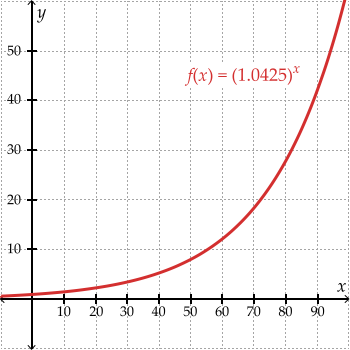
Either by tracing the function or by adding a horizontal line at \(y=1.364\), we can find that the point \((7.452, 1.364)\) lies on \(f(x)\), although we can assume that these values have been rounded.
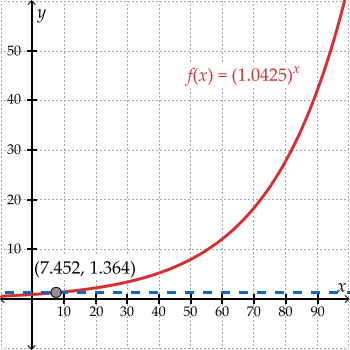
f of x equals 1.0425 to the power of x, dashed line at y equals 1.364, point labelled at (7.452, 1.364)

This means that \((1.0425)^{7.452} \approx 1.364\), then \(n\approx 7.452\).

Solution — Alternate Graph

There is another graph that we can use to solve  \(15~000= 11~000(1.0425)^n\).

Instead of dividing both sides by \(11~000\), we can leave the equation as is and consider the exponential function \(g(x)=11~000(1.0425)^x\).

This time, the solution to the equation is the \(x\)-coordinate of the point on \(g(x)\) that has a \(y\)-coordinate of \(15~000\).

We can produce the graph of \(g(x)\) using a graphing calculator and find the point with the \(y\)-coordinate of \(15~000\). It turns out that the point \((7.4 52, 15,000)\) lies on the graph.
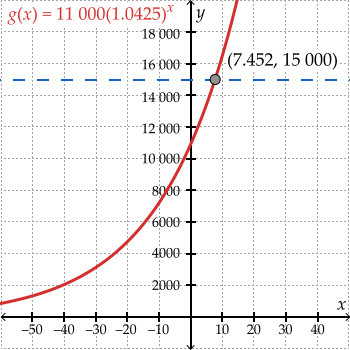
Graph of g of x equals 11000(1.0425) to the power of x, dashed line at y equals 15000, point labelled at (7.452,15000)

Therefore, as we found before \(n\approx 7.452\).

Solution — Conclusion

Let's use our solution of \(n\approx 7.452\) to finish answering the question.

Since interest is compounded semi-annually, \(n\) represents the number of \(\dfrac{1}{2}\) years. We could leave the answer in \(\dfrac{1}{2}\) years, although it might make more sense to express it in full years.

The number of years is

\(\dfrac{7.452}{2}=3.726\)

Therefore, it takes about \(3.726\) years (or approximately \(3\) years and almost \(9\) months) for the balance of the loan to grow to \($15~000\).

If partial compounding periods were not allowed, note that since \(n\) is between \(7\) and \(8\), \(n=7\) produces a balance less than \($15~000\), while \(n=8\) produces a balance greater than \($15~000\). 

The solution would be \(n=8\), which is equivalent to \(4\) years, although the balance of the loan would have surpassed \($15~000\) by this time.

Solution — Guess and Check

Although graphing is a more effective way to solve this type of equation, it's possible to solve \(15~000= 11~000(1.0425)^n\) using the guess and check method.

Under this method, you would simply substitute different values of \(n\) until you find the one that comes closest to satisfying the equation.

For this particular example, eventually we would find the following:

\(11~000(1.0425)^7\approx 14~720.59\)

\(11~000(1.0425)^8 \approx 15~346.21\)

Therefore, \(n\) is between \(7\) and \(8\). Then, if we needed a more specific answer, we could start substituting values of \(n\), like \(7.1\), \(7.2\), and so on. This could take a while.

Although guessing and checking works eventually, solving by graphing is much more direct and precise if we have access to graphing technology.


Check Your Understanding 7

Question — Version 1

\($5850\) is invested in a GIC with a monthly interest rate of \(0.27\%\), compounded monthly. How many months does it take for the balance to accumulate to \($13~600\)? Identify the number of full months that are needed to produce a balance of \($13~600\).

Answer — Version 1

It will take \(313\) months.

Feedback — Version 1

  • \(P=5850\)
  • \(A=13~600\)
  • \(i=0.0027\)

We need to find \(n\).

\(\begin{align*} A &= P(1+i)^{n} \\ 13~600 &= 5850(1.0027)^n \end{align*}\)

Simplify the equation:

\(2.325 \approx (1.0027)^n\)

Consider the following graph of the function \(f(x)=(1.0027)^x\).

The solution to the equation is the \(x\)-coordinate of the point on the graph of \(f(x)\) that has a \(y\)-coordinate \(2.325\).

Graph of f of x equals 1.0027 to the power x and the line y equals 2.325. Point A is plotted where they intersect.

The point \(A=(312.876 \ldots, 2.325)\) lies on the graph of \(f(x)\), so \(1.0027)^{312.876} \approx 2.325\), so \(n \approx 312.876\). 

Note that \(n=312\) produces a balance less than \($13~600\), while \(n=313\) produces a balance greater than \($13~600\). The solution is \(n=313\).

Therefore, it will take almost \(313\) months for \($5850\) to accumulate to \($13~600\).

Question — Version 2

How many months does it take for \($6800\) invested at an auual interest rate of \(7.08\%\), compounded monthly, to double? Identify the number of full months required for the investment to double in value.

Answer — Version 2

The investment will double in \(118\) months.

Feedback — Version 2

The investment doubles in value, so \(A=2($6800)=$13~600\).

Interest is compounded monthly, so \(i=\left( \dfrac{7.08}{12} \right) \% = 0.59\% = 0.0059\).

  • \(P=6800\)
  • \(A=13~600\)
  • \(i=0.0059\)

We need to find \(n\).

\(\begin{align*} A &= P(1+i)^{n} \\ 13~600 &=6800 (1.0059)^n \end{align*}\)

Simplify the equation:

\(2 \approx (1.0059)^n\)

Consider the following graph of the function \(f(x)=(1.0059)^x\).

The solution to the equation is the \(x\)-coordinate of the point on the graph of \(f(x)\) that has a \(y\)-coordinate \(2\). 

Graph of f of x equals 1.0059 to the power x and the line y equals 2. Point A is plotted where they intersect.

The point \(A=(117.828 \ldots, 2)\) lies on the graph of \(f(x)\), so \((1.0059)^{117.828} \approx 2\), so \(n \approx 117.828\). 

Note that \(n=117\) produces a balance less than \($13~600\), while \(n=118\) produces a balance greater than \($13~600\). The solution is \(n=118\).

Therefore, it will take almost \(118\) months for the orginial investment to double in value.


In addition to all of the techniques discussed in this lesson, problems involving compound interest can also be solved using a TVM Solver. 

Using a TVM Solver

A TVM Solver (or "Time Value of Money" Solver) is a feature found on some graphing calculators, on financial calculators, or online.  It can be used to solve problems involving compound interest. 

The TVM solver we will use in this lesson looks similar to those found on a graphing calculator.  There are typically seven values to consider - if you enter six of them, the TVM solver will be able to calculate the seventh. A TVM solver is typically used for calculations relating to annuities (which you will see in a later lesson); however, we can also use it for simpler compound interest questions. 

For compound interest, use the TVM solver as follows: 

  • \(N\) represents the number of years (note the difference from \(n\)).
  • \(I\%\) represents the yearly interest rate.  It is entered as a percent, not as a decimal. 
  • \(PV\) represents the present value.
  • \(PMT\) is left equal to \(0\) for this lesson.
  • \(FV\) represents the future value.
  • \(P/Y\) is left equal to \(1\).
  • \(C/Y\) represents the number of compounding periods in a year.

On a TVM solver: 

For an investment, \(PV\) is entered or displayed as a negative value, while \(FV\) is entered or displayed as a positive value.  This is because at the start of an investment, you are paying money into an investment, while at the end of the investment you are receiving money back. 

For a loan,  \(PV\) is entered or displayed as a positive value, while \(FV\) is entered or displayed as a negative value.  This is because at the start of a loan, the lender pays you, while at the end of the loan, you pay the lender.

In this last example, we will solve for the number of compounding periods, both by graphing, and by using a TVM solver. 

Example 11

How long does it take for an investment to triple, at an annual interest rate of \(7.2\%\), compounded monthly?

Solution

  • The investment triples if \(A=3P\).
  • \(\dfrac{7.2\%}{12}=0.6\%\), so \(i=0.006\).
  • \(n\) is unknown.

Method 1: Set up an equation and solve by graphing

Substitute into the compound interest formula:

\(\begin{align*} A &= P(1+i)^n \\ 3P &= P (1.006)^n\end{align*}\)

Dividing both sides by \(P\) gives \((1.006)^n=3\).  This is an equation that we can solve by graphing.

Consider the graph of \(f(x)=(1.006)^x\) and find the point that has a \(y\)-coordinate of \(3\). Remember that any points found using graphing technology will likely have been rounded. 

The point \((183.651, 3)\) approximately lies on \(f(x)=(1.006)^x\), which means that \((1.006)^{183.651}\approx3\).  

Thus, the solution to the equation \((1.006)^n=3\) is \(n \approx 183.651\).  This is the number of months it takes for the investment to triple.

Divide by \(12\) to determine the number of years: \(\dfrac{183.651}{12}\approx 15.3\)

Therefore, it takes approximately \(15.3\) years (or \(15\) years, \(4\) months) for an investment to triple at an annual interest rate of \(7.2\%\), compounded monthly.  

\(\)Method 2: Use a TVM solver 

We need to decide which values to enter into the TVM solver. 

We are not given a present value, but the solution will be the same for any size of investment. 

So let's pick an amount of principal, say \($100\), and calculate how long it takes for it to triple to \($300\).  

Then, here are the values that need to be entered into the solver:

  • Nothing for \(N\), since that is what we are trying to find.
  • \(I\%=7.2\)  (Recall that this input is always the annual interest rate).
  • \(PV=-100\) (Negative, since we would pay \($100\) into the investment).
  • \(FV=300\) (Positive, since at the end of the investment we would receive \($300\) back).
  • \(C/Y=12\) (Interest is compounded monthly, so \(12\) times per year).

\(PMT\) and \(P/Y\) are not used, so the values in the solver should not be changed. 

  • \(\texttt{N=0}\)
  • \(\texttt{I%=7.2}\)
  • \(\texttt{PV=-100}\)
  • \(\texttt{PMT=0}\)
  • \(\texttt{FV=300}\)
  • \(\texttt{P/Y=1}\)
  • \(\texttt{C/Y=12}\)
  • \(\texttt{PMT: }\class{PMT}{\texttt{END}} \texttt{ BEGIN}\)

Now we use the TVM solver to determine the value for \(N\). The calculator will now display that value.

  • \(\texttt{N=15.3}\)
  • \(\texttt{I%=7.2}\)
  • \(\texttt{PV=-100}\)
  • \(\texttt{PMT=0}\)
  • \(\texttt{FV=300}\)
  • \(\texttt{P/Y=1}\)
  • \(\texttt{C/Y=12}\)
  • \(\texttt{PMT: }\class{PMT}{\texttt{END}} \texttt{ BEGIN}\)

The display indicates that \(N=15.3\).  Recall that this is the number of years, and it is consistent with the answer we obtained by graphing. 

It turns out that a TVM solver can help us find any of \(PV\), \(FV\), \(N\), or \(I\%\) if we know the values of the other three (and the number of compounding periods per year). Although it is important to know how to use the algebraic or graphical techniques discussed in this lesson, a TVM solver is a quick way to check your answers!


Check Your Understanding 8

Question

How many years does it take for the amount of money invested at an annual interest rate of \(12\%\) compounded monthly, to triple in value? Use a TVM solver.

A sample TVM solver where the values for N, I%, PV, FV, and C/Y are needed.

Answer

It takes \(9.2\) years.

Feedback

The following values are inputed into a TVM solver to find the value of \(N\).

  • \(\texttt{N=9.2}\)
  • \(\texttt{I%=12}\)
  • \(\texttt{PV=-100}\)
  • \(\texttt{PMT=0}\)
  • \(\texttt{FV=300}\)
  • \(\texttt{P/Y=1}\)
  • \(\texttt{C/Y=12}\)
  • \(\texttt{PMT: }\class{PMT}{\texttt{END}} \texttt{ BEGIN}\)

Interactive Version

TVM Solver for Compound Interest


Wrap-Up


Lesson Summary

  • Compound interest is earned when interest is re-invested.  That is, interest is earned on both the principal and any previously earned interest.
  • The formula \(A=P(1+i)^n\) can be used to calculate compound interest, where \(A \) is the accumulated or future value, \(P\) is the principal or present value, \(i\) is the interest rate per compounding period, and \(n\) is the number of compounding periods.
    • This formula is sometimes written as \(FV=PV(1+i)^n\).
  • Compound interest is an example of exponential growth, and the accumulated values of an investment or loan after each compounding period can also be represented by a geometric sequence.
  • The values of \(i\) and \(n\) in the formula \(A=P(1+i)^n\) depend on the compounding period used:
    Compounding Period Description Interest Rate (\(i\)) Number of Periods (\(n\))

    Annually

    Interest is compounded once each year

    \(i=\) yearly rate

    \(n=\) number of years

    Semi-annually

    Interest is compounded twice each year

    \(i=\) yearly rate \(\div 2\)

    \(n=\) number of years \(\times 2\)

    Quarterly

    Interest is compounded four times each year

    \(i=\) yearly rate \(\div 4\)

    \(n=\) number of years \(\times 4\)

    Monthly\(\)

    Interest is compounded each month (\(12\) times per year) 

    \(i=\) yearly rate \(\div 12\)

    \(n=\) number of years \(\times 12\)

  • When three of the four quantities \(A\), \(P\), \(i\), and \(n\) are known, the fourth can be calculated.
    • \(A\), \(P\), and \(i\) can be calculated algebraically using the compound interest formula.
    • \(P\) can be calculated using the re-arranged formula \(P=A(1+i)^{-n}\).
    • \(n\) can be determined graphically, using an exponential function.
    • All four can be calculated using a TVM solver.

Take It With You

A GIC account has an interest rate of \(3.5\%\), compounded annually. Maryam deposits \($2000\) into this type of GIC for three years.  When the first GIC matures, she reinvests the balance plus \($2000\) more dollars in a new GIC  (at the same interest rate) for four years.  When the second GIC matures, she reinvests the balance plus \($5000\) more dollars in a third GIC (at the same interest rate) for three more years. What is the accumulated value of Maryam's investment at the end of the third GIC?