Explore This Summary
As you completed the "Explore This" activity, you may have noticed that:
- As more terms were added, the circle got closer and closer to being completely shaded.
- This means that as more terms are added to the series \(\dfrac12+\dfrac14+\dfrac18+\dfrac1{16}+\dfrac1{32}+ \cdots\), the sum gets closer and closer to \(1\).
When Can We Evaluate an Infinite Geometric Series?
Recall that a sequence is infinite if it continues indefinitely, with no last term.
An infinite geometric series is the sum of the terms of an infinite geometric sequence. Sometimes it is possible to evaluate such a sum, other times it is not. Let's examine a few cases to see when an infinite geometric series can be evaluated.
Case 1: \(r \ge 1\)
Consider the series \(5+10+20+40+80+\cdots\).
Is it possible to evaluate the sum of the whole series?
Let's look at some values of \(S_n\).
- \(S_1=5\)
- \(\begin{align*} S_2&=5+10 \\&=15 \end{align*}\)
- \(\begin{align*} S_3&=5+10+20 \\&=35 \end{align*} \)
- \(\begin{align*} S_4&=5+10+20+40\\&=75\end{align*}\)
- \(\begin{align*} S_5 &= 5+10+20+40+80\\ &= 155\end{align*}\)
Here is a graph of the \(S_n\) values.
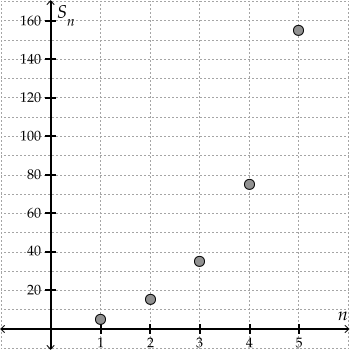
The sums are growing without approaching a particular value; it is not going to be possible to evaluate the sum of the entire series.
Case 2: \(r \le -1\)
Consider the series \(1-3+9-27+\cdots\).
Again, let's look at some values of \(S_n\).
\(S_1=1\)
\(S_2=1-3=-2\)
\(S_3=1-3+9=7\)
\(S_4=1-3+9-27=-20\)
\(S_5=1-3+9-27+81=61\)
Here is the graph of the \(S_n\) values:
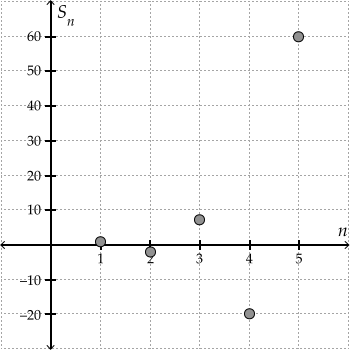
The sum alternates between positive and negative, and is not approaching any particular value. Thus, it is not possible to evaluate the sum of the whole series.
Case 3: \(-1 \lt r \lt 1\), where \(r \ne 0\)
Consider the series from the Explore This activity: \(\dfrac12+\dfrac14+\dfrac18+\dfrac1{16}+\cdots\)
Here are some sums:
\(S_1=\dfrac12\)
\(S_2=\dfrac12+\dfrac14=\dfrac34\)
\(S_3=\dfrac12+\dfrac14+\dfrac18=\dfrac78\)
\(S_4=\dfrac12+\dfrac14+\dfrac18+\dfrac1{16} = \dfrac{15}{16}\)
\(S_5=\dfrac12+\dfrac14+\dfrac18+\dfrac1{16}+\dfrac1{32}=\dfrac{31}{32}\)
Here is the graph of the \(S_n\) values:
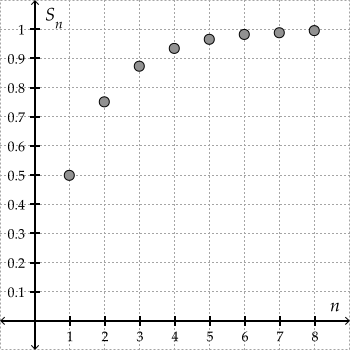
The sums gradually get closer and closer to \(1\). It turns out that the sum of this infinite series is, in fact, \(1\).
It is possible to evaluate the sum of an infinite geometric series if \(-1\lt r \lt 1\), \(r \ne 0\). In this case, the series is said to converge.
If \(r \gt 1\) or \(r \lt -1\), the series diverges. In this case, the sum of the series does not approach a particular value.
How to Evaluate an Infinite Geometric Series
Consider the graph of \(f(x)=\left(\dfrac12\right)^x\):

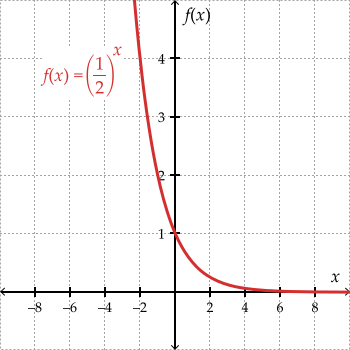
As \(x\) gets closer to positive infinity, \(f(x)\) or \(\left(\dfrac12 \right)^x\) approaches zero.
In general, if \(-1 \lt c \lt 1\) and \(c \ne 0\), \(c^x\) approaches zero as \(x\) gets closer to positive infinity.
This idea can be applied to geometric sequences and series. For a geometric series with \(-1 \lt r \lt 1\), as \(n\) gets closer to infinity (i.e., for large term numbers) , \(r^n\) approaches \(0\).
So in the formula \(S_n=\dfrac{a(r^n-1)}{r-1}\), we can replace \(r^n\) with zero to find the sum of the infinite series (which is represented by the notation \(S_{\infty}\)):
\(\begin{align*} S_{\infty} &= \dfrac{a(0-1)}{r-1}\\ S_{\infty} &= \dfrac{a(-1)}{r-1} \\ S_{\infty} &= \dfrac{a}{1-r}\end{align*} \)
If \(-1 \lt r \lt 1\), the sum of the infinite geometric series \(a + ar + ar^2 + ar^3 + \cdots\) is
\(S_{\infty}=\dfrac{a}{1-r}\).
Example 8
Find the sum of the series \(10~000-2500+625 + \cdots\).
Solution
This is an infinite geometric series.
- \(a=10~000\)
- \(r=\dfrac{t_2}{t_1}=\dfrac{-2500}{10~000}=-\dfrac14=-0.25\)
Since \(-1 \lt r \lt 1\), it is possible to evaluate the sum using the formula \(S_{\infty}=\dfrac{a}{1-r}\).
\(\begin{align*}
S_{\infty} &= \dfrac{10~000}{1-(-0.25)} \\
&= \dfrac{10~000}{1.25} \\
&= 8000
\end{align*}\)
Therefore, \(10~000-2500+625 + \cdots = 8000\).
Here is a graph of the partial sums \(S_n\), such as \(S_1=10~000\), \(S_2=10~000-2500=7500\), and so on.

Notice that, as the number of terms (\(n\)) increases, the sum (\(S_n\)) gets closer and closer to \(8000\). In fact, from \(S_5\) on, the sums are already quite close to that value.
Example 9
Use a geometric series to write \(0.777777\dots\) as a fraction.
Solution
\(0.777777\dots\) can be written as a geometric series, since
\(0.777777\ldots = \dfrac7{10}+\dfrac7{100}+\dfrac7{1000} + \cdots\)
\(a=\dfrac7{10}\) and each term is \(\dfrac1{10}\)th of the previous term, so \(r=\dfrac1{10}\).
Since \(-1 \lt r \lt 1\), the series can be evaluated using the formula \(S_{\infty}=\dfrac{a}{1-r}\).
So,
\(\begin{align*} \dfrac7{10}+\dfrac7{100}+\dfrac7{1000} + \cdots &= \dfrac{\frac7{10}}{1-\frac1{10}} \\[5px] &= \dfrac{\frac7{10}}{\frac9{10}} \\[5px] &= \dfrac79 \end{align*}\)
Therefore, \(0.777777\dots\) is equal to the fraction \(\dfrac79\).