Exercises


  1. For each of the following geometric sequences, write a recursion formula, write the general term, and find \(t_{11}\). 
    1. \(\dfrac38,~ \dfrac32, ~6, ~24, \ldots\)
    2. \(-40, ~20, -10, ~5, \ldots\)
  2. For each of the following sequences, determine the general term and find \(t_9\):
    1. The geometric sequence with common ratio \(r=-3\) and \(t_5=27\).
    2. The geometric sequence with \(t_4=\dfrac23\) and \(t_5=\dfrac12\).
    3. The geometric sequence with \(t_1=-3\) and \(t_4=-375\).
    4. The geometric sequence with \(t_4=48\) and \(t_{10}=3072\).
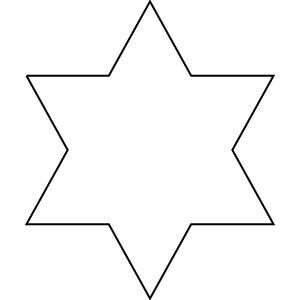
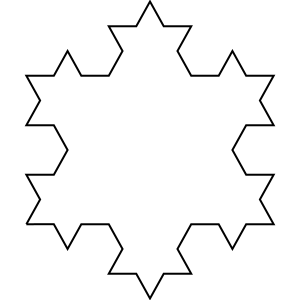
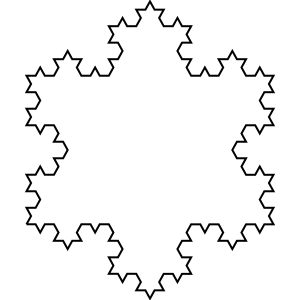
  3. The Koch snowflake is another example of a fractal. Look at the first four iterations of the Koch snowflake shown below. The first iteration has three sides. Each iteration after the first has more sides than the previous iteration, and the side lengths are smaller than in the previous one.

    Iteration 1
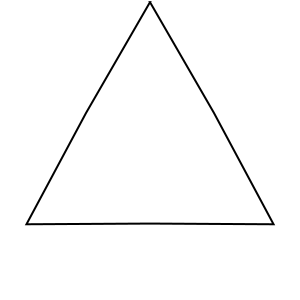
    An equilateral triangle.

    Iteration 2

    On each side of Iteration 1, a new equilateral triangle is drawn so that the base of the triangle takes up one-third of the side. The bases of the new equilateral triangles are not shown.

    Iteration 3

    On each side of Iteration 2, a new equilateral triangle is drawn so that the base of the triangle takes up one-third of the side. The bases of the new equilateral triangles are not shown.

    Iteration 4

    Use a geometric sequence to answer each of the following questions:

    1. How many side lengths will be in the \(8\)th iteration of the Koch snowflake?
    2. If each of the sides in the first iteration of the Koch snowflake are \(3000\) mm long, approximately how long will the sides be in the \(8\)th iteration? (Round your answer to two decimal places.)
  4. A biologist introduces some frogs into a large protected pond and checks the population at the end of the summer each year. The data are recorded in the table below:
    Year Population at the End of August
    \(2016\) \(64\)
    \(2017\) \(96\)
    \(2018\) \(144\)
    1. Explain why the population (based on the data we have so far) can be represented by a geometric sequence.
    2. Assuming that the population continues to follow a geometric sequence, write an expression for \(t_n\), the population \(n\) years after \(2015\) (i.e., where \(t_1\) represents the population in \(2016\)). 
    3. How many frogs should the biologist expect in \(2020\)? 
    4. When will the population reach \(729\) frogs?
  5. How many terms are in the following geometric sequence?

    \(\dfrac5{64}, -\dfrac5{16}, ~\dfrac54,\ldots, -327~680\)

  6. Consider a sequence with \(t_2=9\) and \(t_5=243\). 
    1. Find the general term for an arithmetic sequence with these two terms.
    2. Find the general term for a geometric sequence with these two terms. 
    3. For which term numbers are the terms in the arithmetic sequence greater than the corresponding terms in the geometric sequence? 
  7. A geometric sequence has common ratio \(r=\dfrac12\) and \(t_3+t_5=1000\). Find the general term of the sequence.
  8. A geometric sequence has \(t_1=7\). Find \(t_8\) in the sequence if:
    1. \(t_4\) is \(196\) less than \(t_1\) 
    2. \(t_3\) is \(140\) greater than \(t_2\)
  9. Is it possible to have a geometric sequence with \(t_6=200~000\) and \(t_{10}=-12~500\). Why or why not?
  10. Consider the sequence \(2, -5, ~8, -11~, ~14, \ldots\).
    1. Is the sequence arithmetic, geometric, or neither? 
    2. Find \(t_{100}\). 
    3. Write the general term of the sequence.