In this section, we will be discussing more complicated examples involving geometric sequences and their general terms.
Example 9
A scientist has a petri dish full of single-celled organisms. Every hour, these organisms split, so that there are twice as many of them. In hour \(5\), there are \(2400\) single-celled organisms in the dish.
How many organisms were in the dish in hour \(1 \)?
Solution
Consider the sequence, where \(t_n\) represents the number of single-celled organisms in the dish in hour \(n \).
Each term in this sequence is two times the previous term, since every hour the number of organisms doubles.
So the sequence is geometric, with \(r=2\). We are also given that \(t_5=2400\).
To find the number of organisms in the dish in hour \(1\), we need to find \(t_1\), or \(a\). To do this, substitute into the general term for a geometric sequence:
\(\begin{align*}t_n &= ar^{n-1} \\ t_5 &= a(2)^{5-1} \\ 2400 &= a(2^4) \\ 2400 &= 16a \\ a &= 150\end{align*}\)
Therefore, there were \(150\) single-celled organisms in the petri dish in hour \(1\).
Example 10
Find \(t_7\) in the geometric sequence that has \(t_1=-4\) and \(t_{10}=-7~812~500\).
Solution
If we find the general term, which is written in the form \(t_n=ar^{n-1}\) for a geometric sequence, we can use it to calculate \(t_7\). Use the two given terms to determine the values of both \(a\) and \(r\).
In this sequence, \(a=-4\) (since \(t_1=-4\)).
We are also given that \(t_{10}=-7~812~500\).
In a geometric sequence, \(t_{10}=ar^9\), and so in this particular sequence, \(t_{10}=-4r^9\).
This leads to the equation \(-4r^9=-7~812~500\), which can be solved for \(r\).
Divide both sides of the equation by \(-4\):
\[r^9=1~953~125\]
Take the \(9\)th root of both sides. Use the \(n\)th root button on your calculator.
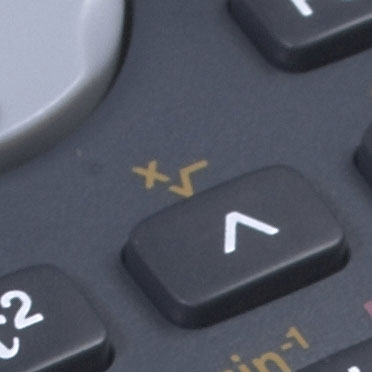
Source: Calculator - elsen029/iStock/Getty Images
Since \(9\) is odd, there will only be one (positive) answer:
\[\begin{align*} r &=\sqrt[9]{1~953~125} \\ r&=5 \end{align*}\]
The general term for a geometric sequence with \(t_1=-4\) and \(t_{10}=-7~812~500\) is \(t_n=-4(5)^{n-1}\).
Now that we know the general term, substitute \(n=7\) to find \(t_7\).
\(\begin{align*} t_7&=-4(5)^{7-1} \\ &= -4(5)^6 \\ &= -4(15~625)\\ &=-62~500 \end{align*}\)
Therefore, a geometric sequence with \(t_1=-4\) and \(t_{10}=-7~812~500\) has \(t_7=-62~500\).
Example 11
Find \(t_4\) in the geometric sequence with \(t_7=648\) and \(t_{11}=128\).
For this sequence, we are not given the initial term. So we will start by trying to determine \(r\).
Step 1: Determine the value of \(r\)
We know that, for any geometric sequence, \(t_7=ar^6\) and \(t_{11}=ar^{10}\).
The ratio of these two terms is \(\dfrac{t_{11}}{t_7}=\dfrac{ar^{10}}{ar^6}\), which simplifies to:\(\dfrac{t_{11}}{t_7}=r^4 \tag{1}\)
We are given the values \(t_7=648\) and \(t_{11}=128\), so we can also write that \(\dfrac{t_{11}}{t_7}=\dfrac{128}{648}\), which simplifies to: \(\dfrac{t_{11}}{t_7}=\dfrac{16}{81} \tag{2}\)
Since both equations \((1)\) and \((2)\) represent the same ratio, we can set them equal to each other:
\(r^4=\dfrac{16}{81}\)
Take the \(4\)th root of both sides of the equation to solve for \(r\).
Since \(4\) is even, there will be two solutions (one positive and one negative):
\[\begin{align*} r&=\pm \sqrt[4]{\dfrac{16}{81}} \\ r&=\pm \dfrac{\sqrt[4]{16}}{\sqrt[4]{81}} \\ r&=\pm \dfrac23 \end{align*}\]
Step 2: Use the possible values of \(r\) to find \(a\)
There are two cases to consider.
Case 1: \(r\) is positive
\(t_7=ar^6\), so \(\)\(ar^6=648\). Substituting \(r=\dfrac23\), we get:
\[\begin{align*} a\left(\dfrac23\right)^6&=648 \\ a\left(\dfrac{64}{729}\right)&= 648 \\ a &= 648 \left(\dfrac{729}{64}\right) \\ a &= \dfrac{59~049}8 \end{align*}\]
Case 2: \(r\) is negative
Since the exponent \(6\) is even, we will get the same solution for \(a\) when we solve \(a\left(-\dfrac23\right)^6=648\).
Therefore, the general term for the sequence is either:
\(t_n=\dfrac{59~049}8\left(\dfrac23\right)^{n-1}\) or \(t_n=\dfrac{59~049}8\left(-\dfrac23\right)^{n-1}\)
Step 3: Use the general term(s) to find \(t_4\)
Since there are two possible general terms for the sequence, there may also be two different values of \(t_4\).
For \(t_n=\dfrac{59~049}8\left(\dfrac23\right)^{n-1}\):
\(\begin{align*} t_4&=\dfrac{59~049}8\left(\dfrac23\right)^{4-1} \\ &=\dfrac{59~049}8\left(\dfrac23\right)^{3}\\ &= \dfrac{59~049}8\left(\dfrac8{27} \right) \\ &= 2187 \end{align*}\)
For \(t_n=\dfrac{59~049}8\left(-\dfrac23\right)^{n-1}\):
\(\begin{align*} t_4&=\dfrac{59~049}8\left(-\dfrac23\right)^{4-1} \\ &=\dfrac{59~049}8\left(-\dfrac23\right)^{3}\\ &= \dfrac{59~049}8\left(-\dfrac8{27} \right) \\ &= -2187 \end{align*}\)
Therefore, a geometric sequence with \(t_7=648\) and \(t_{11}=128\) has \(t_4=2187\) or \(t_4=-2187\).
Note:
When \(r\) is negative (i.e., \(r \lt 0\)), the sequence alternates between positive and negative terms. That is, all odd-numbered terms have one sign, while all even-numbered terms have the opposite sign.
So if \(r\) is negative and \(t_7\) is positive, we can expect \(t_4\) to be negative, (as seen in the previous example).