Exponential Decay


Slide Notes

Glossary

All Slides

The Height of a Bouncing Ball

Suppose you drop a bouncy ball from a height of \(1\) metre.

The Height of a Bouncing Ball Continued

Number of bounces, \(n\) Peak height, \(h\) (metres)
\(0\) \(1 \class{timed in1}{= \left( \dfrac{1}{2} \right)^0}\)
\(1\) \(\dfrac{1}{2} \class{timed in1}{= \left( \dfrac{1}{2} \right)^1}\)
\(2\) \(\dfrac{1}{4} \class{timed in1}{= \left( \dfrac{1}{2} \right)^2}\)
\(3\) \(\dfrac{1}{8} \class{timed in1}{= \left( \dfrac{1}{2} \right)^3}\)
\(4\) \(\dfrac{1}{16} \class{timed in1}{= \left( \dfrac{1}{2} \right)^4}\)

Exponential Decay

Recall

The basic form of an exponential function is given by \(f(x) = c^{x}\) where \(c \gt 0\) and \(c \neq 1\).

  • The function in the previous example is an exponential function with \(c = \dfrac{1}{2}\).


Paused Finished
Slide /

Check Your Understanding 2


Suppose you are given a standard six-sided die. The sides are numbered one through six, and each side has an equal probability of being rolled.

(a) What is the probability, \(P_1\), of rolling a one on a single roll?

Enter the fraction \(\dfrac{a}{b}\) as "\(a\)/\(b\)".

\(P_1 = \)   

(b) What is the probability, \(P_2\), of rolling two ones in a row ? (Note, for independent repeated trials, the probability of a set of events occurring is equal to the product of the probability of each individual event occurring.)

Enter the fraction \(\dfrac{a}{b}\) as "\(a\)/\(b\)".

\(P_2 = \)    

(c) Determine an equation for the probability, \(P(n)\), of rolling \(n\) ones in a row.

Enter the exponent "\(a^b\)" as \(a\)^\(b\).  Enter the fraction \(\dfrac{a}{b}\) as "\(a\)/\(b\)".

\(P(n) = \)  There appears to be a syntax error in the question bank involving the question field of this question. The following error message may help correct the problem:

null

Preview    


Check Your Understanding 3


Example 2

The half-life of a particular radioactive isotope is one minute. This means that after one minute (i.e., one half-life), only half of an initial mass of the radioactive isotope would remain. If there is initially \(800\) grams of the isotope present in a sample, how much will remain after eight minutes?

Solution

Let \(m(t)\) be the mass of isotope present after \(t\) minutes have elapsed.

Since the mass of the isotope present halves each minute, we expect \(m(t)\) to undergo exponential decay involving a function of the form \(c^t\) where \(0 \lt c \lt 1\). However, we must also take into account the fact that the initial mass of the radioactive isotope in our sample is not equal to one. We can do this by using a function of the form

\[ m(t) = a \cdot c^t\]

In this function, we should let \(a = 800\) so that our function gives the correct value for the initial mass (i.e., \(m(0) = 800\)), and we should let \(c = \dfrac{1}{2}\) because the mass halves (i.e., is multiplied by a factor of one-half) for each step in \(t\) (i.e., each minute). Therefore, we have the following expression for \(m(t)\):

\[ m(t) = 800 \cdot \left( \frac{1}{2} \right)^t \]

Substituting \(t=8\) into this expression, we can determine the mass remaining after eight minutes.

\[ m(8) = 800 \cdot \left( \frac{1}{2} \right)^{8} = \frac{800}{256} = 3.125 \]

Therefore, there will be only \(3.125\) grams of radioactive isotope remaining after eight minutes.

Math in Action

This example involved a process known as radioactive decay which occurs frequently in science. For example, radioactive decay is the underlying phenomenon for

  • the production of nuclear energy,
  • medical imaging,
  • carbon dating of organic materials, and
  • predicting the distribution of elements in our universe.

Check Your Understanding 4


Try This Revisited

Beginning with a shaded square, the following algorithm gives rise to what is known as a Sierpinski carpet:

  1. Subdivide the square into \(9\) congruent smaller squares.
  2. Remove the centre square.
  3. Repeat steps 1 and 2 for each remaining square.

This gives rise to the following pattern.
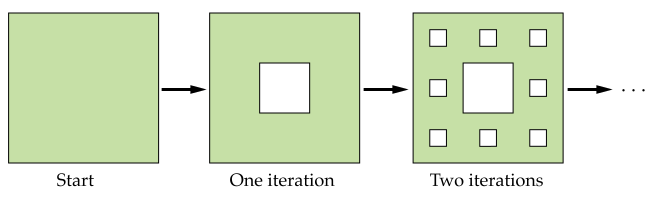
Start with a shaded square. Follow steps 1 to 3 for one iteration. Repeat steps 1 to 3 for a second iteration. Continue repeating these steps for more iterations.

  1. What fraction of the initial square is shaded after one iteration of this algorithm? What about after two iterations?
  2. Determine an expression for the fraction of the initial square that is shaded after \(n\) iterations of this algorithm.

Solution — Part A

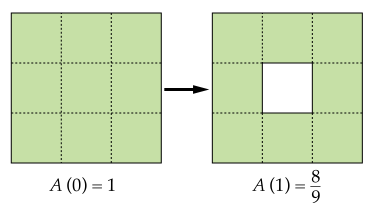
Let \(A(n)\) denote the fraction of the initial area shaded after the \(n\)-th iteration of the algorithm. Note that, \(A(0) = 1\) because the full area is shaded for zero iterations of the algorithm.

In the first iteration, we divide the square into \(9\) congruent subsquares and remove one of them. In terms of area, this is equivalent to saying we divide the shaded area into \(9\) equal parts and remove one.

This leaves us with \(\dfrac{8}{9}\) of the initial shaded area after one iteration which we can write as \(A(1) = \dfrac{8}{9}\).
The remaining shaded area can be thought of as the \(8\) shaded subsquares that we did not remove in the first iteration. Each of these subsquares contains \(\dfrac{1}{9}\) of the initial area.

For the second iteration, we then subdivide each of the remaining subsquares into \(9\) equal parts and remove one of those parts.
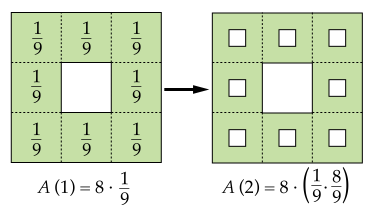
This has the net effect of scaling the shaded area remaining after the first iteration by another factor of \(\dfrac{8}{9}\). Thus, after two iterations of the algorithm, we have \(A(2) = \dfrac{8}{9} \cdot A(1) = \left(\dfrac{8}{9}\right)^2\).

Solution — Part B

This pattern continues with each iteration scaling the remaining shaded area by a factor of \(\dfrac{8}{9}\).

Therefore, the fraction of the initial square that is shaded after \(n\) iterations is given by the exponential function

\[ A(n) = \left( \frac{8}{9} \right)^n\]

Did You Know?

The Sierpinski carpet is an example of a fractal. Roughly speaking, a fractal is a geometrical object whose appearance repeats recursively as you inspect it at smaller and smaller scales. A few examples of places that fractals occur in nature include the following:

The root system of a plant
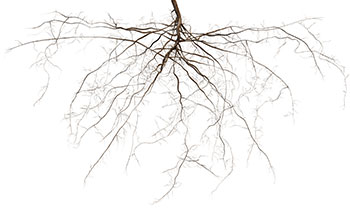
Tree roots.

Our cardiovascular and nervous systems

A representation of the circulatory systems that run through the human body.

The shape of a hurricane

A top view of a hurricane.

The structure of a galaxy

A spiralling galaxy.