Explore This 1 Summary
Here's an example of a function to match you may have seen in this activity with the sine function as a function to change.
\(y=a \sin(b(x-h)^\circ)+k\)
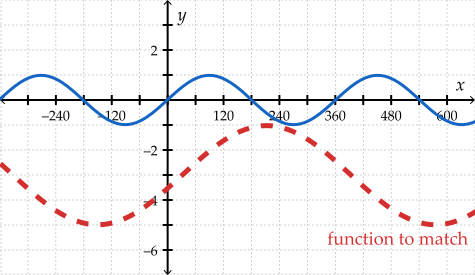
You may have used the amplitude of the function to match to decide if a vertical stretch is needed to determine the value of \(a\). Recall the amplitude \(= |a|\).
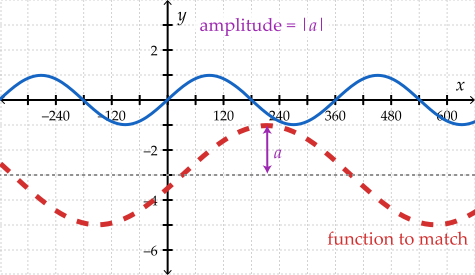
You might have used the period of the function to match to decide if a horizontal stretch is needed to determine the value of \(b\). Recall the period \(=\dfrac{360}{|b|}\).
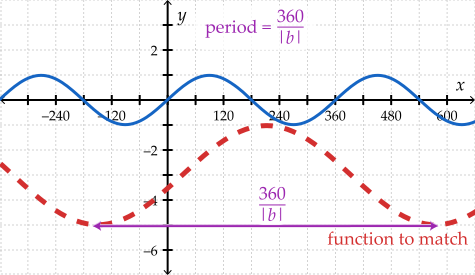
You might have used the axis of the function to match to decide if a vertical translation was needed to determine the value of \(k\). Recall the axis is determined by the line \(y=k\).
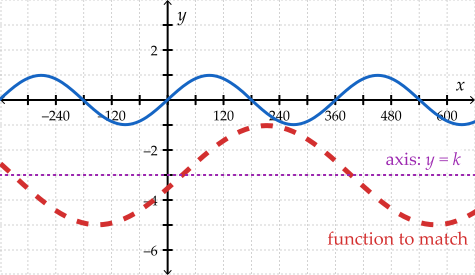
Lastly, you might have used a key point, such as an axis point or a maximum or a minimum on the function to match, to decide if a phase shift was needed to determine the value of \(h\).
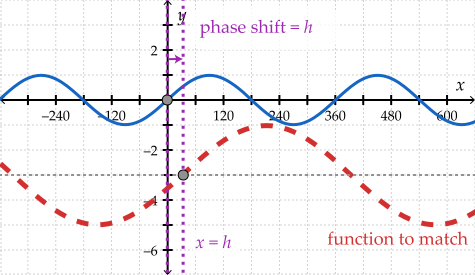
There are many different sequences of decisions that can lead to a correct match.
Let's discuss two possible sequences.
Matching the Graph — Sequence 1
In this first sequence, we will focus on the order of operations for the transformations.
- Examine reflections and stretches to select values for \(a\) and \(b\) since these involve multiplication. Correct!
- Examine translations to select values for \(h\) and \(k\), which appear as addition or subtraction in the function equation.Correct!
Recall we are trying to create an equation of the form \(y=a \sin(b(x-h)^\circ)+k\).
We start with \(y=\sin(x^{\circ})\).
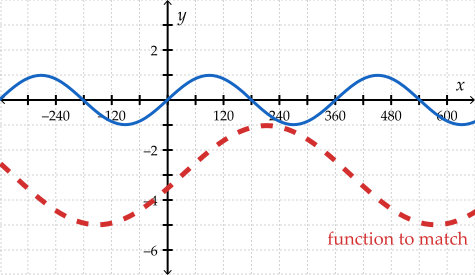
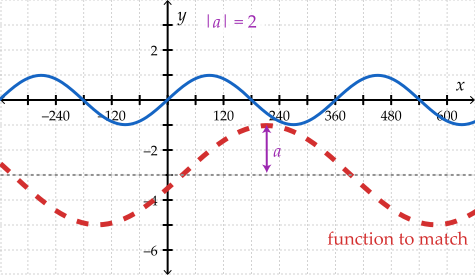
The amplitude of the function to match is \(2\). So \(a\) could be \(+2\) or \(-2\). Let's continue with \(y=-2\sin(x^{\circ})\).
\(y=-2\sin(x^{\circ})\)
Now let's look at the period. Using the two minimum points to define one cycle, the cycle starts when \(x=-150\) and ends when \(x=570\).
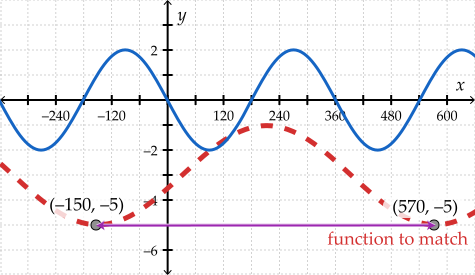
So the period is \(150 +570=720\).
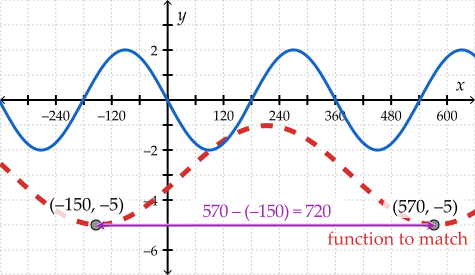
\(\begin{align*} 720&=\dfrac{360}{\left| b\right|}\\ \left| b\right| &=\dfrac{360}{720}\\ \left| b\right| &= 0.5\\ b &= \pm0.5 \end{align*}\)
And there is a horizontal stretch by a factor of \(2\). This means that the value of \(b\) could be \(+0.5\) or \(-0.5\).
Let's continue with \(y=-2\sin(0.5x^{\circ})\).
\(y=-2\sin(0.5x^{\circ})\)
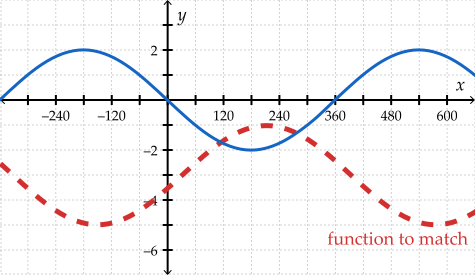
We are finished with the reflections and stretches, so we will now work on the translations.
The axis of the function to match is \(y=-3\). So \(k\) must be \(-3\).
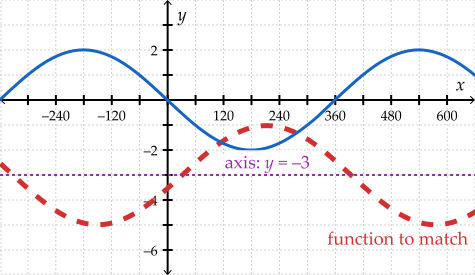
So we will continue with our function to change to be \(y=-2\sin(0.5x^{\circ})-3\).
\(y=-2\sin(0.5x^{\circ})-3\)
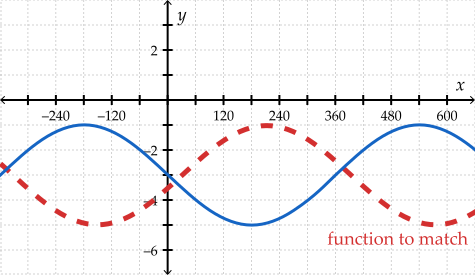
Lastly, let's look at a key point on the function to change to determine the phase shift. A maximum point on the function to change is \((540,-1)\). If this is shifted to the left to the maximum point on the function to match at \((210,-1)\), this would be a shift of \(330\) to the left. This means that \(h =-330\). That is, \(y=-2\sin(0.5(x-(-330))^{\circ})-3\).
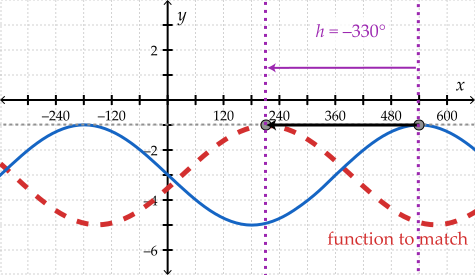
We have now finished with the translations and we have matched the functions.
Therefore, \(y=-2\sin(0.5(x+330)^{\circ})-3\). This is an equation for the function to match.
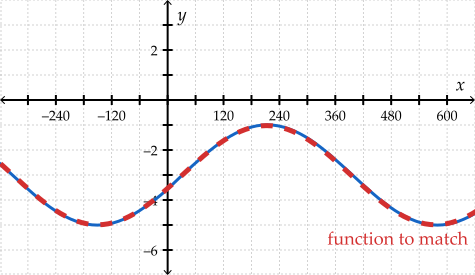
It is important to note that earlier we made some choices about whether the values of \(a\) or \(b\) were positive or negative. And we were given the sine function instead of a cosine function as our base graph. All of these have some effect on what phase shift will be needed to determine the function to match.
Matching the Graph — Sequence 2
Let's look at another decision sequence that also leads to a correct match. In this match, we will exploit the fact that the origin is not affected by reflections and stretches to first decide on the translations for our function to match. After we know where the image of the origin will be, then we will select the remaining parameters.
- Examine translations to select values for \(h\) and \(k\).
- Examine reflections and stretches to select values for \(a\) and \(b\).
Recall we are trying to create an equation of the form \(y=a \sin(b(x-h)^\circ)+k\).
\(y=\sin(x^{\circ})\)
The function to match has a horizontal axis at \(y =-3\).
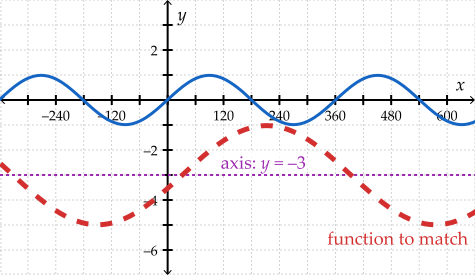
Thus, \(k\) must be \(-3\).
\(y=\sin(x^{\circ})-3\)
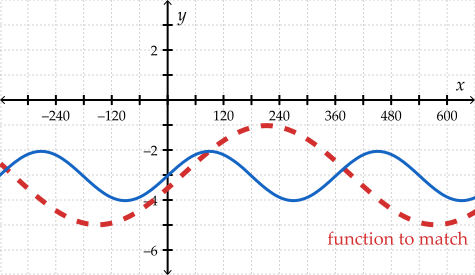
To select the phase shift, notice that the function to change has an axis point at the \(y\)-intercept at \((0, -3)\), and the function to match has an axis point at \((30, -3)\). Shifting to the right by \(30\) aligns these points.
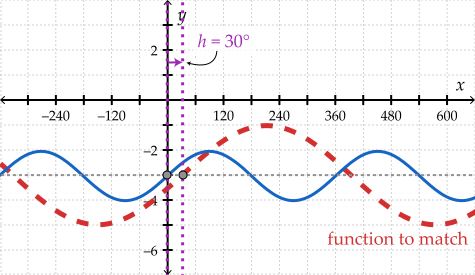
So we can use \(h=30\).
\(y=\sin((x-30)^{\circ})-3\)
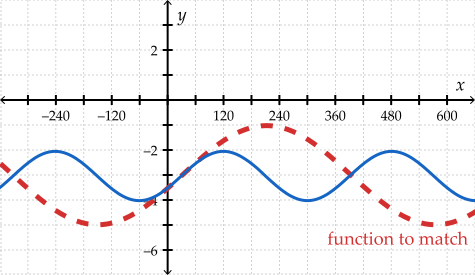
We are finished with the translations and will now continue with the remaining parameters.
The amplitude of the function to match is \(2\), and an \(a\) value of \(+2\) keeps both functions increasing through the common point at \((30, -3)\).
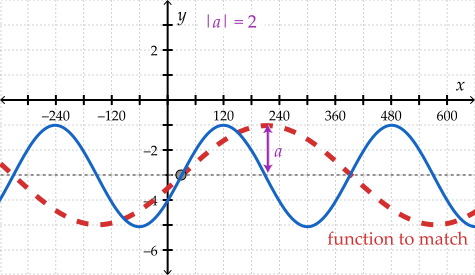
So we will use \(a=2\).
\(y=2\sin((x-30)^{\circ})-3\)
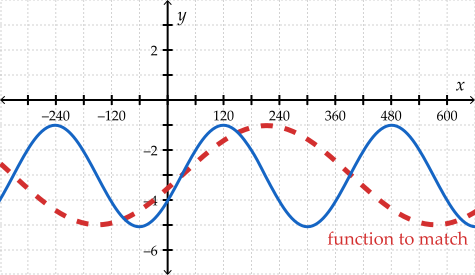
Finally, we see that the function to change goes through a whole cycle in the time that the function to match goes through half a cycle.
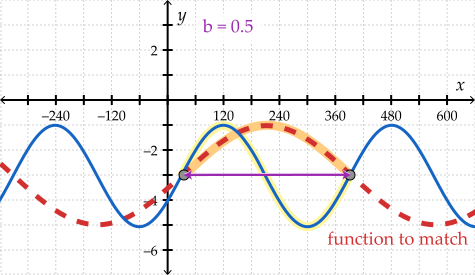
So we need a horizontal stretch by a factor of \(2\), or the value of \(b\) could be \(0.5\).
\(y=2\sin(\class{add13=bg3}{0.5}(x-30)^{\circ})-3\)
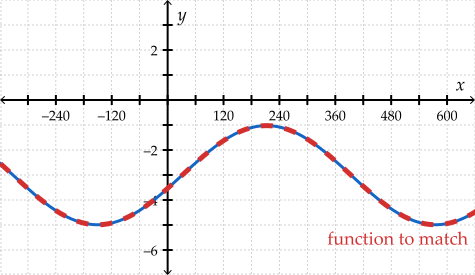
We have now finished with all the transformations and we have matched the functions using a different sequence of decisions than we used previously.
The equation of \(y=2\sin(\class{add13=bg3}{0.5}(x-30)^{\circ})-3\) is another equation for the function to match. The choices we make and the order we make them can affect the equation of the model for a sinusoidal function.
For sinusoidal functions, there is more than one equation that will produce the same graph. In fact, there are infinitely many of them.