Bungee Jumping
Bungee jumpers usually jump from a fixed platform, like a crane or a bridge, while connected to a long elastic cord. The first part of a jump is free fall until the bungee cord stretches and sends the jumper rebounding upwards again. Several rebounds can occur before the jumper is lifted back to the platform.
Did You Know?
Commercial bungee jumping began in the 1980's in New Zealand.

Source: Bungee Jumper - matejmm/E+/Getty Images
Example 5
Hollam made a bungee jump from a platform \(134\) m above a river. His height, in metres, during the first \(19\) seconds of his jump is shown in the table.
| Time (s) |
\(0\) |
\(1\) |
\(2\) |
\(3\) |
\(4\) |
\(5\) |
\(6\) |
\(7\) |
\(8\) |
\(9\) |
\(10\) |
\(11\) |
\(12\) |
\(13\) |
\(14\) |
\(15\) |
\(16\) |
\(17\) |
\(18\) |
\(19\) |
| Height (m) |
\(134\) |
\(129\) |
\(117\) |
\(98\) |
\(72\) |
\(39\) |
\(24\) |
\(13\) |
\(9\) |
\(13\) |
\(24\) |
\(39\) |
\(54\) |
\(65\) |
\(69\) |
\(65\) |
\(54\) |
\(39\) |
\(24\) |
\(13\) |
- Examine the data and select a suitable domain to model the data using a sinusoidal function. Justify your reasoning.
- Write a sinusoidal function to model Hollam's jump where \(h\left(t\right)\) is his height above the river in metres and \(t\) is the time in seconds after he begins his jump.
Solution — Part A
Here is a graph of Hollam's data:
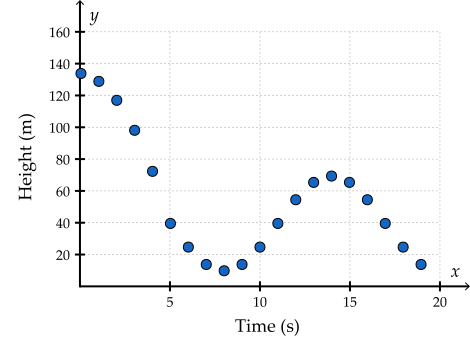
The first part of a bungee jump is free fall and is not influenced by the bungee cord.
From the data, Hollam's height decreases more slowly after \(5\) seconds which suggests that he was no longer free falling and the bungee cord was beginning to stretch.
We will use the domain \(\left\{ t\in\mathbb{R}\mid t\ge 5\right\}\) for our sinusoidal model.
Solution — Part B
Hollam's minimum height was \(9\) m at \(8\) seconds and his maximum rebound height was \(69\) m at \(14\) seconds. This could be half of a sinusoidal cycle with an amplitude of \(\lvert a\rvert=\dfrac{69-9}{2}=30\) m and an average height of \(k=\dfrac{69+9}{2}=39\) m. The period is \(2\left(14-8\right)=12\) seconds, so \(b=\dfrac{360}{12}=30\).
There are infinitely many functions that could model Hollam's height. Here are some sample functions.
The base sine function has a \(y\)-intercept on its axis and the function is increasing. If Hollam's function is
- a sine function, using the increasing axis point \(\left(11,39\right)\) then \(h=11\) and \(a\gt0\), \(h\left(t\right)=30\sin\left(30\left(t-11\right)\right)+39,~t\ge 5\);
- a sine function, using the decreasing axis point \(\left(5,39\right)\) then \(h=5\) and \(a\lt0\), \(h\left(t\right)=-30\sin\left(30\left(t-5\right)\right)+39,~t\ge 5\).
The base cosine function has a \(y\)-intercept at its maximum, so if Hollam's function is
- a cosine function, using the maximum point \(\left(14,69\right)\) then \(h=14\) and \(a\gt0\), \(h\left(t\right)=30\cos\left(30\left(t-14\right)\right)+39,~t\ge 5\);
- a cosine function, using the minimum point \(\left(8,9\right)\) then \(h=8\) and \(a\lt0\), \(h\left(t\right)=-30\cos\left(30\left(t-8\right)\right)+39,~t\ge 5\).
Try This Revisited
The average daily temperatures for each month in Winnipeg, Manitoba, Canada are in the table below.
| Month |
Jan |
Feb |
March |
April |
May |
June |
July |
Aug |
Sep |
Oct |
Nov |
Dec |
| High (\(^\circ\)C) |
\(-10\) |
\(-8\) |
\(0\) |
\(11\) |
\(17\) |
\(23\) |
\(26\) |
\(25\) |
\(20\) |
\(11\) |
\(2\) |
\(-8\) |
| Low (\(^\circ\)C) |
\(-18\) |
\(-17\) |
\(-9\) |
\(0\) |
\(7\) |
\(13\) |
\(16\) |
\(15\) |
\(10\) |
\(3\) |
\(-6\) |
\(-15\) |
- Write sinusoidal functions to model the average daily high temperatures and the average daily low temperatures.
- Compare the properties of the functions. Describe why some properties are similar and others are different.
Solution — Part A
The outdoor temperature depends on the seasons so a sinusoidal model with a period of \(12\) months and \(b=\dfrac{360}{12}=30\) is reasonable.
Average Daily High Temperature
Let \(H\left(m\right)\) represent the average daily high temperature, in \(^\circ\)C, of month \(m\), where \(m=1\) is January and \(m=12\) is December.
From the data, the amplitude of the model sinusoidal function could be \(\dfrac{26-\left(-10\right)}{2}=18\).
The average daily high temperature for the year could be \(\dfrac{26+\left(-10\right)}{2}=8\).
The maximum of the data occurs in July, so a cosine function model could be \(H\left(m\right)=18\cos\left(30\left(m-7\right)\right)+8\).
Average Daily Low Temperature
Let \(L\left(m\right)\) represent the average daily low temperature, in \(^\circ\)C, of month \(m\).
The amplitude of the model sinusoidal function could be \(\dfrac{16-\left(-18\right)}{2}=17\).
The average daily low temperature for the year could be \(\dfrac{16+\left(-18\right)}{2}=-1\).
The maximum of the data occurs in July, so a cosine function model could be \(L\left(m\right)=17\cos\left(30\left(m-7\right)\right)-1\).
Solution — Part B
The amplitude, period, and phase shift of the two models are almost identical. This implies that when the daily high temperature is warmer, the daily low temperature is also warmer. This is reasonable as warmer days typically correspond to warmer nights as well.
The vertical translations for the models are different, \(+8\) compared to \(-1\). Since the rest of the model parameters are similar, the \(k\) values suggest that throughout the year, the daily highs are about \(8-\left(-1\right)=9^\circ\)C warmer than the daily lows. Looking at the data, we can see that differences between the highs and lows for each month is between \(7^\circ\) and \(10^\circ\). This is useful when you leave your home in the early afternoon and want to know whether or not you will need a jacket in the evening.
Angle of Elevation
When an object is sighted above an observer's horizontal plane, the angle between the observer's line of sight and the horizontal is called the angle of elevation.
Example 6
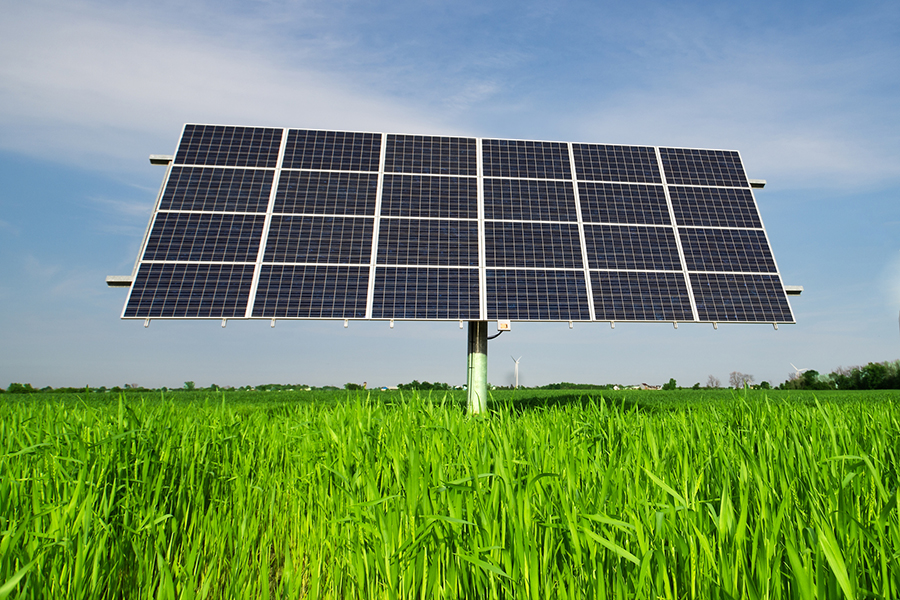
SunPower Company is getting ready to install a solar panel with a device that controls the angle the panel rests on its post. The panel works most effectively if the sun's rays are perpendicular to the panel surface at noon each day. For the installation site, the angle of elevation of the sun at noon on selected days of the year is shown. Day \(1\) is Jan. 1st and day \(365\) is Dec. 31st.
Source: Solar Panel - SimplyCreativePhotography/E+/Getty Images
| Day |
\(1\) |
\(31\) |
\(61\) |
\(91\) |
\(121\) |
\(151\) |
\(181\) |
\(211\) |
\(241\) |
\(271\) |
\(301\) |
\(331\) |
\(361\) |
| Angle (\(^\circ\)) |
\(53.8\) |
\(59.5\) |
\(67.2\) |
\(75.4\) |
\(83.2\) |
\(89.7\) |
\(91.3\) |
\(87.8\) |
\(79.0\) |
\(68.2\) |
\(58.3\) |
\(52.7\) |
\(53.2\) |
- Write a sinusoidal function SunPower could use to keep the panel at the most effective angle each day.
- What angle of elevation will the panel be facing on March 21st?
Solution — Part A
- We will assume we are modelling the angle of elevation for a non-leap year. If the function has a period of \(365\) days, then \(b=\dfrac{360}{365}=\dfrac{72}{73}\).
- From the data, the maximum angle is \(91.3^\circ\) and the minimum angle is \(52.7^\circ\).
- The amplitude for the model is \(\dfrac{91.3-52.7}{2}=19.3\) and \(k=\dfrac{91.3+52.7}{2}=72\).
Using a cosine function and the maximum data point \(\left(181,91.3\right)\), the model function is \(A\left(d\right)=19.3\cos\left(\dfrac{72}{73}\left(d-181\right)\right)+72\), where \(A\left(d\right)\) is the angle of elevation of the sun in degrees and \(d\) is the day of the year, day \(1\) is January 1st.
Alternatively, for a sine function model, we could use the increasing axis point one-quarter of the period or \(\dfrac{365}4=91.25\) days before the maximum at \(\left(89.75,72\right)\) so \(h=89.75\). The parameters \(a\), \(b\), and \(k\) would be the same as in previous cosine model, so the model function would be \(A\left(d\right)=19.3\sin\left(\dfrac{72}{73}\left(d-89.75\right)\right)+72\).
Solution — Part B
To determine the angle of elevation on March 21st, we need to determine the day number, and then evaluate the model function. Using the cosine model,
- January has \(31\) days and February has \(28\) days, so March 21st is the \(80\)th day of the year.\[A\left(80\right)=19.3\cos\left(\dfrac{72}{73}\left(80-181\right)\right)+72\approx68.7759\]
- On March 21st, the angle of elevation that the panel should be facing is approximately \(68.8^\circ\).