The pendulum of an antique clock makes \(30\) complete swings in one minute. A complete swing moves the pendulum from the extreme right point, \(R\), to the extreme left point, \(L\), and back to \(R\) again. The horizontal distance between the two extreme points \(R\) and \(L\) is \(36\) cm.
b. Draw a sketch to model the pendulum swing for the first \(6\) seconds. Assume the pendulum starts at \(R\).
Solution
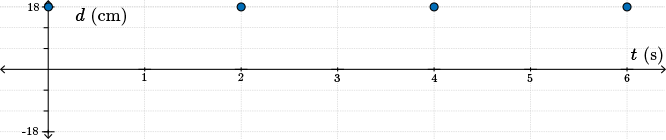


Let \(d\) represent the horizontal distance from \(\color{Mulberry}M\), with positive distance to the right and negative distance to the left.
When the pendulum is at \(\color{NavyBlue}R\), \(d=18\). When the pendulum is at \(\color{BrickRed}L\), \(d=-18\).
Since the period is \(2\) seconds, the pendulum will be at \(\color{NavyBlue}R\), a maximum, at \(0\), \(2\), \(4\), and \(6\) seconds.
The minimum will occur at the halfway point of each period so the pendulum will be at \(\color{BrickRed} L\) at \(1\), \(3\), and \(5\) seconds.
And halfway between the maximum and minimum, the pendulum will be at \(\color{Mulberry}M\).
The pendulum will be at \(\color{Mulberry}M\) at \(0.5\), \(1.5\), \(2.5\), \(3.5\), \(4.5\), and \(5.5\) seconds.
A sketch is shown.