Translations Alternate Format
Lesson Part 1
Today, we will begin our look at transformations.
Introduction to Transformations
A transformation changes one or more of the location, shape, size, or orientation of an object in the coordinate plane.
The object could be, for example, a function like \(y=x^2\), or a geometric shape, like \(\triangle ABD\), shown below.
The initial object is called the pre-image.
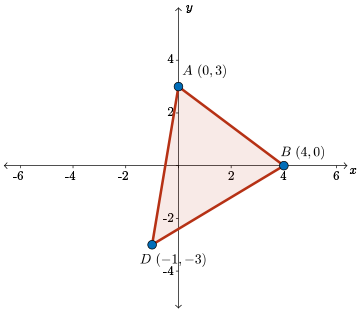
The object that results after transforming the pre-image is called the image.
When moving from \(A\) to \(B\) to \(D\) in \(\triangle ABD\), we would say that there is a clockwise orientation.
Let's create an image by sliding \(\triangle ABD\) \(2\) units to the left and \(1\) unit down.
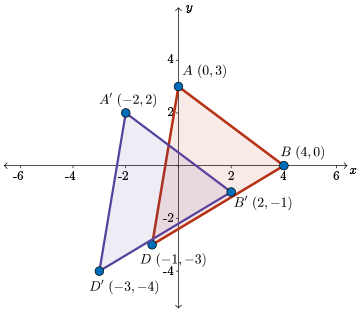
A transformation that changes only the location of the object in the plane is called a translation.
The size, shape, and orientation of \(\triangle ABD\) would not be changed as a result of sliding the triangle to the left and down.
The point that corresponds to \(A\) on the image is \(A'\), to \(B\) is \(B'\), and to \(D\) is \(D'\).
We would read “\(A'\)” as “\(A\) prime.”
You'll see a chart that shows the pre-image and the image of each pre-image point, \(A\), \(B\), and \(D\).
| Pre-image |
|
Image |
| \((x,y)\) |
\(\rightarrow\) |
\((x',y')\) |
| \(A\ (0,3)\) |
\(\rightarrow\) |
\(A'\ (-2,2)\) |
| \(B\ (4,0)\) |
\(\rightarrow\) |
\(B'\ (2,-1)\) |
| \(D\ (-1,-3)\) |
\(\rightarrow\) |
\(D'\ (-3,-4)\) |
We can describe the translation using mapping notation as \((x,y)\rightarrow (x-2,y-1)\).
Translations
We are interested in the following:
- Compare the graph of a function \(y=f(x-h)+k\) to the graph of \(y=f(x)\). We want to develop a rule to describe the effect of \(h\) and \(k\).
- Sketch the graph of \(y=f(x-h)+k\), for specific values of \(h\) and \(k\), given the sketch of the function \(f(x)\), where the equation of \(f(x)\) is not given.
- Write the equation of a function whose graph is a translation of the function \(y=f(x)\).
For some function \(y=f(x-h)+k\), what is the effect of \(h\) and \(k\) on \(y=f(x)\)?
To investigate this use the following worksheet.
When you have finished the investigation, you should be able to describe the effect of \(h\) and \(k\) on \(y=f(x)\) when \(h\) is positive or negative, and when \(k\) is positive or negative.
Investigation
See the investigation in the side navigation.
Lesson Part 2
Vertical and Horizontal Translations
You should have discovered the following after doing the investigation.
For \(y=f(x)+k\),
- when \(k\gt0\), the graph of \(y=f(x)\) is translated up \(k\) units, and
- when \(k\lt 0\), the graph of \(y=f(x)\) is translated down \(\lvert k\rvert\) units.
On the graph shown, \(y=f(x)\) is translated \(2\) units up to obtain \(y=f(x)+2\), and \(4\) units down to obtain \(y=f(x)-4\).
For \(y=f(x-h)\),
- when \(h\gt0\), the graph of \(y=f(x)\) is translated right \(h\) units, and
- when \(h\lt0\), the graph of \(y=f(x)\) is translated left \(\lvert h \rvert\) units.
On the graph shown, \(y=\lvert x\rvert\) is translated \(4\) units right to obtain \(y=\lvert x-4\rvert\), and \(3\) units left to obtain \(y=\lvert x+3\rvert\).
How are \(y=f(x-h)+k\) and \(y=f(x)\) related?
Translations are transformations which change the location of a function but do not change the size, shape, or orientation of the graph.
To get from \(y=f(x)\) to \(y=f(x-h)+k\), translate \(y=f(x)\) horizontally \(h\) units and vertically \(k\) units.
- If \(h\lt 0\), translate left.
- If \(h\gt 0\), translate right.
- If \(k\lt 0\), translate down.
- If \(k\gt 0\), translate up.
Using mapping notation, a horizontal translation of \(h\) units and a vertical translation of \(k\) units would be written
\[(x,y)\rightarrow (x+h,y+k)\]
To sketch the graph of \(y=f(x-h)+k\), translate key points on the base graph \(y=f(x)\).
Check Your Understanding A and B
These questions are not included in the Alternative Format, but can be accessed in the Review section of the side navigation.
Lesson Part 3
Examples
Example 1
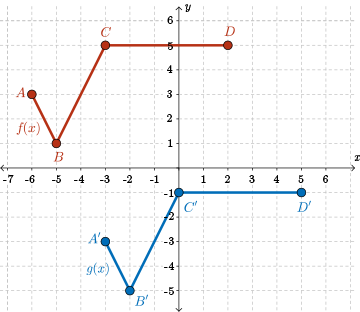
The graph of \(g(x)\) has been obtained by translating \(f(x)\). Determine the equation of \(g(x)\) in terms of \(f(x)\).
Solution
Match the points on \(f(x)\) to their images on \(g(x)\).
Look for the mapping that is applied to each pre-image point to obtain each corresponding image point.
\[ \begin{align*} A\ (-6,3) &\rightarrow A'\ (-3,-3) \\ B\ (-5,1) &\rightarrow B'\ (-2,-5) \\ C\ (-3,5) &\rightarrow C'\ (0,-1) \\ D\ (2,5) &\rightarrow D'\ (5,-1) \\ \end{align*} \]
Therefore, \((x,y)\rightarrow(x+3,y-6)\).
It follows that \(h=3\) and \(k=-6\).
Substituting into \(g(x)=f(x-h)+k\), we obtain \(g(x)=f(x-3)-6\).
Check Your Understanding C
This question is not included in the Alternative Format, but can be accessed in the Review section of the side navigation.
Example 2
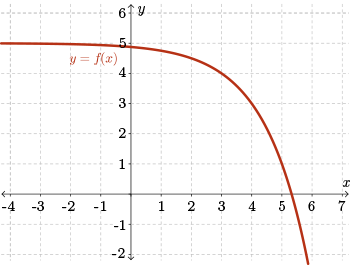
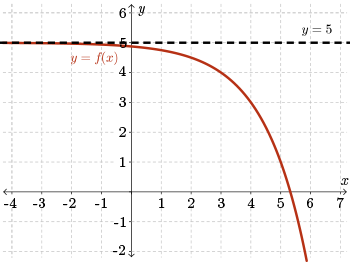
Given the function \(f(x)\) shown on the grid, sketch \(y=f(x+2)-3\).
Solution
Comparing \(y=f(x+2)-3\) to \(y=f(x-h)+k\), we see that \(h=-2\) and \(k=-3\).
Therefore, the translation maps each point on \(y=f(x)\) left \(2\) units and down \(3\) units.
In mapping notation, the translation is written
\[(x,y)\rightarrow (x-2,y-3)\]
It would appear from the graph that there is a horizontal asymptote at \(y=5\).
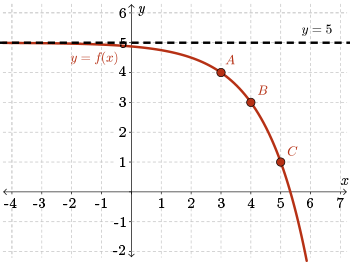
It would also appear that the graph of \(f(x)\) passes through the points \(A\ (3,4)\), \(B\ (4,3)\), and \(C\ (5,1)\).
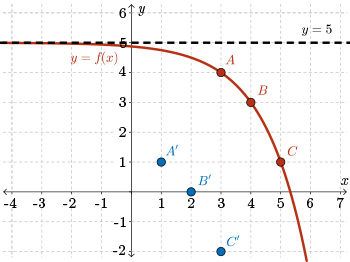
Applying the transformation to the \(3\) known points on the pre-image, we see that \(A\ (3,4)\rightarrow A'\ (1,1),\ B\ (4,3)\rightarrow B'\ (2,0),\) and \(C\ (5,1)\rightarrow C'\ (3,-2)\).
The horizontal asymptote \(y=5\) is not affected by the horizontal translation to the left, but moves down \(3\) units so that \(y=2\) is a horizontal asymptote of the image.
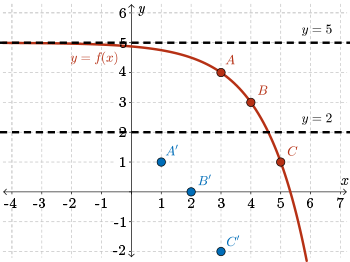
The final graph is shown.

Example 3 — Part A
Determine the equation of the following function. State the domain and range of the image. Sketch the image.
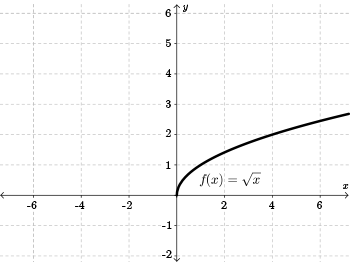
The function \(f(x)=\sqrt{x}\) is translated horizontally \(5\) units to the left.
Solution
Since the translation only moves the function \(5\) units to the left, \(h=-5\) and \(k=0\) in our general function, \(y=f(x-h)+k\).
Since \(f(x)=\sqrt{x}\), \(y=\sqrt{x-h}+k\).
Substituting for \(h\) and \(k\), the equation of the image is \(y=\sqrt{x+5}\).
The domain of \(f(x)=\sqrt{x}\) is \(\{x\mid x\ge 0,x\in \mathbb{R}\}\).
Translating the function \(5\) units to the left shifts the domain \(5\) units to the left.
It follows that the domain of \(y=\sqrt{x+5}\) is \(\{x\mid x\ge -5,x\in \mathbb{R}\}\).
The range of \(f(x)=\sqrt{x}\) is \(\{y\mid y\ge 0,y\in \mathbb{R}\}\).
Since the function is not translated vertically, the range is unchanged.
That is, the range of \(y=\sqrt{x+5}\) is \(\{y\mid y\ge 0,y\in \mathbb{R}\}\).
By knowing how to efficiently sketch \(f(x)=\sqrt{x}\), the image \(y=\sqrt{x+5}\) is easily sketched.
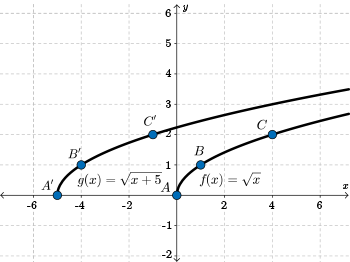
One benefit of having the sketch is that we could use it to obtain the domain and range or to confirm the accuracy of our domain and range.
Example 3 — Part B
Determine the equation of the following function. State the domain and range of the image. Sketch the image.
The mapping \((x,y)\rightarrow (x+3,y+5)\) is applied to \(f(x)=\dfrac{1}{x}\).
Solution
Each point on \(f(x)=\dfrac{1}{x}\) is translated \(3\) units to the right and \(5\) units up.
It follows that \(h=3\) and \(k=5\) in \(y=f(x-h)+k\).
Since \(f(x)=\dfrac{1}{x}\), \(y=\dfrac{1}{x-h}+k\).
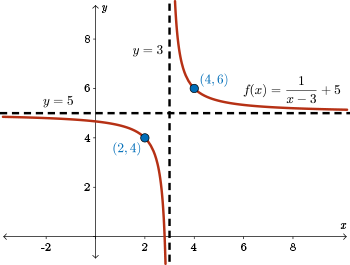
Substituting for \(h\) and \(k\), the equation of the image is \(y=\dfrac{1}{x-3}+5\).
The vertical asymptote of the base function, \(f(x)=\dfrac{1}{x}\), is \(x=0\).
The translation moves it \(3\) units to the right.
Therefore, the vertical asymptote of the image is \(x=3\).
The horizontal asymptote of the base function, \(f(x)=\dfrac{1}{x}\), is \(y=0\).
The translation moves it \(5\) units up.
Therefore, the horizontal asymptote of the image is \(y=5\).
The domain of \(f(x)=\dfrac{1}{x}\) is \(\{x\mid x\not = 0,x\in \mathbb{R}\}\).
Translating the function \(3\) units to the right moves the restriction on \(x\), in the domain, \(3\) units to the right.
It follows that the domain is \(\{x\mid x\not = 3,x\in \mathbb{R}\}\).
The range of \(f(x)=\dfrac{1}{x}\) is \(\{y\mid y\not = 0,y\in \mathbb{R}\}\).
Translating the function \(5\) units up moves the restriction on \(y\), in the range, \(5\) units up.
It follows that the range is \(\{y\mid y\not = 5,y\in \mathbb{R}\}\).
By knowing how to efficiently sketch \(f(x)=\dfrac{1}{x}\), the image \(y=\dfrac{1}{x-3}+5\) is easily sketched.
Lesson Part 4
Examples
Let's take our example to a higher level. Let's see if we can solve a slightly more difficult problem.
Example 4
Determine the translation which maps \(y=x^2+8x+11\) onto \(y=x^2+3\).
Solution
Based on your prior knowledge of quadratic functions, both functions are congruent to \(y=x^2\).
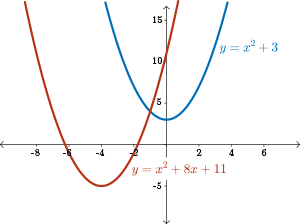
Their locations are different.
If we could find the vertex of each parabola, then we could determine the translation which maps the pre-image vertex onto the image vertex.
This would, in fact, be the translation we are looking for.
The image \(y=x^2+3\) has vertex \(V'\ (0,3)\).
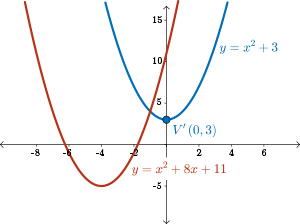
To find the vertex of the pre-image, we need to write it in vertex form. We will do so by completing the square.
Complete the square on \(y=x^2+8x+11\) to rewrite the pre-image equation in vertex form.
\[ \begin{align*} y &= x^2+8x+11 \\ &= x^2+8x+4^2-4^2+11 \\ &= (x+4)^2-16+11 \\ &= (x+4)^2-5 \\ \end{align*} \]
The pre-image has vertex \(V\ (-4,-5)\).
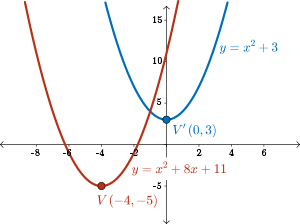
To move \(V\ (-4,-5)\) to \(V'\ (0,3)\), move right \(4\) units and up \(8\) units.
In mapping notation, the general translation is
\[(x,y)\rightarrow (x+4, y+8)\]
In function notation, if \(f(x)=x^2+8x+11\) and \(g(x)=x^2+3\), then \(g(x)=f(x-4)+8\).
Summary
- We have described translations in general.
- We have developed a general rule for translations.
- We have determined translations used to map pre-images onto images.
- We have sketched functions which were translations of other functions.
In future modules, we will examine reflections, stretches, and combinations of transformations.
Check Your Understanding D
This question is not included in the Alternative Format, but can be accessed in the Review section of the side navigation.