Stretches Alternative Format
Lesson Part 1
Introduction
In a previous module, we noted that a transformation changes one or more of the location, shape, size, or orientation of an object in the coordinate plane.
A translation changed the location of an object or function in the coordinate plane but left all other attributes the same.
A reflection in the \(x\)-axis or \(y\)-axis changed the orientation and location of the object or function in the coordinate plane but left all other attributes the same.
In this module, we examine
- horizontal stretches about the \(y\)-axis,
- vertical stretches about the \(x\)-axis, and
- stretches about both the \(x\)-axis and the \(y\)-axis.
Properties of Stretches
On the graph, \(\triangle ABC\) is stretched vertically about the \(x\)-axis by a factor of \(2\).
The image \(\triangle A'B'C'\) is shown.
We will use this specific diagram to make some observations about stretches.
The size of an object or shape of a function is changed as a result of a stretch.
The orientation is not changed.
On the pre-image, from \(A\) to \(B\) to \(C\), we move in a clockwise direction.
On the image, from \(A'\) to \(B'\) to \(C'\), we also move in a clockwise direction.
The perpendicular distance from the \(x\)-axis to any point on the image is twice as far as the perpendicular distance from the \(x\)-axis to the corresponding point on the pre-image.
On the diagram, \(\lvert PB'\rvert=2\times \lvert PB\rvert\) and \(\lvert QC'\rvert=2\times \lvert QC\rvert\).
The absolute value bars are used to indicate the length of each line segment.
Any point on the \(x\)-axis will be invariant as a result of a vertical stretch about the \(x\)-axis.
In this case, \(A(1,0)\) is invariant, so naming it \(AA'\) is a little bit redundant.
Vertical stretches about the \(x\)-axis
To start with our stretches today, we need to do a little bit of a warm up as we get into stretches.
Example 1
Consider the function \(y=f(x)\). Five specific points on the function are shown. 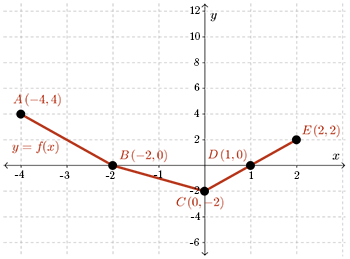
Sketch the graph \(g(x)=3f(x)\).
Solution
Using a table of values, we will determine the image points associated with the five specific points on \(f(x)\).
So the first two columns of the table of values indicate the \(x\) and \(y\)-coordinates of the pre-image points.
The first and third columns are the \(x\) and \(y\)-coordinates of the image point.
\[ \begin{array}{c|c|c} x & y=f(x) & y=g(x)=3f(x) \\ \hline-4 & 4 & 12 \\ -2 & 0 & 0 \\ 0 & -2 & -6 \\ 1 & 0 & 0 \\ 2 & 2 & 6 \\ \end{array} \]
The image is shown on the graph. 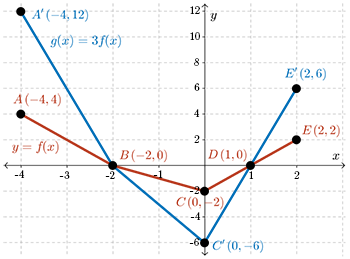
Comparing the image points to the corresponding pre-image points, note that the \(x\)-coordinates are unchanged and the \(y\)-coordinates are \(3\) times their original value.
To obtain an image point, the mapping is \((x,y)\rightarrow (x,3y)\).
Points \(B\) and \(D\) are invariant since they are on the \(x\)-axis.
We would say that \(y=f(x)\) is stretched vertically about the \(x\)-axis by a factor of \(3\).
Example 2
Consider the function \(y=f(x)\). Five specific points on the function are shown. 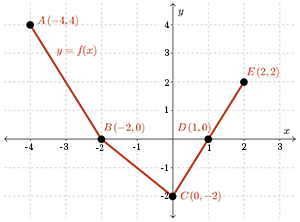
Sketch the graph \(g(x)=\dfrac{1}{2}f(x)\).
Solution
Using a table of values, we will determine the image points associated with the five specific points on the pre-image \(y=f(x)\).
\[ \begin{array}{c|c|c} x & y=f(x) & y=g(x)=\dfrac{1}{2}f(x) \\ \hline-4 & 4 & 2 \\ -2 & 0 & 0 \\ 0 & -2 & -1 \\ 1 & 0 & 0 \\ 2 & 2 & 1 \\ \end{array} \]
The image is shown on the graph. 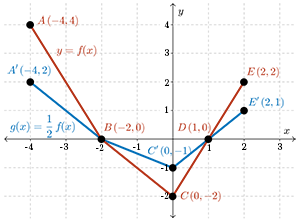
Comparing the image points to the corresponding pre-image points, note that the \(x\)-coordinates are unchanged and the \(y\)-coordinates are half of their original value.
To obtain an image point, the mapping is \((x,y)\rightarrow \left(x,\frac{1}{2}y\right)\).
Points \(B\) and \(D\) are invariant since they are on the \(x\)-axis.
We would say that \(y=f(x)\) is stretched vertically about the \(x\)-axis by a factor of \(\frac{1}{2}\).
Worksheet
Can we make some general conclusions concerning vertical stretches about the \(x\)-axis?
Use the worksheet to further investigate vertical stretches about the \(x\)-axis.
Using a slider to change the values of \(a\) in \(y=af(x)\), you will be able to stretch our five base functions.
When you have completed the investigation, you should be able to make conclusions about comparing \(y=af(x)\) to \(y=f(x)\) for values of \(a\gt 1\) and for values of \(a\) such that \(0\lt a \lt 1\).
Investigation 1
See Investigation 1 in the side navigation.
Lesson Part 2
Vertical stretches about the \(x\)-axis
You should have discovered the following after doing the investigation:
For \(y=f(x)\), if \(g(x)=af(x)\) and \(a\gt 1\), then \(g(x)\) is a vertical stretch of \(f(x)\) about the \(x\)-axis by a factor of \(a\).
Example 3
If \(f(x)=\sqrt{x}\) and \(g(x)=2f(x)\), then \(g(x)=2\sqrt{x}\) is a vertical stretch of \(f(x)\) about the \(x\)-axis by a factor of \(2\).
Since \(A(0,0)\) is on the \(x\)-axis, \(A(0,0)\) is an invariant point.
The distance of any other image point from the \(x\)-axis is \(2\) times the distance of the corresponding pre-image point from the \(x\)-axis.
For example, \(C'\) is \(4\) units from the \(x\)-axis and \(C\) is \(2\) units from the \(x\)-axis.
You should have noticed the following after doing the investigation.
For \(y=f(x)\), if \(g(x)=af(x)\) and \(0\lt a\lt 1\), then \(g(x)\) is a vertical stretch of \(f(x)\) about the \(x\)-axis by a factor of \(a\).
This sounds the same, but the effect is different.
Example 4
If \(f(x)=x^2\) and \(g(x)=\dfrac{1}{4}f(x)\), then \(g(x)=\dfrac{1}{4}x^2\) is a vertical stretch of \(f(x)\) about the \(x\)-axis by a factor of \(\dfrac{1}{4}\).
Since \(C(0,0)\) is on the \(x\)-axis, \(C(0,0)\) is an invariant point.
The distance of any other image point from the \(x\)-axis is one-quarter of the distance of the corresponding pre-image point from the \(x\)-axis.
\(E'\) is \(1\) unit from the \(x\)-axis and \(E\) is \(4\) units from the \(x\)-axis.
Sometimes this type of stretch is referred to as a compression.
Check Your Understanding A
This question is not included in the Alternative Format, but can be accessed in the Review section of the side navigation.
Horizontal stretches about the \(y\)-axis
Example 5
Consider the function \(y=f(x)\). Five specific points on the function are shown. 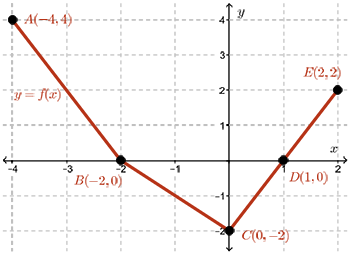
Sketch the graph \(g(x)=f(2x)\).
Solution
Since \(g(x)=f(2x)\), the \(y\)-coordinates of the image and pre-image points are the same.
At \(A(-4,4)\), we know that \(f(-4)=4\).
We want to determine the value of \(x\) so that \(g(x)=f(2x)=f(-4)=4\).
It follows that \(2x=-4\) and \(x=-2\).
Therefore, \(g(-2)=4\) and \(A'\), the image of \(A\), is \((-2,4)\).
At \(B(-2,0)\), we know that \(f(-2)=0\).
We want to determine the value of \(x\) so that \(g(x)=f(2x)=f(-2)=0\).
It follows that \(2x=-2\) and \(x=-1\).
Therefore, \(g(-1)=0\) and \(B'\) is \((-1,0)\).
Using the same reasoning, \(D(1,0)\rightarrow D'\left(\dfrac{1}{2},0\right)\) and \(E(2,2)\rightarrow E'(1,2)\).
The image is shown on the graph. 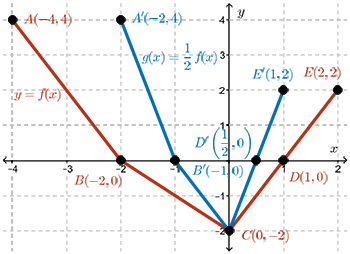
The \(y\)-coordinates are unchanged and the \(x\)-coordinates are half of their original values.
The mapping appears to be \((x,y)\rightarrow \left(\dfrac{1}{2}x,y\right)\).
Point \(C\) is invariant since it is on the \(y\)-axis.
We would say that \(y=f(x)\) is stretched horizontally about the \(y\)-axis by a factor of \(\dfrac{1}{2}\).
As mentioned earlier, this may also be referred to as a compression.
Check Your Understanding B
This question is not included in the Alternative Format, but can be accessed in the Review section of the side navigation.
Worksheet
Can we make other conclusions concerning horizontal stretches about the \(y\)-axis?
If we graph \(y=f(bx)\) for \(b\gt 1\), will the pre-image points on \(y=f(x)\) always move horizontally closer to the \(y\)-axis?
What happens when we graph \(y=f(bx)\) for \(0\lt b \lt 1\)?
Use the worksheet to further investigate horizontal stretches about the \(y\)-axis.
Using a slider to change the values of \(b\) in \(y=f(bx)\), you will be able to stretch our five base functions.
When you have completed the investigation, you should be able to make conclusions about comparing \(y=f(bx)\) to \(y=f(x)\) for values of \(b\gt 1\) and for values of \(b\) such that \(0\lt b \lt 1\).
Investigation 2
See Investigation 2 in the side navigation.
Lesson Part 3
Horizontal stretches about the \(y\)-axis
You should have discovered the following after doing the investigation:
For \(y=f(x)\), if \(g(x)=f(bx)\) and \(b \gt 1\), then \(g(x)\) is a horizontal stretch of \(f(x)\) about the \(y\)-axis by a factor of \(\dfrac{1}{b}\).
Example 6
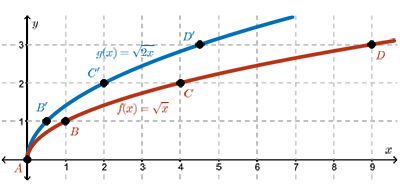
If \(f(x)=\sqrt{x}\) and \(g(x)=f(2x)\), then \(g(x)=\sqrt{2x}\) is a horizontal stretch of \(f(x)\) about the \(y\)-axis by a factor of \(\dfrac{1}{2}\).
Since \(A(0,0)\) is on the \(y\)-axis, \(A(0,0)\) is an invariant point.
The distance of any other image point from the \(y\)-axis is half the distance of the corresponding pre-image point from the \(y\)-axis.
\(C'\) is \(2\) units from the \(y\)-axis and \(C\) is \(4\) units from the \(y\)-axis.
Sometimes this type of stretch is referred to as a compression.
You should have also discovered the following after doing the investigation:
For \(y=f(x)\), if \(g(x)=f(bx)\) and \(0\lt b\lt 1\), then \(g(x)\) is a horizontal stretch of \(f(x)\) about the \(y\)-axis by a factor of \(\dfrac{1}{b}\).
Example 7
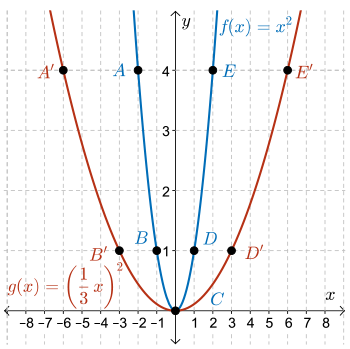
If \(f(x)=x^2\) and \(g(x)=f\left(\dfrac{1}{3}x\right)\), then \(g(x)=\left(\dfrac{1}{3}x\right)^2\) is a horizontal stretch of \(f(x)\) about the \(y\)-axis by a factor of \(\dfrac{1}{\left(\frac{1}{3}\right)}=3\).
Since \(C(0,0)\) is on the \(y\)-axis, \(C(0,0)\) is an invariant point.
The distance of any other image point from the \(y\)-axis is \(3\) times the distance of the corresponding pre-image point from the \(y\)-axis.
\(E'\) is \(6\) units from the \(y\)-axis and \(E\) is \(2\) units from the \(y\)-axis.
Notice that \(g(x)=\left(\dfrac{1}{3}x\right)^2\) simplifies to \(g(x)=\dfrac{1}{9}x^2\).
A vertical stretch of \(f(x)=x^2\) by a factor of \(\dfrac{1}{9}\) about the \(x\)-axis would have the same effect as this horizontal stretch.
Sketching
Example 8
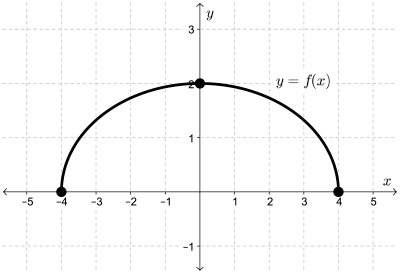
Given the relation \(y=f(x)\) shown on the grid, sketch \(y=\dfrac{1}{2}f(x)\).
Solution
To graph \(y=\dfrac{1}{2}f(x)\), note that the transformation is a vertical stretch of \(y=f(x)\) by a factor of \(\dfrac{1}{2}\) about the \(x\)-axis.
The points \((-4,0)\) and \((4,0)\) on the \(x\)-axis are invariant.
The point \((0,2)\) on the \(y\)-axis compresses to \((0,1)\). 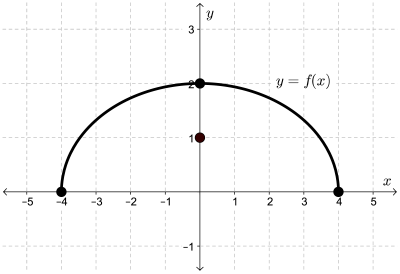
The sketch of \(y=\dfrac{1}{2}f(x)\) is shown on the graph. 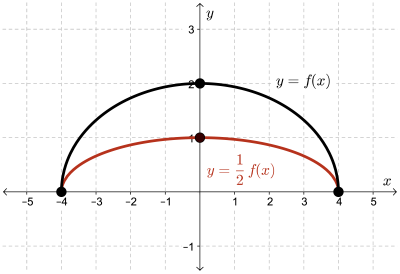
Example 9
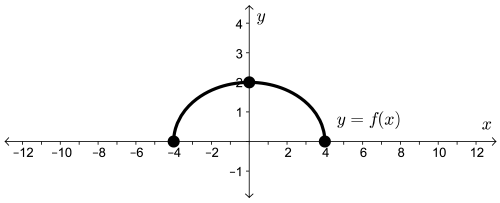
Given the relation \(y=f(x)\) shown on the grid, sketch \(y=f\left(\dfrac{1}{3}x\right)\).
Solution
To graph \(y=f\left(\dfrac{1}{3}x\right)\), note that the transformation is a horizontal stretch of \(y=f(x)\) by a factor of \(3\) about the \(y\)-axis.
The points \((0,2)\) and \((0,-2)\) on the \(y\)-axis are invariant.
We can take some points that are not on the y-axis and apply the transformation.
The point \((4,0)\rightarrow (12,0)\) and \((-4,0)\rightarrow (-12,0)\). 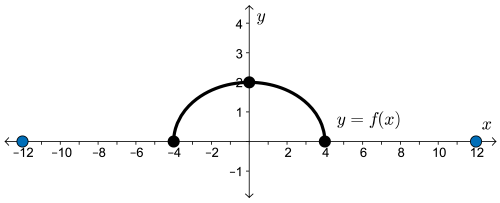
The sketch of \(y=f\left(\dfrac{1}{3}x\right)\) is shown on the graph. 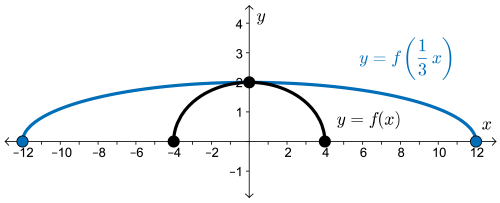
Example 10
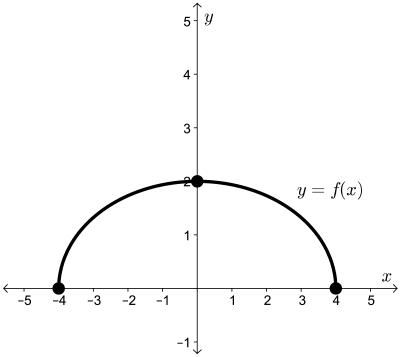
Given the relation \(y=f(x)\) shown on the grid, sketch \(y=2f(4x)\).
Solution
To graph \(y=2f(4x)\), note that the transformation is a horizontal stretch of \(y=f(x)\) by a factor of \(\dfrac{1}{4}\) about the \(y\)-axis and a vertical stretch of \(y=f(x)\) by a factor of \(2\) about the \(x\)-axis.
There are no invariant points.
Using mapping notation, \((x,y)\rightarrow \left(\dfrac{1}{4}x,2y\right)\).
The point \((4,0)\rightarrow (1,0)\) and \((-4,0)\rightarrow (-1,0)\).
The point \((0,2)\rightarrow (0,4)\) and \((0,-2)\rightarrow (0,-4)\). 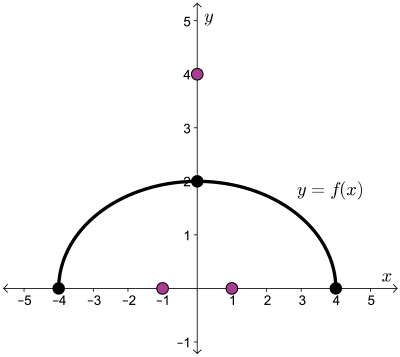
The sketch of \(y=2f\left(4x\right)\) is shown on the graph. 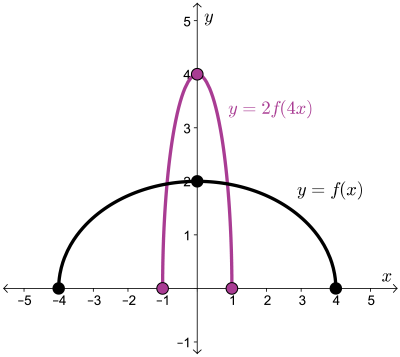
Check Your Understanding C
This question is not included in the Alternative Format, but can be accessed in the Review section of the side navigation.
Lesson Part 4
Determine the Equation
Example 11
The graph shows two functions, the pre-image \(f(x)=\lvert x\rvert\) and image \(g(x)\).
Determine an equation for \(g(x)\) in terms of \(f(x)\). 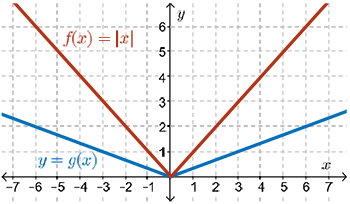
Two solutions will be provided for this example.
Solution 1
The origin \((0,0)\) is invariant and the shape has been changed from pre-image to image.
Could this be a vertical stretch about the \(x\)-axis?
Draw a few vertical lines from the \(x\)-axis to the pre-image and image.
These are shown on the graph. 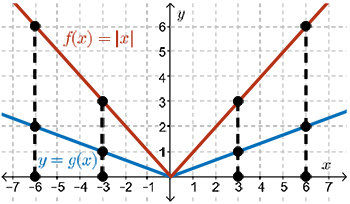
The table shows several pre-image points and the corresponding image points.
\[ \begin{array}{c c c}(x,y) & \rightarrow & (x',y') \\ \hline (-6,6) & \rightarrow & (-6,2) \\ (-3,3) & \rightarrow & (-3,1) \\ (0,0) & \rightarrow & (0,0) \\ (3,3) & \rightarrow & (3,1) \\ (6,6) & \rightarrow & (6,2) \\ \end{array} \]
It appears that \((x,y)\rightarrow \left(x,\dfrac{1}{3}y\right)\).
This is a vertical stretch of \(f(x)\) by a factor of \(\dfrac{1}{3}\) about the \(x\)-axis.
Therefore, \(g(x)=\dfrac{1}{3}f(x)=\dfrac{1}{3}\lvert x \rvert\).
But could this \(g(x)\) described another way?
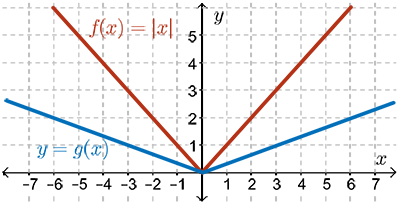
Solution 2
The origin \((0,0)\) is invariant and the shape has been changed from pre-image to image.
Could this be a horizontal stretch about the \(y\)-axis?
Draw a few horizontal lines from the \(y\)-axis to the pre-image and image.
These are shown on the graph. 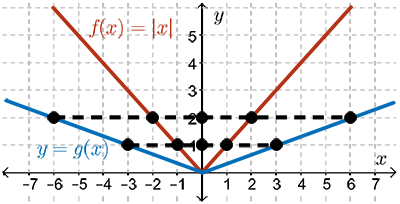
The table shows several pre-image points and the corresponding image points.
\[ \begin{array}{c c c}(x,y) & \rightarrow & (x',y') \\ \hline (-2,2) & \rightarrow & (-6,2) \\ (-1,1) & \rightarrow & (-3,1) \\ (0,0) & \rightarrow & (0,0) \\ (1,1) & \rightarrow & (3,1) \\ (2,2) & \rightarrow & (6,2) \\ \end{array} \]
It appears that \((x,y)\rightarrow (3x,y)\).
This is a horizontal stretch of \(f(x)\) by a factor of \(3\) about the \(y\)-axis.
Therefore, \(g(x)=f\left(\dfrac{1}{3}x\right)=\left| \dfrac{1}{3}x \right|\).
We also saw that \(g(x)=\dfrac{1}{3}f(x)=\dfrac{1}{3}\lvert x \rvert\). So, \(\dfrac{1}{3}\lvert x \rvert=\left| \dfrac{1}{3}x \right|\).
Example 12
The function \(f(x)=2^x\) is stretched vertically about the \(x\)-axis by a factor of \(3\) and horizontally about the \(y\)-axis by a factor of \(\dfrac{1}{2}\).
Determine the equation of the image. Sketch both the pre-image and the image.
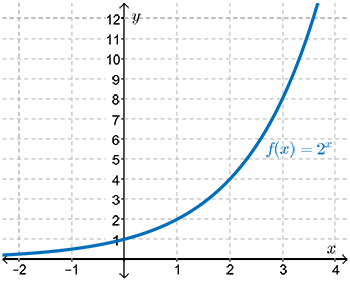
Solution
Let \(g(x)\) be the image of \(f(x)\) after being stretched about the \(x\)-axis and \(y\)-axis.
Then, \(g(x)=af(bx)=a(2)^{bx}\).
Since the vertical stretch factor is \(3\), \(a=3\).
Since the horizontal stretch factor is \(\dfrac{1}{2}\), \(b=2\).
Then, \(g(x)=3(2)^{2x}\).
To sketch the image, we can take “key” points on the pre-image function \(f(x)=2^x\) and apply the mapping \((x,y)\rightarrow \left(\dfrac{1}{2}x,3y\right)\).
\[ \begin{array}{c c c}(x,y) & \rightarrow & (x',y') \\ \hline \left(-1,\frac{1}{2}\right) & \rightarrow & \left(-\frac{1}{2},\frac{3}{2}\right) \\ (0,1) & \rightarrow & (0,3) \\ (1,2) & \rightarrow & \left(\frac{1}{2},6\right) \\ (2,4) & \rightarrow & (1,12) \\ \end{array} \]
This could be done with a table of values or directly from the graph of the pre-image.
The final graph is shown. 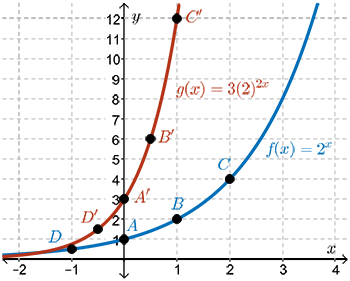
Check Your Understanding D, E and F
These questions are not included in the Alternative Format, but can be accessed in the Review section of the side navigation.
Summary
Throughout this module we have examined vertical stretches about the \(x\)-axis and horizontal stretches about the \(y\)-axis.
In earlier modules, we examined horizontal and vertical translations and reflections in the \(x\)-axis and \(y\)-axis.
In a future module, we will apply multiple transformations to relations and functions.
We will combine the various transformations to compare \(g(x)=af\left[b(x-h)\right]+k\) to \(y=f(x)\).
Investigation 3
See Investigation 3 in the side navigation.