Even and Odd Polynomial Functions Alternative Format
Lesson Part 1
Knowing the symmetry of a function can be very beneficial when graphing the function for the first time.
In This Module
- We will investigate the symmetry of higher degree polynomial functions.
- We will generalize a rule that will assist us in recognizing even and odd symmetry, when it occurs in a polynomial function.
Symmetry in Polynomials
Recall, a function can be even, odd, or neither depending on its symmetry.
If a function is symmetric about the \(y\)-axis, then the function is an even function and \(f(-x)=f(x)\).
If a function is symmetric about the origin, that is \(f(-x)=-f(x)\), then it is an odd function.
The cubic function, \(y=x^3\), an odd degree polynomial function, is an odd function.
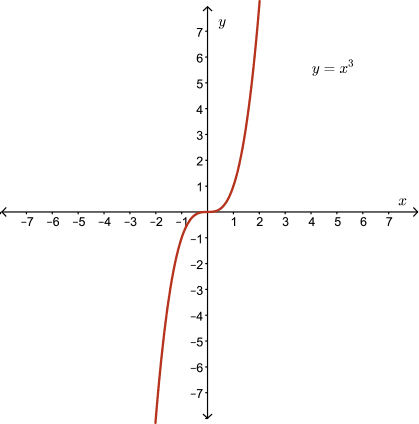
That is, the function is symmetric about the origin.
If the graph of the function is reflected in the \(x\)-axis, followed by a reflection in the \(y\)-axis, it will map onto itself.
We can also determine algebraically that this function, \(y = x^{3}\), is odd by showing that \(f(-x) = -f(x)\).
Algebraically,
\[f(-x)=(-x)^3=-x^3=-f(x)\]
Since \(f(-x)=-f(x)\), \(y=x^3\) is an odd function.
Is this the case for all cubic functions?
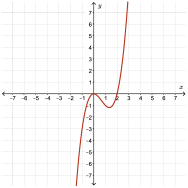
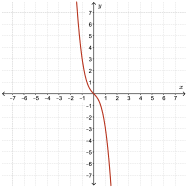
Consider the following cubic functions and their graphs. Can you identify any even or odd symmetry in the graphs of these functions?
\[(1) \ y=2x^3+x^2-x+1\]
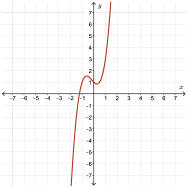
\[(2)\ y=x^3-2x\]
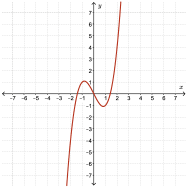
\[(3)\ y=x^3-2x-3\]
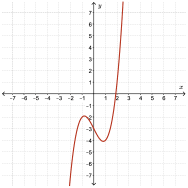
\[(4)\ y=x^3-2x^2\]
\[(5)\ y=-2x^3-x\]
\[(6)\ y=-\frac{1}{2}x^3+x\]
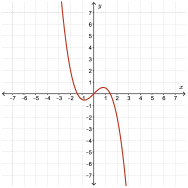
None of these functions have even symmetry. That is, no function is symmetric about its \(y\)-axis. The \(3\) odd functions, those symmetrical about the origin, are numbers \(2\), \(5\), and \(6\).
| \((2)\ y=x^3-2x\) |
\((5)\ y=-2x^3-x\) |
\((6)\ y=-\frac{1}{2}x^3+x\) |
|
|
|
What do these functions have in common?
They have a term of degree \(3\) and a term of degree \(1\); that is, an \(x^3\) term and an \(x\) term.
The other \(3\) functions defined by
\[y=2x^3+x^2-x+1\qquad y=x^3-2x-3\qquad y=x^3-2x^2\]
are neither even nor odd.
Along with an odd degree term, \(x^3\), these functions also have terms of even degree; that is, an \(x^2\) term and/or a constant term of degree \(0\).
It appears an odd polynomial must have only odd degree terms.
Use the investigation provided to test this hypothesis. Graph a variety of cubic functions and identify any even or odd symmetry that may occur. Create equations of cubic functions with only odd-degree terms. What do you notice? Can you create a cubic function with even symmetry?
Investigation 1
See Investigation 1 in the table of contents.
Lesson Part 2
Let us look at this situation algebraically. We will start by defining \(f(x)\) to be the general third-degree polynomial function of the form
\[f(x)=ax^3+bx^2+cx+d, \text{ where } a \neq 0.\]
We can then determine the expression for \(f(-x)\). By comparing this expression to the expression for \(f(x)\), we can show that \(f(-x) \neq f(x)\) for any value of \(a\), \(b\), \(c\), or \(d\), since \(a \neq 0\).
\begin{align*} f(-x) &= a(-x)^3 + b(-x)^2 + c(-x) + d \\ &= -ax^3 + bx^2 - cx + d \\ &\neq f(x) \end{align*}
for any values of \(a\), \(b\), \(c\), or \(d\) since \(a \neq 0\).
Therefore, a cubic function is never an even function.
We now find the expression for \(-f(x)\).
\[-f(x)=-ax^3-bx^2-cx-d\]
By comparing \(-f(x)\) to \(f(-x)\), we see \(f(-x)=-f(x)\) when \(b=0\) and \(d=0\), that is when \(f(x)=ax^3+cx\).
This supports our earlier findings from the study of the sample graphs. A cubic function is an odd function when the terms of the function are all of an odd degree.
Therefore, cubic functions of the form \(f(x)=ax^3+cx\), \(a \neq 0\), are odd functions.
Similarly, it should follow that even polynomial functions would have only even degree terms.
If we consider the general \(4^{th}\) degree polynomial function,
\[f(x)=ax^4+bx^3+cx^2+dx+e\]
then
\begin{align*} f(-x) &= a(-x)^4 + b(-x)^3 + c(-x)^2 + d(-x) + e \\ &= ax^4 - bx^3 + cx^2 - dx + e \end{align*}
Setting the coefficients \(b=0\) and \(d=0\) will result in \(f(-x)=f(x)\), and hence an even function.
Therefore, quartic functions have even symmetry when the terms of the function are all even-degree terms.
\(f(x)=ax^4+cx^2+e\), \(a \neq 0\), are even functions.
We must still consider the expression for \(-f(x)\). In comparing this expression to the expression for \(f(-x)\), we can see that \(f(-x) \neq -f(x)\) for any values of \(a\), \(b\), \(c\), or \(d\), since \(a \neq 0\).
\[\begin{align*} -f(x) &= -ax^4-bx^3-cx^2-dx-e \\ &\neq f(-x) \end{align*} \]
for any values of \(a\), \(b\), \(c\), or \(d\) since \(a \neq 0\).
Therefore, a quartic function is never an odd function.
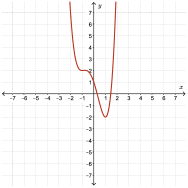
To illustrate the results graphically, we compare the following functions. Can you identify any even or odd symmetry in the graphs of these quartic functions?
\((1)\ y=x^4+x^3-2x^2-3x+1\)
\((2)\ y=x^4-2x^2+1\)
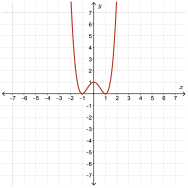
\((3)\ y=x^4+2x^3\)
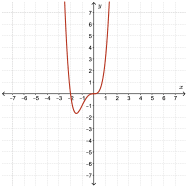
\((4)\ y=x^4-2x^3+x\)
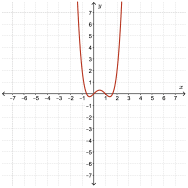
\((5)\ y=-2x^4+x^2\)
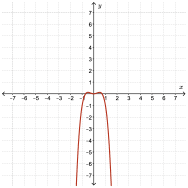
\((6)\ y=-2x^4-x^2+4x\)
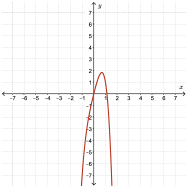
The graphs of these \(4^{th}\) degree polynomial functions support the algebraic findings. There are no odd functions in these examples, none of the graphs here are symmetrical about the origin, and the even functions are the quartic functions that have only even-degree terms, which is the case of graph number \(2\) and graph number \(5\).
Use the next investigation to confirm our findings on even symmetry with \(4^{th}\) degree polynomial functions. Then, use the worksheet to investigate even or odd symmetry in \(2^{nd}\), \(5^{th}\), and \(6^{th}\) degree polynomial functions. Determine under what conditions a polynomial function will have even symmetry and under what conditions the polynomial function will have odd symmetry.
Investigation 2
See Investigation 2 in the table of contents.
Lesson Part 3
In Summary
- A polynomial function is an even function and is symmetrical about the y-axis if and only if each of the terms of the function is of an even degree.
- A polynomial function is an odd function with symmetry about the origin if and only if each of the terms of the function is of an odd degree.
- The graphs of even degree polynomial functions will never have odd symmetry.
- The graphs of odd degree polynomial functions will never have even symmetry.
Note: The polynomial function \(f(x)=0\) is the one exception to the above set of rules. This function is both an even function (symmetrical about the \(y\)-axis) and an odd function (symmetrical about the origin).
Identifying even or odd symmetry in a function will help us to be more accurate when sketching its graph.
Check Your Understanding A
This question is not included in the Alternative Format, but can be accessed in the Review section of the side navigation.
Examples
Example 1
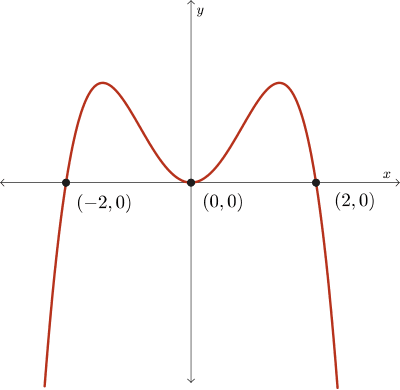
Sketch the graph of the function \(y=-2x^4+8x^2\).
What do we know about this function?
- The function is an even degree polynomial with a negative leading coefficient. Therefore, \(y \rightarrow -\infty\) as \(x \rightarrow \pm\infty\).
- Since all of the terms of the function are of an even degree, the function is an even function. Therefore, the function is symmetrical about the \(y\)-axis.
To find the zeros we will need to factor the polynomial.
- The function in factored form is\[\begin{align*} y &= -2x^2(x^2-4) \\ &=-2x^2(x-2)(x+2) \end{align*}\] Therefore, the zeros of the function are at \(x=\pm 2\) and \(x=0\) (multiplicity \(2\)).
Sketch
We now draw the axes and mark the position of the three zeros.
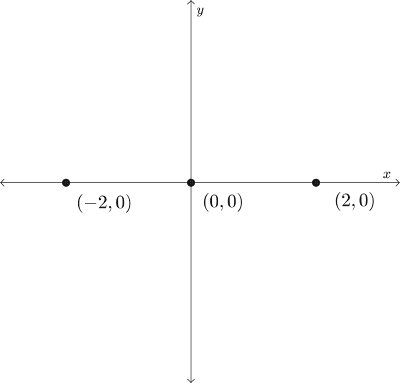
With a negative end behaviour, we will begin sketching the graph in the third quadrant, heading up towards the first zero at \(x = -2\).
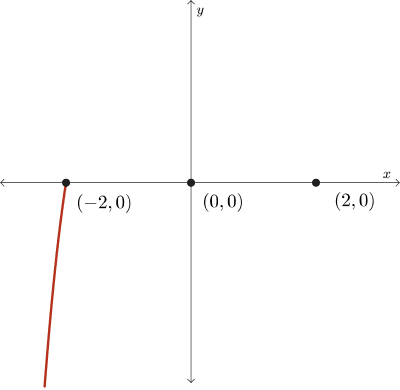
We will cross the \(x\)-axis and continue on into the second quadrant. We must turn at some point soon and head back toward the second \(x\)-intercept at \(x = 0\). There is a turning point at this zero since the zero is of multiplicity \(2\). We must come into the origin prepared to turn and head back out up into the first quadrant.
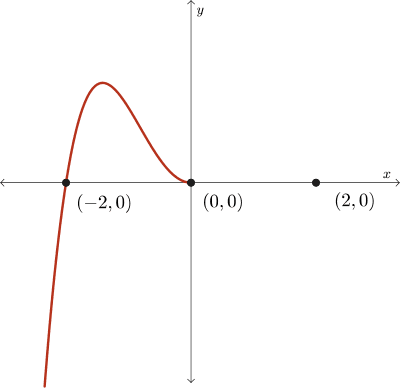
Now keep in mind that this function is symmetrical about the \(y\)-axis. We must create a mirror image of the section of the curve that we have created so far. In doing this, we will pass through the third zero at \(x = 2\).
Check Your Understanding B
This question is not included in the Alternative Format, but can be accessed in the Review section of the side navigation.
Lesson Part 4
Examples
Example 2
- Show that every polynomial function can be expressed as the sum of an even and an odd polynomial function.
- Prove that every function can be expressed as the sum of an even and odd function.
Solution
It is pretty straightforward to show that every polynomial function can be expressed as a sum of an even and odd polynomial function. By grouping all terms of even degree and all terms of odd degree, we can create an even and odd function.
To show this statement is true algebraically, we first define \(p(x)\) as a general \(n^{th}\) degree polynomial.
Let \(P(x)\) be any polynomial function of the form
\[P(x)=a_nx^n+a_{n-1}x^{n-1}+a_{n-2}x^{n-2}+\cdots+a_3x^3+a_2x^2+a_1x+a_0\]
where the coefficients \(a_0,a_1,a_2,a_3,\ldots,a_n\) are real numbers, \(n \geq 0\), and \(n \in Z\).
We must then consider the two cases, the case when \(n\) is even and the case when \(n\) is odd. This is only necessary to show the proper grouping of the even and odd-degree terms.
If \(n\) is even, then
\[ \begin{align*} P(x) = &\left(a_nx^n + a_{n-2}x^{n-2} + \cdots + a_2x^2 + a_0 \right) && \text{(even degree terms)} \\ + &\left(a_{n-1}x^{n-1} + a_{n-3}x^{n-3} + \cdots + a_1x\right) && \text{(odd degree terms)} \end{align*} \]
showing \(P(x)\) as the sum of an even function and an odd function.
If \(n\) is odd, then
\[ \begin{align*} P(x) = &\left(a_nx^n + a_{n-2}x^{n-2} + \cdots + a_3x^3 + a_1x \right) && \text{(odd degree terms)} \\ + &\left(a_{n-1}x^{n-1} + a_{n-3}x^{n-3} + \cdots + a_2x^2 + a_0\right) && \text{(even degree terms)} \end{align*} \]
showing \(P(x)\) as the sum of an odd function and an even function.
Note: If \(P(x)\) is an even function (or odd function), then \(P(x)\) can be expressed as the sum of \(P(x)\) and \(f(x)=0\). (Recall: \(f(x)=0\) is both an even and odd function.)
In both cases, we are simply separating the terms of the polynomial into even-degree terms and odd-degree terms and grouping them as such to form two functions, one an even function and the other an odd function.
- Prove that every function can be expressed as the sum of an even and odd function.
Solution
To prove that every function can be written as the sum of an even and odd function is a more challenging task.
Let \(f(x)\) be any function. Observe that
\[ \begin{align*} f(x) &= \dfrac{2f(x)}{2} \\ &= \dfrac{f(x)+f(x)}{2} \end{align*}\]
We will now add \(f(-x)\) and subtract \(f(-x)\) to the numerator of this expression. This process of adding a term and then subtracting the term to maintain equivalence is a helpful tool used in proofs and is used with quadratics when completing the square.
\[\begin{align*} f(x) &= \dfrac{f(x)+0+f(x)}{2} \\ &= \dfrac{f(x)+(f(-x)-f(-x))+f(x)}{2} \end{align*} \]
Now, we can rearrange the terms and group them to form two functions that we will identify as \(g(x)\) and \(h(x)\).
\[ \begin{align*} f(x) &= \dfrac{(f(x)+f(-x))+(f(x)-f(-x))}{2} \\ &= \dfrac{f(x)+f(-x)}{2}+\dfrac{f(x)-f(-x)}{2} \end{align*} \]
Let \(g(x)=\dfrac{f(x)+f(-x)}{2}\) and \(h(x)=\dfrac{f(x)-f(-x)}{2}\)
Therefore, \(f(x)=g(x)+h(x)\).
Now, we have the task to prove that one of the functions is even and the other is odd.
Consider,
\[ \begin{align*} g(-x) &= \dfrac{f(-x)+f(-(-x))}{2} \\ &= \dfrac{f(-x)+f(x)}{2} \\ &= g(x) \end{align*} \]
Thus, \(g(x)\) is even.
And if we look at \(h(-x)\),
\[\begin{align*} h(-x) &= \dfrac{f(-x) - f(-(-x))}{2} \\ &= \dfrac{f(-x) - f(x)}{2} \\ &= \dfrac{-\left(f(x) - f(-x)\right)}{2} \\ &= -\dfrac{f(x) - f(-x)}{2} \\&= -h(x) \end{align*}\]
Thus, \(h(x)\) is odd.
Therefore, any function, \(f(x)\), can be expressed as the sum of an even and odd function.