Working with Sinusoidal Functions Alternative Format
Lesson Part 1
Recall
In an earlier module, we looked at the transformational form of two parent sinusoidal functions \(y = \sin(x)\) and \(y = \cos(x)\).
The Sine Function
\(y = {\color{BrickRed}a}\sin\left[{\color{NavyBlue}b}(x - {\color{Mulberry}h})\right] + {\color{Violet}k}\)
The Cosine Function
\(y = {\color{BrickRed}a}\cos\left[{\color{NavyBlue}b}(x - {\color{Mulberry}h})\right] + {\color{Violet}k}\)
We graphed sinusoidal functions using a variety of techniques.
We discussed the features of the functions and how to determine them from the equation. The roles of \({\color{BrickRed}a}\), \({\color{NavyBlue}b}\), \(\color{Mulberry}h\), and \({\color{Violet}k}\) are listed below:
- The amplitude is \(\lvert {\color{BrickRed}a} \rvert\) and can be determined by the formula \(\dfrac{\text{maximum } - \text{ minimum}}{2}\).
If \({\color{BrickRed}a} \lt 0\), the parent function is reflected about the \(x\)-axis.
- The period is \(\dfrac{2\pi}{\color{NavyBlue}\lvert b \rvert}\) radians or \(\dfrac{360^{\circ}}{\color{NavyBlue}\lvert b \rvert}\).
If \({\color{NavyBlue}b} \lt 0\), the parent function is reflected about the \(y\)-axis.
- The phase shift is \(\color{Mulberry}h\).
- The vertical displacement is \({\color{Violet}k}\) and can be calculated using \(\dfrac{\text{maximum } + \text{ minimum}}{2}\).
\(k\) is the average of the maximum and minimum values of the function.
The equation of the central horizontal axis is \(y = {\color{Violet}k}\).
- The maximum value is \({\color{Violet}k} + {\color{BrickRed}\lvert a \rvert}\) and the minimum value is \({\color{Violet}k} - {\color{BrickRed}\lvert a \rvert}\).
Examples
In the first part of this module, we will be determining an equation from either some given information or from a graph.
Example 1
Determine an equation for a sine function that has been reflected about the \(x\)-axis, has a maximum value \(12\), a minimum value \(2\), a period \(4\pi\), and a phase shift \(-\dfrac{\pi}{3}\).
Solution
A quick sketch of one period is shown in the figure. Since the period is \(4\pi\), the horizontal distance between the key points is \(\pi\) radians. The horizontal axis is \(y=k\), where \(k\) is to be determined.
The equation is of the form
\[y = a\sin\left[b(x-h)\right] + k\]
Since there is a reflection about the \(x\)-axis, \(a \lt 0\).
To determine the amplitude, we subtract the minimum value, \(2\), from the maximum value, \(12\), and divide the result by \(2\). So, the amplitude is \(\dfrac{12-2}{2} = \dfrac{10}{2} = 5\). Combining the fact that \(a\lt 0\) and the amplitude is \(5\), it follows that \(a = -5\).
We know that \(k\) is the average of the maximum and minimum values so \(k = \dfrac{12+2}{2} = \dfrac{14}{2} = 7\). (It follows that the equation of the central horizontal axis is \(y = 7\).)
Since the phase shift is given, we know that \(h = -\dfrac{\pi}{3}\).
We know that the period of a sinusoidal function \(= \dfrac{2\pi}{\lvert b \rvert}\). Rearranging, we get \(\lvert b \rvert = \dfrac{2\pi}{\text{period}} = \dfrac{2\pi}{4\pi} = \dfrac{1}{2}\).
Since there is no reflection about the \(y\)-axis, \(b \gt 0\) and it follows that \(b = \dfrac{1}{2}\). Combining the information, we have \(a = -5, b = \dfrac{1}{2}, h = -\dfrac{\pi}{3}\) and \(k = 7\). A possible equation is \(y = -5\sin\left[\dfrac{1}{2}\left(x + \dfrac{\pi}{3}\right)\right]+7\).
Notice that it's a possible equation. There are other equations, and we'll look at that as we move through this module.
Check Your Understanding A
This question is not included in the Alternative Format, but can be accessed in the Review section of the side navigation.
Lesson Part 2
Examples
Example 2
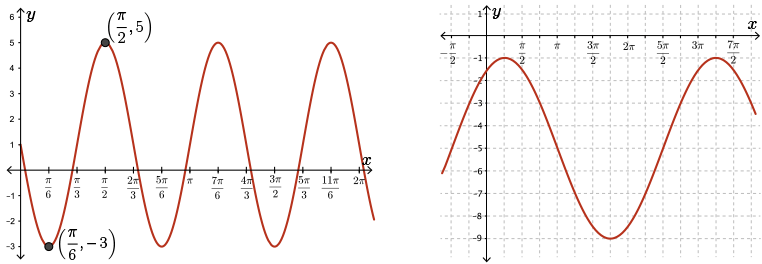
A sinusoidal function is defined for \(x \geq 0\). The first minimum occurs as \(\left(\dfrac{\pi}{6} , -3\right)\) and the first maximum occurs at \(\left(\dfrac{\pi}{2} , 5\right)\). Determine a possible equation for this function.
Solution
We start with a sketch. In this case, the sketch is simply the two points, \(\left(\dfrac{\pi}{6} , -3\right)\) and \(\left(\dfrac{\pi}{2} , 5\right)\), which is not very helpful, it would seem.
However, since we know that we're dealing with a sinusoidal function, if we draw a sinusoidal curve through the adjacent minimum and maximum points, we may be able to acquire more information.
The maximum value is \(5\) and the minimum value is \(-3\).
\(k\) is the average of the maximum and minimum values. So, \(k = 1\) and the vertical displacement is \(1\). The central horizontal axis is \(y=1\).
The amplitude is \(\dfrac{5 - (-3)}{2} = 4\) so \(\lvert a \rvert = 4\).
The period can be found by determining the horizontal distance from one minimum point to the next minimum point.
The horizontal distance from one minimum point to the next maximum point is half of a period.
So half of a period is \(\dfrac{\pi}{2} - \dfrac{\pi}{6} = \dfrac{\pi}{3}\). It follows that the full period length is \(2 \times \dfrac{\pi}{3} = \dfrac{2\pi}{3}\) radians.
At this point, we can calculate \(\lvert b \rvert\).
Recall that period \(= \dfrac{2\pi}{\lvert b \rvert}\). After rearranging, \(\lvert b \rvert = \dfrac{2\pi}{\text{period}} = \dfrac{2\pi}{\dfrac{2\pi}{3}} = 3\).
We still must decide which sinusoidal function to model with.
From our work, we know that \(\lvert a \rvert = 4, \lvert b \rvert = 3,\) the period is \(\dfrac{2\pi}{3},\) and \(k = 1\).
Using our knowledge of the behaviour of a sinusoidal function and the fact that one-quarter of a period is \(\dfrac{2\pi}{3} \div 4 = \dfrac{\pi}{6}\), we can determine the coordinates of more points on the graph.
Several more points have been added to the graph. We now have the points \(\left(0,1\right)\), \(\left(\dfrac{\pi}{6},-3\right)\), \(\left(\dfrac{\pi}{3},1\right)\), \(\left(\dfrac{\pi}{2},5\right)\), \(\left(\dfrac{2\pi}{3},1\right)\), \(\left(\dfrac{5\pi}{6},-3\right)\), \(\left(\pi,-1\right)\), and \(\left(\dfrac{7\pi}{6},5\right)\).
If we model this information with a cosine function, we could use the point \(\left(\dfrac{\pi}{2} , 5\right)\) as the first point in a five-point sketch. The other four points will be \(\left(\dfrac{2\pi}{3},1\right)\), \(\left(\dfrac{5\pi}{6},-3\right)\), \(\left(\pi,-1\right)\), and \(\left(\dfrac{7\pi}{6},5\right)\).
We would use a phase shift of \(h = \dfrac{\pi}{2}, a = 4, b = 3,\) and \(k = 1\) resulting in the equation \(y = 4\cos\left[3\left(x - \dfrac{\pi}{2}\right)\right] + 1\). But this is one possibility. We could model differently.
If we model with a cosine function which has been reflected in the \(x\)-axis, we could use the point \(\left(\dfrac{\pi}{6} , -3\right)\) as the first point in a five-point sketch. The other four points will be \(\left(\dfrac{\pi}{3},1\right)\), \(\left(\dfrac{\pi}{2},5\right)\), \(\left(\dfrac{2\pi}{3},1\right)\), and \(\left(\dfrac{5\pi}{6},-3\right)\).
We would use a phase shift of \(h = \dfrac{\pi}{6} , a = -4, b = 3,\) and \(k=1\), resulting in the equation \(y = -4\cos\left[3\left(x - \dfrac{\pi}{6}\right)\right] + 1\).
If we model with the sine function, we could use the point \(\left(\dfrac{\pi}{3} , 1\right)\) as the first point in a five-point sketch. The other four points will be \(\left(\dfrac{\pi}{2},5\right)\), \(\left(\dfrac{2\pi}{3},1\right)\), \(\left(\dfrac{5\pi}{6},-3\right)\), and \(\left(\pi,-1\right)\).
We would use a phase shift of \(h = \dfrac{\pi}{3}, a = 4, b = 3\) and \(k = 1\), resulting in the equation \(y = 4\sin\left[3\left(x - \dfrac{\pi}{3}\right)\right] + 1\).
If we model with the sine function which has been reflected in the \(x\)-axis, we could also use the point \((0,1)\) as the first point in a five-point sketch. The other four points will be \(\left(\dfrac{\pi}{6},-3\right)\), \(\left(\dfrac{\pi}{3},1\right)\), \(\left(\dfrac{\pi}{2},5\right)\), and \(\left(\dfrac{2\pi}{3},1\right)\).
We would use a phase shift of \(h = 0, a = -4, b = 3,\) and \(k = 1\), resulting in the equation \(y = -4\sin(3x)+1\).
As you can see, there's a variety of choices for how we model this function. In this case, the last one is probably the simplest.
Check Your Understanding B
This question is not included in the Alternative Format, but can be accessed in the Review section of the side navigation.
Lesson Part 3
Examples
Example 3
A sinusoidal function is shown on the following graph. Determine a possible equation for this graph.
Solution
First, we will determine the maximum and minimum values.
One way to do this is to draw horizontal lines tangent to the curve through maximum and minimum points.
As a result of this, we get several pieces of information.
The maximum is \(-1\), the minimum is \(-9\), and the amplitude is \(4\). It follows that \(\lvert a \rvert = 4\).
The central horizontal axis is \(y = -5\). Remember that \(k\) is the average of the maximum and minimum values. From this, we get that the vertical displacement is \(k = -5\) or down \(5\) units.
Two consecutive maximum points are \(\left(\dfrac{\pi}{4},-1\right)\) and \(\left(\dfrac{13\pi}{4},-1\right)\). By using the difference between the \(x\)-coordinates of these two consecutive maximum points, we determine that the period is \(\dfrac{13\pi}{4} - \dfrac{\pi}{4} = 3\pi\).
It follows that \(\lvert b \rvert = \dfrac{2\pi}{3\pi} = \dfrac{2}{3}\).
We can plot key points on the graph: maximum points, minimum points, and points on the central horizontal axis: \(\left(-\dfrac{\pi}{2},-5\right)\), \(\left(\dfrac{\pi}{4},-1\right)\), \(\left(\pi,-5\right)\), \(\left(\dfrac{7\pi}{4},-9\right)\), \(\left(\dfrac{5\pi}{2},-5\right)\), and \(\left(\dfrac{13\pi}{4},-1\right)\).
We can read the phase shift from the graph and select an appropriate sinusoidal function.
- For a phase shift \(h = -\dfrac{\pi}{2}, a = 4, b = \dfrac{2}{3}, k = -5,\) and \(y = 4\sin\left[\dfrac{2}{3}\left(x + \dfrac{\pi}{2}\right)\right] - 5\).
- For a phase shift \(h = \dfrac{\pi}{4}, a = 4, b = \dfrac{2}{3}, k = -5,\) and \(y = 4\cos\left[\dfrac{2}{3}\left(x - \dfrac{\pi}{4}\right)\right] - 5\).
- For a phase shift \(h = \pi, a = -4, b = \dfrac{2}{3}, k = -5,\) and \(y = -4\cos\left[\dfrac{2}{3}\left(x - \pi \right)\right] - 5\).
- For a phase shift \(h = \dfrac{7\pi}{4}, a = -4, b = \dfrac{2}{3}, k = -5,\) and \(y = -4\cos\left[\dfrac{2}{3}\left(x - \dfrac{7\pi}{4}\right)\right] - 5\).
There are also other equations that we can obtain by choosing different phase shifts.
Check Your Understanding C
This question is not included in the Alternative Format, but can be accessed in the Review section of the side navigation.
Example 4
In the previous example, we developed several equations which could be used to model the given information.
Once we have an equation, we are generally interested in obtaining more information, either from the graph or from the equation.
Using the graph of \(y=4\sin\left[\dfrac{2}{3}\left(x+\dfrac{\pi}{2}\right)\right]-5\) shown in the figure, determine all possible values of \(x\) such that the value of the sinusoidal function is a maximum. Give it a try.
Solution
From the graph, we can see that a maximum of \(-1\) occurs when \(x = \dfrac{\pi}{4}\).
From our earlier work, we know that the period is \(3\pi\).
Therefore, the maximum value \(-1\) occurs when
\[x = \dfrac{\pi}{4} + 3\pi n , n \in \mathbb{Z}\]
Example 5
Using the equation \(y = 4\sin\left[\dfrac{2}{3}\left(x + \dfrac{\pi}{2}\right)\right] - 5\), determine all possible values of \(x\) such that the value of the sinusoidal function is a maximum.
Solution
From the equation, we see that \(a = 4\), \(b = \dfrac{2}{3}\), \(h = -\dfrac{\pi}{2}\), and \(k = -5\). Using \(a = 4\) and \(k=-5\), the maximum value is \(-5 + 4= -1\), as we saw from the graph. The period is \(\dfrac{2\pi}{\lvert b \rvert} = \dfrac{2\pi}{\dfrac{2}{3}} = 3\pi\).
The angle \(\dfrac{2}{3}\left(x + \dfrac{\pi}{2}\right)\) looks a bit complex so we can simplify if we let \(A = \dfrac{2}{3}\left(x + \dfrac{\pi}{2}\right)\).
We know from our experience that for \(y = \sin(A)\), a maximum occurs when \(A = \dfrac{\pi}{2}\).
\[ \dfrac{2}{3}\left(x + \dfrac{\pi}{2}\right) = \dfrac{\pi}{2} \]
Multiplying both sides of the equation by \(\dfrac{3}{2}\) and simplifying, we get
\[ \begin{align*} x + \dfrac{\pi}{2} &= \dfrac{3\pi}{4} \\ x &= \dfrac{3\pi}{4} - \dfrac{\pi}{2} \\ x &= \dfrac{\pi}{4} \end{align*} \]
Since we know that the period is \(3\pi\) radians and that a maximum occurs when \(x= \dfrac{\pi}{4}\), the maximum value \(-1\) occurs when \(x = \dfrac{\pi}{4} + 3 \pi n, n \in \mathbb{Z}\). So, we get the same result that we saw before.
This same approach will also work to determine when the minimum values or middle values occur. The middle values are the values that occur on the central horizontal axis.
But what if we want other values? We can approximate from the graph or solve the sinusoidal equation for the required values.
Lesson Part 4
Examples
Let's look at a slightly different example.
Example 6
Determine the values of \(x, 0 \leq x \leq 3\pi\) so that \(y = 4\sin\left[\dfrac{2}{3}\left(x + \dfrac{\pi}{2}\right)\right]-5\) equals \(-3\).
Solution
The angle \(\dfrac{2}{3}\left(x + \dfrac{\pi}{2}\right)\) looks a bit complex so we can simplify if we let \(A = \dfrac{2}{3}\left(x + \dfrac{\pi}{2}\right)\).
We will solve an equation which is much more straightforward.
\[ \begin{align*} 4\sin(A) - 5 &=-3 \\ 4\sin(A) &= 2 \\ \sin(A) &=\dfrac{1}{2} \end{align*} \]
We know, from our work with special triangles, that the reference angle is \(\dfrac{\pi}{6}\) and \(\sin\left(A\right) \gt 0\) in quadrants \(1\) and \(2\). It follows that \(A = \dfrac{\pi}{6}\) in quadrant \(1\) and \(A = \pi - \dfrac{\pi}{6} = \dfrac{5\pi}{6}\) in quadrant \(2\).
Since \(A = \dfrac{2}{3}\left(x + \dfrac{\pi}{2}\right)\), we know that
\[ \begin{align*} \dfrac{2}{3}\left(x + \dfrac{\pi}{2}\right) &=\dfrac{\pi}{6} \\ x + \dfrac{\pi}{2} &= \dfrac{\pi}{6} \times \dfrac{3}{2} \\ x+\dfrac{\pi}{2} &= \dfrac{\pi}{4} \\ x &= \dfrac{\pi}{4} - \dfrac{\pi}{2} \\ x &= -\dfrac{\pi}{4} \end{align*} \]
\[ \begin{align*} \dfrac{2}{3}\left(x + \dfrac{\pi}{2}\right) &=\dfrac{5\pi}{6} \\ x + \dfrac{\pi}{2} &=\dfrac{5\pi}{6} \times \dfrac{3}{2} \\ x + \dfrac{\pi}{2} &=\dfrac{5\pi}{4} \\ x &= \dfrac{5\pi}{4} - \dfrac{\pi}{2} \\ x &= \dfrac{3\pi}{4} \end{align*} \]
We want \(0 \leq x \leq 3\pi\) and, from earlier work, we know that the period of \(y = 4\sin\left[\dfrac{2}{3}\left(x + \dfrac{\pi}{2}\right)\right] - 5\) is \(3\pi\).
The solution \(x = -\dfrac{\pi}{4}\) is not in the domain, but the coterminal angle \(x = - \dfrac{\pi}{4} + 3\pi = \dfrac{11\pi}{4}\) is in the domain.
The other solution \(x = \dfrac{3\pi}{4}\) is already in the required domain.
Adding or subtracting \(3\pi\) to either of these solutions takes us outside the domain.
Therefore, the only solutions are \(x = \dfrac{3\pi}{4}\) and \(x = \dfrac{11\pi}{4}\).
Since we have the graph of \(y = 4\sin\left[\dfrac{2}{3}\left(x + \dfrac{\pi}{2}\right)\right]-5\) from the previous example, let's go back to the graph and check to see if our solutions are reliable, if they're accurate.
Our two solutions, again, are in the domain \(x\) from \(0\) to \(3\pi\) inclusive.
Take a look at the sketch. The shaded section of the graph contains the part of the function between \(0\) and \(3\pi\) radians. Everything outside would not be under consideration. And if you look at the graph, the two points \(x = \dfrac{3\pi}{4}\) and \(x = \dfrac{11\pi}{4}\) are there as expected. And if you look also at the \(y\)-axis, you'll see that \(y\) does equal \( -3\) at both of those points.
Summary
In this module, we developed equations to model situations which were defined by information given about a function or by a sketch of a function.
We used the graph of the function and the equation to obtain more information about the function.
We used the sketches to read information and we solved some trigonometric equations.
In a future module, we will look at applications which can be modelled with sinusoidal functions.