Double Angle Formulas Alternative Format
Lesson Part 1
In This Module
We will extend our knowledge of compound angle formulas to include the double angle formulas.
These formulas are special cases of the angle sum formulas studied in the previous module.
Double Angle Formula for Sine
Consider that \(\sin(2\theta)\) can be expressed as \(\sin(\theta + \theta)\).
Using the angle sum formula for sine, \(\sin(A + B) = \sin(A)\cos(B) + \cos(A)\sin(B)\), we have
\[ \begin{align*} \sin(2\theta) &= \sin(\theta + \theta) \\ &= \sin(\theta)\cos(\theta) + \cos(\theta)\sin(\theta) \\ &= 2\sin(\theta)\cos(\theta) \end{align*} \]
Thus, the double angle formula for sine is \(\sin(2\theta) = 2\sin(\theta)\cos(\theta)\).
Double Angle Formula for Cosine
Similarly, we can develop a formula for \(\cos(2\theta)\) using the angle sum formula for cosine, \(\cos(A + B) = \cos(A)\cos(B) - \sin(A)\sin(B)\).
We have,
\[ \begin{align*} \cos(2\theta) &= \cos(\theta + \theta) \\ &= \cos(\theta)\cos(\theta) - \sin(\theta)\sin(\theta) \\ &= \cos^2(\theta) - \sin^2(\theta) \end{align*} \]
Making appropriate substitutions using the Pythagorean identity, \(\sin^2(\theta) + \cos^2(\theta) = 1\), the double angle formula for cosine can be expressed in two other ways.
Using \({\color{BrickRed}\cos^2(\theta) = 1 - \sin^2(\theta)}\),
\[ \begin{align*} \cos(2\theta) &= \cos^2(\theta) - \sin^2(\theta) \\ &= {\color{BrickRed} 1 - \sin^2(\theta)} - \sin^2(\theta) \\ &= 1 - 2\sin^2(\theta) \end{align*} \]
Using \({\color{BrickRed}\sin^2(\theta) = 1 - \cos^2(\theta)}\),
\[ \begin{align*} \cos(2\theta) &= \cos^2(\theta) - \sin^2(\theta) \\ &= \cos^2(\theta) - \Big({\color{BrickRed}1 - \cos^2(\theta)}\Big) \\ &= 2\cos^2(\theta) - 1 \end{align*} \]
Thus, the double angle formula for cosine is given by
\[ \begin{align*} &\cos(2\theta) = \cos^2(\theta) - \sin^2(\theta) \\ \text{or} \quad\quad &\cos(2\theta) = 1 - 2\sin^2(\theta) \\ \text{or} \quad\quad &\cos(2\theta) = 2\cos^2(\theta) - 1 \end{align*} \]
So, there are three different versions of the double angle formula for cosine with advantages to each, as you will see when we apply these formulas later in the lesson.
Double Angle Formula for Tangent
Finally, let's determine the double angle formula for \(\tan(2\theta)\). Using the angle sum formula for tangent,
\[\tan(A+B) = \dfrac{\tan(A) + \tan(B)}{1 - \tan(A)\tan(B)}\]
express \(\tan(2\theta)\) in terms of \(\tan(\theta)\).
We will obtain the double angle formula for tangent in two different ways.
Using the angle sum formula for tangent, we have
\[ \begin{align*} \tan(2\theta) &= \tan(\theta + \theta) \\ &= \dfrac{\tan(\theta) + \tan(\theta)}{1 - \tan(\theta)\tan(\theta)} \\ &= \dfrac{2\tan(\theta)}{1 - \tan^2(\theta)} \end{align*} \]
Alternatively, using the quotient identity, we have
\[ \begin{align*} \tan(2\theta) &= \dfrac{\sin(2\theta)}{\cos(2\theta)} \\ \end{align*} \]
We will then make substitutions using the double angle formulas for \(\sin(2\theta)\) and \(\cos(2\theta)\):
\[ \begin{align*} \tan(2\theta) &= \dfrac{2\sin(\theta)\cos(\theta)}{\Big( \cos^2(\theta) - \sin^2(\theta) \Big)} \end{align*} \]
An expression in terms of \(\tan(\theta)\) can then be obtained by dividing the numerator and denominator of this expression by \(\cos^2(\theta)\), a technique similar to one used in developing the angle sum formula for tangent in the previous module:
\[ \begin{align*} \tan(2\theta) &= \dfrac{2\sin(\theta)\cos(\theta)}{\Big( \cos^2(\theta) - \sin^2(\theta) \Big)} \div {\color{BrickRed}\dfrac{\cos^2(\theta)}{\cos^2(\theta)}} \\ &= \dfrac{\dfrac{2\sin(\theta)\cos(\theta)}{\color{BrickRed}\cos^2(\theta)}}{\dfrac{\cos^2(\theta)}{\color{BrickRed}\cos^2(\theta)} - \dfrac{\sin^2(\theta)}{\color{BrickRed}\cos^2(\theta)}} \\ &= \dfrac{2\tan(\theta)}{1 - \tan^2(\theta)} \end{align*} \]
Here are the two methods side-by-side for comparison:
\[ \begin{align*} \tan(2\theta) &= \tan(\theta + \theta) \\ &= \dfrac{\tan(\theta) + \tan(\theta)}{1 - \tan(\theta)\tan(\theta)} \\ &= \dfrac{2\tan(\theta)}{1 - \tan^2(\theta)} \end{align*} \]
\[ \begin{align*} \tan(2\theta) &= \dfrac{\sin(2\theta)}{\cos(2\theta)} \\ &= \dfrac{2\sin(\theta)\cos(\theta)}{\Big( \cos^2(\theta) - \sin^2(\theta) \Big)} \\ &= \dfrac{2\sin(\theta)\cos(\theta)}{\Big( \cos^2(\theta) - \sin^2(\theta) \Big)} \div {\color{BrickRed}\dfrac{\cos^2(\theta)}{\cos^2(\theta)}} \\ &= \dfrac{\dfrac{2\sin(\theta)\cos(\theta)}{\color{BrickRed}\cos^2(\theta)}}{\dfrac{\cos^2(\theta)}{\color{BrickRed}\cos^2(\theta)} - \dfrac{\sin^2(\theta)}{\color{BrickRed}\cos^2(\theta)}} \\ &= \dfrac{2\tan(\theta)}{1 - \tan^2(\theta)} \end{align*} \]
There are more steps to the second approach, but it is certainly worth discussing.
Check Your Understanding A
This question is not included in the Alternative Format, but can be accessed in the Review section of the side navigation.
Lesson Part 2
Double Angle Summary
Double Angle Formula for Sine
\(\sin(2A) = 2\sin(A)\cos(A)\)
Double Angle Formula for Tangent
\(\tan(2A) = \dfrac{2\tan(A)}{1 - \tan^2(A)}\)
Double Angle Formulas for Cosine
\(\cos(2A) = \cos^2(A) - \sin^2(A)\)
\(\cos(2A) = 1 - 2\sin^2(A)\)
\(\cos(2A) = 2\cos^2(A) - 1\)
As was mentioned in the previous module, understanding the development of these identities or formulas and the relationships between them will help you recall or produce a formula when needed.
Now, let's see how we might use these formulas.
Examples
In our first example, we are asked to find the exact value of two different trigonometric expressions. The key to simplifying these expressions is to identify a pattern and make a connection with one of the double angle formulas, much like we did in the previous lesson with the compound angle formulas.
Example 1 — Part A
Determine the exact value of \(\sin^2(75^{\circ}) - \cos^2(75^{\circ})\).
Solution
The first expression can be simplified using \(\cos(2A) = \cos^2(A) - \sin^2(A)\).
\[ \begin{align*} \sin^2(75^{\circ}) - \cos^2(75^{\circ}) &= -\Big(\cos^2(75^{\circ}) - \sin^2(75^{\circ})\Big) \\ &= -\cos\Big(2(75^{\circ})\Big) \\ &= -\cos\Big(150^{\circ}\Big) \end{align*} \]
Now, \(150^{\circ}\) has a reference angle of \(30^{\circ}\) and a terminal arm in the second quadrant.

So,
\[ \cos\Big(150^{\circ}\Big)=-\dfrac{\sqrt{3}}{2} \]
Therefore,
\[ \sin^2(75^{\circ}) - \cos^2(75^{\circ}) = -\cos\Big(150^{\circ}\Big)=-\left(-\dfrac{\sqrt{3}}{2}\right)=\dfrac{\sqrt{3}}{2} \]
Example 1 — Part B
Determine the exact value of \(\sin\left(\dfrac{\pi}{8}\right) \cos\left(\dfrac{\pi}{8}\right)\).
Solution
Rearranging the double angle formula for sine, we have \(\sin(A)\cos(A) = \dfrac{1}{2} \sin(2A)\).
Thus,
\[ \begin{align*} \sin\left(\dfrac{\pi}{8}\right)\cos\left(\dfrac{\pi}{8}\right) &= \dfrac{1}{2}\sin\left(2\left(\dfrac{\pi}{8}\right)\right) \\ &= \dfrac{1}{2}\sin\left(\dfrac{\pi}{4}\right) \end{align*} \]
Using the special triangle for \(\dfrac{\pi}{4}\), i.e., \(\dfrac{\pi}{4}-\dfrac{\pi}{4}-\dfrac{\pi}{2}\) triangle with corresponding opposite side lengths \(1:1:\sqrt{2}\), we get
\[ \sin\left(\dfrac{\pi}{4}\right) = \dfrac{1}{\sqrt{2}} \]
Therefore,
\[ \begin{align*} \sin\left(\dfrac{\pi}{8}\right)\cos\left(\dfrac{\pi}{8}\right)&= \dfrac{1}{2}\left(\dfrac{1}{\sqrt{2}}\right) \\ &= \left(\dfrac{1}{2\sqrt{2}}\right) \end{align*} \]
Rationalising the denominator, we get
\[ \begin{align*} \sin\left(\dfrac{\pi}{8}\right)\cos\left(\dfrac{\pi}{8}\right)&= \left(\dfrac{1}{2\sqrt{2}} \right) \times {\color{BrickRed}\dfrac{\sqrt{2}}{\sqrt{2}}} \\ &= \dfrac{\sqrt{2}}{4} \end{align*} \]
Here is the complete solution procedure when all steps are put together:
\[ \begin{align*} \sin\left(\dfrac{\pi}{8}\right)\cos\left(\dfrac{\pi}{8}\right) &= \dfrac{1}{2}\sin\left(2\left(\dfrac{\pi}{8}\right)\right) \\ &= \dfrac{1}{2}\sin\left(\dfrac{\pi}{4}\right) \\ &= \dfrac{1}{2}\left(\dfrac{1}{\sqrt{2}}\right) \\ &= \left(\dfrac{1}{2\sqrt{2}}\right) \\ &= \left(\dfrac{1}{2\sqrt{2}} \right) \times {\color{BrickRed}\dfrac{\sqrt{2}}{\sqrt{2}}} \\ &= \dfrac{\sqrt{2}}{4} \end{align*} \]
Both \(\dfrac{1}{2\sqrt{2}}\) and \(\dfrac{\sqrt{2}}{4}\) are exact values and correct answers to the question. However, \(\dfrac{\sqrt{2}}{4}\), with a rationalised denominator, is a more standard form used by mathematicians.
Example 2
If \(\tan(\theta) = -\dfrac{\sqrt{5}}{2}\) for \(\dfrac{\pi}{2} \leq \theta \leq \pi\), determine the exact value of \(\sin(2\theta)\).
Solution
Since \(\sin(2\theta) = 2\sin(\theta)\cos(\theta)\), to determine the exact value of \(\sin(2\theta)\), we must determine the exact values of \(\sin(\theta)\) and \(\cos(\theta)\).
Now, \(\dfrac{\pi}{2} \leq \theta \leq \pi\), so \(\theta\) is an obtuse angle with a terminal arm in the second quadrant.
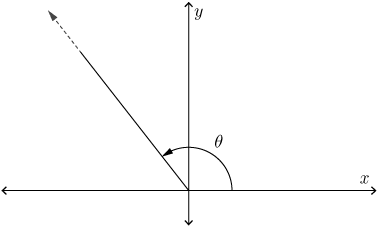
Using this information and the fact that \(\tan(\theta) = -\dfrac{\sqrt{5}}{2}\), we know that the terminal arm passes through the point \(P\,\left(-2,\sqrt{5}\right)\).
The hypotenuse of the right-angled triangle has length \(\sqrt{2^2+\left(\sqrt{5}\right)^2}=3\), found using the Pythagorean theorem.
Then, since the value of sine is positive and cosine is negative for angles with a terminal arm in the second quadrant, \(\sin(\theta) = \dfrac{\sqrt{5}}{3}\) and \(\cos(\theta) = -\dfrac{2}{3}\).
Finally,
\[ \begin{align*} \sin(2\theta) &= 2\sin(\theta)\cos(\theta) \\ &= 2\left(\dfrac{\sqrt{5}}{3}\right)\left(-\dfrac{2}{3}\right) \\ &= -\dfrac{4\sqrt{5}}{9} \end{align*} \]
Therefore, the exact value of \(\sin(2\theta)\) is \(-\dfrac{4\sqrt{5}}{9}\).
Lesson Part 3
Examples
The double angle formulas for cosine can be used to determine exact values of trigonometric ratios for angles corresponding to the reference angles \(\dfrac{\pi}{12}, \dfrac{\pi}{8}, \dfrac{3\pi}{8}\) or \(\dfrac{5\pi}{12}\). We will demonstrate this in the next example by finding the exact value of \(\cos\left(\dfrac{5\pi}{8}\right)\).
Example 3
Determine the exact value of \(\cos\left(\dfrac{5\pi}{8}\right)\).
Solution
If \(\theta = \dfrac{5\pi}{8}\), then \(2\theta = 2 \left(\dfrac{5\pi}{8}\right) = \dfrac{5\pi}{4}\), which corresponds to the special reference angle \(\dfrac{\pi}{4}\).
Now, using \(\cos(2\theta) = 2\cos^2(\theta) - 1\), we have \(\cos\left(\dfrac{5\pi}{4}\right) = 2\cos^2\left(\dfrac{5\pi}{8}\right) - 1\).
Rearranging this equation to isolate \(\cos\left(\dfrac{5\pi}{8}\right)\), we have
\[ \begin{align*} 2\cos^2\left(\dfrac{5\pi}{8}\right) &= \cos\left(\dfrac{5\pi}{4}\right) + 1 \\ \cos^2\left(\dfrac{5\pi}{8}\right) &= \dfrac{\cos\left(\dfrac{5\pi}{4}\right) + 1}{2} \\ \cos\left(\dfrac{5\pi}{8}\right) &= \pm \sqrt{\dfrac{\cos\left(\dfrac{5\pi}{4}\right) + 1}{2}} \end{align*} \]
However, \(\cos\left(\dfrac{5\pi}{8}\right) \lt 0\) since \(\dfrac{5\pi}{8}\) is an angle with a terminal arm in the second quadrant. So, \(\cos\left(\dfrac{5\pi}{8}\right) = - \sqrt{\dfrac{\cos\left(\dfrac{5\pi}{4}\right) + 1}{2}}\).
Using this statement, we substitute \(\cos\left(\dfrac{5\pi}{4}\right)=-\dfrac{1}{\sqrt{2}}\):
\[ \begin{align*} \cos\left(\dfrac{5\pi}{8}\right) &= -\sqrt{\dfrac{-\dfrac{1}{\sqrt{2}}+1}{2}} \end{align*} \]
We can then simplify this expression by multiplying the numerator and denominator by \(\sqrt{2}\) to remove the fractional form of \(\dfrac{1}{\sqrt{2}}\) in the numerator:
\[ \begin{align*} \cos\left(\dfrac{5\pi}{8}\right) &= -\sqrt{\dfrac{\left(-\dfrac{1}{\sqrt{2}}+1\right)}{2} \times {\color{BrickRed}\dfrac{\sqrt{2}}{\sqrt{2}}}} \\ \cos\left(\dfrac{5\pi}{8}\right) &= -\sqrt{\dfrac{-1 + \sqrt{2}}{2\sqrt{2}}} \end{align*} \]
We then multiply the numerator and denominator again by \(\sqrt{2}\) to rationalise the denominator:
\[ \begin{align*} \cos\left(\dfrac{5\pi}{8}\right) &= -\sqrt{\dfrac{\left(-1 + \sqrt{2}\right)}{2\sqrt{2}} \times {\color{BrickRed}\dfrac{\sqrt{2}}{\sqrt{2}}}} \\ \cos\left(\dfrac{5\pi}{8}\right) &= -\sqrt{\dfrac{-\sqrt{2} + 2}{4}} \\ \cos\left(\dfrac{5\pi}{8}\right) &= -\dfrac{\sqrt{2-\sqrt{2}}}{2} \end{align*} \]
Here is the complete solution procedure when all steps are put together:
\[ \begin{align*} 2\cos^2\left(\dfrac{5\pi}{8}\right) &= \cos\left(\dfrac{5\pi}{4}\right) + 1 \\ \cos^2\left(\dfrac{5\pi}{8}\right) &= \dfrac{\cos\left(\dfrac{5\pi}{4}\right) + 1}{2} \\ \cos\left(\dfrac{5\pi}{8}\right) &= \pm \sqrt{\dfrac{\cos\left(\dfrac{5\pi}{4}\right) + 1}{2}} \\ \cos\left(\dfrac{5\pi}{8}\right) &= -\sqrt{\dfrac{-\dfrac{1}{\sqrt{2}}+1}{2}} \\ \cos\left(\dfrac{5\pi}{8}\right) &= -\sqrt{\dfrac{\left(-\dfrac{1}{\sqrt{2}}+1\right)}{2} \times {\color{BrickRed}\dfrac{\sqrt{2}}{\sqrt{2}}}} \\ \cos\left(\dfrac{5\pi}{8}\right) &= -\sqrt{\dfrac{-1 + \sqrt{2}}{2\sqrt{2}}} \\ \cos\left(\dfrac{5\pi}{8}\right) &= -\sqrt{\dfrac{\left(-1 + \sqrt{2}\right)}{2\sqrt{2}} \times {\color{BrickRed}\dfrac{\sqrt{2}}{\sqrt{2}}}} \\ \cos\left(\dfrac{5\pi}{8}\right) &= -\sqrt{\dfrac{-\sqrt{2} + 2}{4}} \\ \cos\left(\dfrac{5\pi}{8}\right) &= -\dfrac{\sqrt{2-\sqrt{2}}}{2} \end{align*} \]
Therefore, the exact value of \(\cos\left(\dfrac{5\pi}{8}\right)\) is \(-\dfrac{\sqrt{2 - \sqrt{2}}}{2}\).
Extension
If we rearrange the double angle formula, \(\cos(2\theta) = 2\cos^2(\theta) - 1\), we obtain
\[\cos(\theta) = \pm \sqrt{\dfrac{\cos(2\theta) + 1}{2}}\]
If \(2\theta = A\), then \(\theta = \dfrac{A}{2}\) and
\[\cos\left(\dfrac{A}{2}\right) = \pm \sqrt{\dfrac{\cos(A) + 1}{2}}\]
Similarly, rearranging \(\cos(2\theta) = 1 - 2\sin^2(\theta)\), we obtain \(\sin(\theta) = \pm \sqrt{\dfrac{1 - \cos(2\theta)}{2}}\).
Thus,
\[\sin\left(\dfrac{A}{2}\right) = \pm \sqrt{\dfrac{1- \cos(A)}{2}}\]
These identities or formulas are known as half-angle formulas.
Knowing the half-angle formula for cosine would have saved a few steps in completing the last question. However, the exact value of specific sine or cosine ratios can be determined by simply rearranging the appropriate double angle formula.
Check Your Understanding B
This question is not included in the Alternative Format, but can be accessed in the Review section of the side navigation.
Example 4
Prove the identity \(\dfrac{\sin(2x)}{1 + \cos(2x)} = \tan(x)\).
Solution
We must algebraically prove that this statement is true for all permissible values of the variable \(x\).
Substituting \(\cos(2x)=2\cos^2(x)-1\) and simplifying, we get
\[ \begin{align*} \text{L.S.} &= \dfrac{\sin(2x)}{1 + {\color{BrickRed}\cos(2x)}} \\ &= \dfrac{2\sin(x)\cos(x)}{1 + {\color{BrickRed}2\cos^2(x) - 1}} \\ &= \dfrac{2\sin(x)\cos(x)}{2\cos^2(x)} \\ &= \dfrac{2\sin(x)\cos(x)}{2\cos^2(x)} \\ &= \dfrac{\sin(x)}{\cos(x)} \\ &= \tan(x) \\ &= \text{R.S.} \end{align*} \]
Thus, \(\dfrac{\sin(2x)}{1 + \cos(2x)} = \tan(x)\) for all permissible values of the variable \(x\).
This version of the double angle formula for cosine works best since the right side of the equation is \(\tan(x)=\dfrac{\sin(x)}{\cos(x)}\). So the denominator of the left side must simplify to \(\cos(x)\). A different version of this formula could have been used, but additional steps would be required in simplifying the expression to \(\tan(x)\).
Notice, if we substitute \(x = \dfrac{A}{2}\) into this identity, we have a half-angle formula for tangent:
\[\tan\left(\dfrac{A}{2}\right) = \dfrac{\sin(A)}{1 + \cos(A)}\]
Lesson Part 4
Examples
Example 5
Prove \(\dfrac{\cos(3x)}{\cos(x)} - \dfrac{\sin(3x)}{\sin(x)} = \dfrac{\tan(x) - \cot(x)}{\cot(2x)}\) for all permissible values of \(x\).
Solution
This example is a bit more challenging.
We begin on the left side by finding a common denominator:
\[ \begin{align*} \text{L.S.} &= \dfrac{\cos(3x)}{\cos(x)} - \dfrac{\sin(3x)}{\sin(x)} \\ &= \dfrac{\cos(3x)}{\cos(x)}\times \dfrac{\color{BrickRed}\sin(x)}{\color{BrickRed}\sin(x)} - \dfrac{\sin(3x)}{\sin(x)}\times \dfrac{\color{BrickRed}\cos(x)}{\color{BrickRed}\cos(x)} \\ &= \dfrac{\sin(x)\cos(3x) - \cos(x)\sin(3x)}{\sin(x)\cos(x)} \\ \end{align*} \]
In doing so, the numerator can be simplified using the angle difference formula for sine:
\[ \begin{align*} \text{L.S.} &= \dfrac{\sin(x - 3x)}{\sin(x)\cos(x)} \\ &= \dfrac{\sin(-2x)}{\sin(x)\cos(x)} \\ \end{align*} \]
Since sine is an odd function, we get
\[ \begin{align*} \text{L.S.} &= \dfrac{-\sin(2x)}{\sin(x)\cos(x)} \\ \end{align*} \]
Substituting \(\sin(2x)= 2 \sin(x)\cos(x)\),
\[ \begin{align*} \text{L.S.} &= \dfrac{-2\sin(x)\cos(x)}{\sin(x)\cos(x)} \\ &= -2 \end{align*} \]
On the right side, substitutions are made using the quotient identities:
\[ \begin{align*} \text{R.S.} &= \dfrac{\tan(x) - \cot(x)}{\cot(2x)} \\ &= \left(\dfrac{\sin(x)}{\cos(x)} - \dfrac{\cos(x)}{\sin(x)}\right) \div \dfrac{\cos(2x)}{\sin(2x)} \end{align*} \]
The numerator is simplified by finding a common denominator. We can carry out the division by \(\cot(2x)=\dfrac{\cos(2x)}{\sin(2x)}\), by multiplying by its reciprocal.
\[ \begin{align*} \text{R.S.} &= \left(\dfrac{\sin^2(x) - \cos^2(x)}{\sin(x)\cos(x)}\right) \times \dfrac{\sin(2x)}{\cos(2x)} \end{align*} \]
Substitutions are then made using the double angle formulas for sine and cosine. Then, cancelling common factors in the numerator and denominator, we get
\[ \begin{align*} \text{R.S.} &= \dfrac{-\Big(\cos^2(x) - \sin^2(x)\Big)\Big(2\sin(x)\cos(x)\Big)}{\sin(x)\cos(x)\Big(\cos^2(x) - \sin^2(x)\Big)} \\ &= -2 \end{align*} \]
Here is the complete solution procedure:
\[ \begin{align*} &\text{L.S.} = \dfrac{\cos(3x)}{\cos(x)} - \dfrac{\sin(3x)}{\sin(x)} \\ &= \dfrac{\cos(3x)}{\cos(x)}\times \dfrac{\color{BrickRed}\sin(x)}{\color{BrickRed}\sin(x)} - \dfrac{\sin(3x)}{\sin(x)}\times \dfrac{\color{BrickRed}\cos(x)}{\color{BrickRed}\cos(x)} \\ &= \dfrac{\sin(x)\cos(3x) - \cos(x)\sin(3x)}{\sin(x)\cos(x)} \\ &= \dfrac{\sin(x - 3x)}{\sin(x)\cos(x)} \\ &= \dfrac{\sin(-2x)}{\sin(x)\cos(x)} \\ &= \dfrac{-\sin(2x)}{\sin(x)\cos(x)} \\ &= \dfrac{-2\sin(x)\cos(x)}{\sin(x)\cos(x)} \\ &= -2 \end{align*} \]
\[ \begin{align*} &\text{R.S.} = \dfrac{\tan(x) - \cot(x)}{\cot(2x)} \\ &= \left(\dfrac{\sin(x)}{\cos(x)} - \dfrac{\cos(x)}{\sin(x)}\right) \div \dfrac{\cos(2x)}{\sin(2x)} \\ &= \left(\dfrac{\sin^2(x) - \cos^2(x)}{\sin(x)\cos(x)}\right) \times \dfrac{\sin(2x)}{\cos(2x)} \\ &= \dfrac{-\Big(\cos^2(x) - \sin^2(x)\Big)\Big(2\sin(x)\cos(x)\Big)}{\sin(x)\cos(x)\Big(\cos^2(x) - \sin^2(x)\Big)} \\ &= -2 \end{align*} \]
\(\text{L.S.} = \text{R.S.}\)
Therefore, \(\dfrac{\cos(3x)}{\cos(x)} - \dfrac{\sin(3x)}{\sin(x)} = \dfrac{\tan(x) - \cot(x)}{\cot(2x)}\) for all permissible values of the variable.
Remember, there is often more than one approach to proving an identity.
Example 6
Find all pairs \((x,y)\), such that \(\sin^2(x) - \cos^2(y) = 0\) and \(\sin^2(y) + \cos^2(x) = \frac{3}{2}\) where \(0 \leq x \leq \pi\) and \(0 \leq y \leq \pi\).
Solution
Let
\[ \begin{align} \sin^2(x) - \cos^2(y) &= 0 \\ \sin^2(y) + \cos^2(x) &= \dfrac{3}{2} \end{align} \]
Systems of two equations in two unknowns are often solved using substitution or elimination. There appears to be no easy way to use substitution in this case. So, let's see what happens when we add \((1)\) and \((2)\):
\[ \begin{align*} \sin^2(x) - \cos^2(y) + \sin^2(y) + \cos^2(x) &= \dfrac{3}{2} \\ \sin^2(x) + \cos^2(x) + \sin^2(y) - \cos^2(y) &= \dfrac{3}{2} \\ \sin^2(x) + \cos^2(x) - \left(\cos^2(y) - \sin^2(y)\right) &= \dfrac{3}{2} \\ 1 - \cos(2y) &= \dfrac{3}{2} \\ \end{align*} \]
We now have an equation with a single trigonometric ratio in terms of \(2y\). Rearranging the equation,
\[ \begin{align*} -\cos(2y) &= \dfrac{1}{2} \\ \cos(2y) &= -\dfrac{1}{2} \end{align*} \]
Since \(0 \leq y \leq \pi\), then \(0 \leq 2y \leq 2\pi\).
If we let \(2y = \theta\), then \(\cos(\theta) = -\dfrac{1}{2}\), where \(0 \leq \theta \leq 2\pi\).
Since the ratio of value is \(\dfrac{1}{2}\), the reference or related acute angle is \(\dfrac{\pi}{3}\). The cosine ratio is negative for angles with a terminal arm in the \(2^{\text{nd}}\) and \(3^{\text{rd}}\) quadrants.
Thus, \(\theta = \pi - \dfrac{\pi}{3} = \dfrac{2\pi}{3}\) or \(\pi + \dfrac{\pi}{3} = \dfrac{4\pi}{3}\).
Replacing \(\theta\) with \(2y\), we have \(2y = \dfrac{2\pi}{3}\) or \(\dfrac{4\pi}{3}\).
Therefore, \(y = \dfrac{\pi}{3}\) or \(\dfrac{2\pi}{3}\).
Note that these two values of \(y\) are in the domain \([0,\pi]\).
Now substitute \(y = \dfrac{\pi}{3}\) and \(\dfrac{2\pi}{3}\) into \((1)\) to determine corresponding values for \(x\).
Substituting \(y = \dfrac{\pi}{3}\) into \((1)\),
\[ \begin{align*} \sin^2(x) - \cos^2\left(\frac{\pi}{3}\right) &= 0 \\ \sin^2(x) &= \cos^2\left(\frac{\pi}{3}\right) \\ \sin^2(x) &= \left(\frac{1}{2}\right)^2 \\ \sin^2(x) &= \frac{1}{4} \\ \sin(x) &= \pm \frac{1}{2} \end{align*} \]
For \(0 \leq x \leq \pi\), \(\sin(x) \gt 0\) so \(\sin(x) = \dfrac{1}{2}\). Thus, \(x = \dfrac{\pi}{6}\) or \(\dfrac{5\pi}{6}\).
Substituting \(y = \dfrac{2\pi}{3}\) into \((1)\),
\[ \begin{align*} \sin^2(x) - \cos^2\left(\frac{2\pi}{3}\right) &= 0 \\ \sin^2(x) &= \cos^2\left(\frac{2\pi}{3}\right) \\ \sin^2(x) &= \left(-\frac{1}{2}\right)^2 \\ \sin^2(x) &= \frac{1}{4} \\ \sin^2(x) &= \pm \frac{1}{2} \end{align*} \]
For \(0 \leq x \leq \pi\), \(\sin(x) \gt 0\) so \(\sin(x) = \dfrac{1}{2}\). Thus, \(x = \dfrac{\pi}{6}\) or \(\dfrac{5\pi}{6}\).
Therefore, all possible solutions of \((x,y)\) in the domain are \(\left(\dfrac{\pi}{6}, \dfrac{\pi}{3}\right)\), \(\left(\dfrac{5\pi}{6}, \dfrac{\pi}{3}\right)\), \(\left(\dfrac{\pi}{6}, \dfrac{2\pi}{3}\right)\), and \(\left(\dfrac{5\pi}{6}, \dfrac{2\pi}{3}\right)\).
Summary
The double angle identities or formulas are special cases of the angle sum formulas, where the two angles are equal.
Double Angle Formula for Sine
\(\sin(2A) = 2\sin(A)\cos(A)\)
Double Angle Formula for Tangent
\(\tan(2A) = \dfrac{2\tan(A)}{1 - \tan^2(A)}\)
Double Angle Formulas for Cosine
\(\cos(2A) = \cos^2(A) - \sin^2(A)\)
\(\cos(2A) = 1 - 2\sin^2(A)\)
\(\cos(2A) = 2\cos^2(A) - 1\)
They can be used to simplify trigonometric expressions, prove identities, and determine exact values of trigonometric ratios for angles corresponding to the reference angles \(\dfrac{\pi}{12}\), \(\dfrac{\pi}{8}\), \(\dfrac{3\pi}{8}\), or \(\dfrac{5\pi}{12}\) (\(15^{\circ}\), \(22.5^{\circ}\), \(67.5^{\circ}\), or \(75^{\circ}\)). Notice that these angles are one-half of an angle associated with the special triangle.
The double angle formulas can also be used to derive other identities or formulas, such as the half-angle formulas.
In the next module, “Solving Trigonometric Equations,” we will discuss how the double angle formulas and other identities can be used to solve certain trigonometric equations.