Sketching \( f(x)= 2\sin^2{(x)} \):
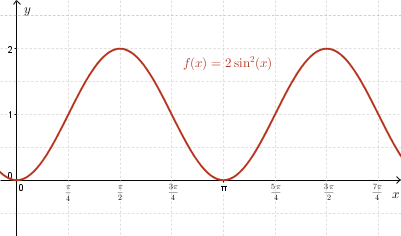
Rearranging \( \cos{(2x)}=1-2\sin^2{(x)} \), we have \( 2\sin^2{(x)}=-\cos{(2x)} +1 \); this implies that the graph of \( f(x)= 2\sin^2{(x)} \) is the same as the graph of \( y=-\cos{(2x)} +1 \).
Therefore, the graph of \( y=f(x) \) can be obtained by applying the following transformations to the graph of \( y=\cos{(x)} \):
- a reflection in the \( x \)-axis
- a horizontal stretch about the \( y \)-axis by a factor of \( \frac{1}{2} \)
- a vertical translation \( 1 \) unit upwards.
Sketching \( g(x)=3\sin{(2x)}\cos{(2x)}-1 \):
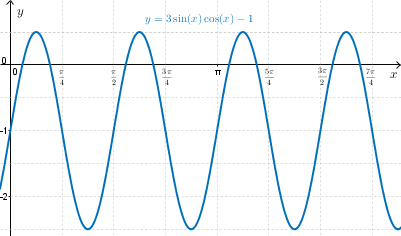
From \( \sin{(4x)}=2\sin{(2x)}\cos{(2x)} \), we have \( \sin{(2x)}\cos{(2x)}=\frac{1}{2}\sin{(4x)} \).
Substituting this into \( g(x)=3\sin{(2x)}\cos{(2x)}-1 \), we obtain \( g(x)=3\left(\frac{1}{2}\sin{(4x)}\right)-1 \) or \( g(x)=\frac{3}{2}\sin{(4x)}-1 \).
Therefore, the graph of \( y=g(x) \) can be obtained by applying the following transformations to the graph of \( y=\sin{(x)} \):
- a vertical stretch about the \( x \)-axis by a factor of \( \frac{3}{2} \)
- a horizontal stretch about the \( y \)-axis by a factor of \( \frac{1}{4} \)
- a vertical translation \( 1 \) unit downwards.