Exercises


  1. Given \( f(x) = \sqrt{x} \) and \( g(x) = 2x - 4 \):
    1. Determine \( (f \cdot g)(x), \left( \frac{f}{g} \right)(x) \), and \( \left( \frac{g}{f} \right)(x) \).
    2. State the domain of \( f(x) \), \( g(x) \), \( (f \cdot g)(x) \), \( \left( \frac{f}{g} \right)(x) \), and \( \left( \frac{g}{f} \right)(x) \).
  2. Given \( f(x) = x - 3 \) and \( g(x) = 2x + 5 \):
    1. Find \( (f \cdot g)\left( \frac{2}{3} \right) \).
    2. Determine the value of \( x \) if \( \left( \frac{f}{g} \right)(x) = \frac{2}{3} \).
  3. Given the graphs of \(y = f(x) \) and \(y = g(x) \): f piecewise linear from left to right through (-4,2),(0,2),(3,-1),(4,-1); g through (-4,1),(-2,1),(-2,0),(4,2)
    1. Draw the graph of \( y = (f \cdot g)(x) \). State the domain and range.
    2. Draw the graph of \( y = \left( \frac{g}{f} \right)(x) \). State the domain and range.
    3. Identify the interval(s) in which the function \( f \cdot g \) is increasing and the interval(s) in which it is decreasing.
    4. Identify the interval(s) in which the function \( \dfrac{g}{f} \) is increasing and the interval(s) in which it is decreasing.
     
  4. Given \( f(x) = \log_{3}(x + 6) \) and \( g(x) = x^2 - 4x \):
    1. Determine \( (f \cdot g)(x) \), \( \left( \frac{f}{g} \right)(x) \), and \( \left( \frac{g}{f} \right)(x) \), and state the domain of each function.
    2. Evaluate \( (f \cdot g)(-3) \) and \( \left( \frac{f}{g} \right)(3) \).
    3. Determine the \( x \)-intercepts of \( y = (f \cdot g)(x) \) and \( y = \left( \frac{g}{f} \right)(x) \).
  5. Given \( f(x) = x \) and \( g(x) = \cos(x) \):
    1. Identify the domain of \( y = f(x) \cdot g(x) \).
    2. Identify the domain of \( y = \dfrac{f(x)}{g(x)} \).
    3. Identify the domain of \( y = \dfrac{g(x)}{f(x)} \).
    4. Identify which of \( y = f(x) \), \( y = g(x) \), \( y = f(x) \cdot g(x) \), and \( y = \dfrac{f(x)}{g(x)} \) are even functions and which are odd functions.
    5. Graph the function \( y = f(x) \cdot g(x) \) for the restricted domain \( -2\pi \leq x \leq 3\pi \).
  6. Given the functions \( f(x) = ax - 1 \) and \( g(x) = bx^2 + 3x + 5 \), determine the value of \( a \) and \( b \) if \( (g \cdot f)(x) = -48x^3 + 26x^2 + 27x - 5 \).
  7. Using the definitions of an even and an odd function, algebraically show that the following statements are true for any two non-zero functions \( f(x) \) and \( g(x) \).
    1. If \(\ f(x) \) and \( \ g(x) \) are both even functions, then \( (f \cdot g)(x) \) and \( \left( \frac{f}{g} \right)(x) \) are both even functions.
    2. If \( f(x) \) and \( g(x) \) are both odd functions, then \( (f \cdot g)(x) \) and \( \left( \frac{f}{g} \right)(x) \) are both even functions.
    3. If \( f(x) \) is an even function and \( g(x) \) is an odd function, then \( (f \cdot g)(x) \) and \( \left( \frac{f}{g} \right)(x) \) are both odd functions.
  8. Consider \( f(x) \) and \( g(x) \) each defined by one of the equations listed below.

    \( y = \frac{1}{x - 2} \)
    \( y = (4 - x)^2 \)
    \( y = \sin(x) \)
    \( y = \cos(x) \)
    \( y = \left\lvert x^2 - 4 \right\rvert \)
    \( y = 3^{-x + 3} \)
    \( y = 2^x \)
    \( y = -5x \)
    \( y = \frac{1}{4 - x^2} \)
    \( y = 12 \)
    \( y = \sqrt{36 - x^2} \)
    \( y = 2x \)

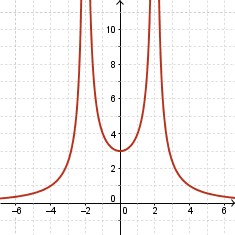
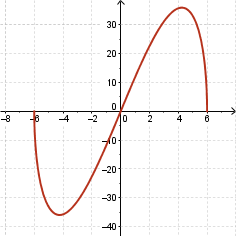
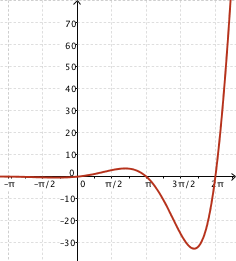
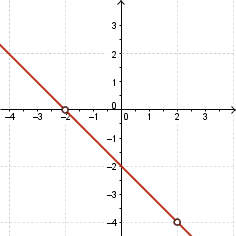
    Determine the product function \( \left( y = f(x) \cdot g(x) \right) \) or the quotient function \( \left( y=\dfrac{f(x)}{g(x)} \right) \) that was used to graph each of the following. Give reasons for your answer. For the functions, consider which are even, which are odd, the domains and the vertical asymptotes, as well as the end behaviour of the graphs of the functions.
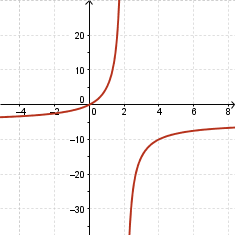
    1. Vertical asymptote at x=2,horizontal asymptote at y=5,increasing on domain

    2. Resembles periodic function increasing exponentially in amplitude as x goes from negative infinity to infinity

    3. Line through (-2,0), (0,-2)

    4. Vertical asymptotes at x = -2, 2;horizontal asymptote at y=0;increasing on (-infinity,-2),(0,2); decreasing elsewhere

    5. Defined only on -6 less than x less than 6, resembles periodic function passing through origin with linear segment near origin
  9. State the domain and sketch the graph of the function \( q(x) = \dfrac{\log_2(x)}{\sqrt{8 - x}} \).
    1. Using graphing technology, graph the product function \( y = x\left( 2^x \right) \). Which component function, \( f(x) = x \) or \( g(x) = 2^x \), has the most influence on the behaviour of the graph of \( y = (f \cdot g)(x) \)? Explain why.
    2. Using graphing technology, graph \( y = x^n\left( 2^x \right) \) for \( n = 1 \), \(2\), and \( 3 \). Describe changes that occur between the graphs as the degree of the power function, \( y = x^n \), increases. Explain why these changes might occur.
    3. Predict the behaviour of \( y = x^4\left( 2^x \right) \) and \( y = x^5 \left( 2^x \right) \). Use graphing technology to verify your prediction.
  10. Consider the functions \( f(x) = x + 3 \) and \( g(x) = \left\lvert x - 2 \right\rvert \).
    1. Identify the intervals on where \( (f \cdot g)(x) \geq 0 \).
    2. Sketch the graph of \( y = (f \cdot g)(x) \).
    3. Identify the intervals where \( \left( \dfrac{f}{g}\right)(x) \geq 0 \).
    4. Sketch the graph of \( y = \left(\dfrac{f}{g}\right)(x) \).