Help
Toggle navigation
System Homepage
Advanced Functions and Pre-Calculus
Rational Functions
Vertical Asymptotes and Discontinuity
Watch
Lesson Part 1 (2:42)
Lesson Part 2 (4:08)
Lesson Part 3 (5:16)
Lesson Part 4 (4:32)
Lesson Part 5 (1:19)
Alternative Format
Review
01.
02.
03.
Practise
Exercises
Answers
Solutions
Exercises
The rational function \( f(x) = \dfrac{2x}{x-4} \) has a vertical asymptote at \( x = 4 \).
Support this statement using a table of values. Investigate the behaviour of the function as \( x \) approaches \( 4 \) from the left \( (x\rightarrow4^-) \) and as \( x \) approaches \( 4 \) from the right \( (x \rightarrow 4^+) \). What happens to the value of \( y \) in each situation?
Support this statement algebraically by discussing the value of the numerator and denominator of the function at \( x = 4 \).
The rational function \( f(x) = \dfrac{-3x-6}{2x+4} \) has a hole in its graph at \( x = -2 \).
Support this statement using a table of values. Investigate the behaviour of the function as \( x \) approaches \( -2 \) from the left \( (x\rightarrow-2^-) \) and as \( x \) approaches \( -2 \) from the right \( (x \rightarrow -2^+) \). What happens to the value of \( y \) in each situation?
Support this statement algebraically by discussing the value of the numerator and denominator of the function at \( x = -2 \).
What are the exact coordinates of the hole?
Consider the rational function \( f(x) = \dfrac{-3x^2-15x-18}{x^2+x-2} \).
Explain why the function is discontinuous at \( x = -2 \) and \( x = 1 \).
Using a table of values, investigate the behaviour of the function near \( x = -2 \) and \( x = 1 \).
Based on your findings in part (b) describe the behaviour of the graph of the function at \( x = -2 \) and \( x = 1 \).
How can the behaviour of the graph of \( f(x) \) at \( x=-2 \) and \( x=1 \) be determined algebraically using the equation?
Given \( a \neq b, a, b \in \mathbb{R} \), discuss the similarities and differences, if any, in the discontinuities of the graphs of the following pairs of functions:
\( f(x) = \dfrac{(x-a)(x-b)}{x-b} \) and \( g(x) = x-a \)
\( f(x) = \dfrac{(x-a)(x-b)}{(x-b)^2} \) and \( g(x) = \dfrac{x-a}{x-b} \)
\( f(x) = \dfrac{(x-b)^2}{(x-a)(x-b)} \) and \( g(x) = \dfrac{x-b}{x-a} \)
State the domain of each function, then determine the equation of any vertical asymptotes and/or coordinates of any holes in the graph of the function.
\( f(x) = \dfrac{2x}{x-3} \)
\( f(x) = \dfrac{2x^2+x}{x^2-5x+6} \)
\( f(x) = \dfrac{3x^2-21x}{6x^2-39x-21} \)
\( f(x) = \dfrac{x^3+x}{6x^3+x^2-x} \)
\( f(x) = \dfrac{x^3-x}{2x^3+9x^2+13x+6} \)
For each rational function, identify any vertical asymptote(s) and discuss the behaviour of the function near these asymptote(s).
\( f(x) = \dfrac{-x}{x-4} \)
\( f(x) = \dfrac{-3x+1}{2x+5} \)
\( f(x) = \dfrac{x^2}{x^2-9} \)
Based on your understanding of vertical asymptotes and holes, choose the most appropriate graph for each equation below. Support your choice.
\( f(x) = \dfrac{x-3}{x^2-3x} \)
\( g(x) = \dfrac{x^2+3x}{x^2+9} \)
\( h(x) = \dfrac{-3}{x+3} \)
\( p(x) = \dfrac{3x}{x^2+3x} \)
\( q(x) = \dfrac{x+3}{x^2-9} \)
\( r(x) = \dfrac{3x+9}{x^2+6x+9} \)
I.
II.
III.
IV.
V.
VI.
Determine, with support, an equation for a rational function of the form \( y = \dfrac{g(x)}{h(x)} \) that satisfies the given conditions.
Vertical asymptotes of \( x = -1 \) and \( x = 3 \)
Vertical asymptotes of \( x = -2 \) and \( x = \frac{-1}{2} \) and a \( y \)-intercept of \( \frac{3}{2} \)
A hole at \( (\frac{1}{3},-2) \) and a vertical asymptote of \( x = 1 \)
\( g(2) = 0 \) and \( h(2) = 0 \), a vertical asymptote of \( x = 2 \) and a hole at \( (\frac{1}{5},\frac{5}{6}) \)
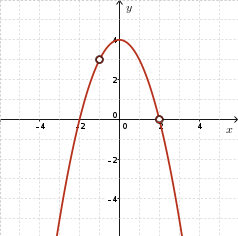
Determine an equation for the rational function shown in the graph below.
Previous
More
Quit
Previous Unit Item
Next Unit Item
Next