Help
Toggle navigation
System Homepage
Grades 7 & 8 Mathematics
Representing and Comparing Numbers (N)
Lesson 5: Multiples of Positive Integers
Watch
Try This
Multiples of Whole Numbers
The Least Common Multiple
Applications of Multiples
Alternative Format
Review
Question 1
Question 2
Question 3
Question 4
Question 5
Practise
Exercises
Answers and Solutions
Question Descriptions
Exercises
List the first five multiples of each number.
\(5\)
\(7\)
\(12\)
\(16\)
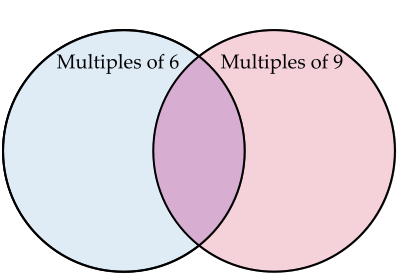
Sort these numbers into the following diagram.
\(12,~ 18,~ 27,~ 30,~38,~ 45,~ 48, ~52,~ 54,~ 81,~ 84,~ 90\)
What can you say about the numbers in the overlapping region?
Explain how you would find the first common multiple of \(30\) and \(35\).
List the first six common multiples of \(3\) and \(5\).
What pattern do the common multiples of \(3\) and \(5\) have?
How can you find the second common multiple of two numbers if you are given the first common multiple?
The first common multiple of \(28\) and \(63\) is \(252\). What is the second common multiple?
A drummer must play the drum on every sixth beat and the cymbals on every tenth beat. On which beat will the drummer play both for the first time?
A common multiple of two different numbers is \(32\).
How could you find the two numbers?
Is there more than one possible answer?
Find as many pairs of numbers with a common multiple of \(32\) as you can.
Hamburgers are sold in packages of \(6\), while hamburger buns are sold in packages of \(8\). You must have at least \(135\) hamburgers for the school BBQ and you want exactly the same number of buns and hamburgers. What is the least number of packages of each of each that you should buy?
True or False. Mark each statement as true or false. If the statement is false, give an example to show why.
If two numbers are multiples of \(11\), then their sum must also be a multiple of \(11\).
If a number is a multiple of \(2\) and another number is a multiple of \(3\), then their sum must be a multiple of \(6\).
Determine the mystery decimal number from the clues listed.
Clue#1: between \(\dfrac{2}{5}\) and \(\dfrac{3}{5}\)
Clue#2: greater than \(\dfrac{1}{2}\)
Clue#3: a multiple of \(0.11\)
Previous
More
Quit
Previous Unit Item
Next Unit Item
Next