Alternative Format


Try This

Why Learn to Multiply Decimals?

Often fractional quantities are given in decimal form.

Money is represented using decimal numbers.

Distance is measured in kilometres or metres.

Sources: Vegetables - JennaWagner/E+/Getty Images; Speedometer - delectus/iStock/Getty Images Plus

Now, we already know how to multiply fractions. And we also know how to represent many of our decimal numbers as fractions.

Is there any advantage to learning how to multiply decimals?

Let's consider a few points to convince ourselves that being able to work with decimal numbers is important.

  • It often takes more time to compare fractions than to compare decimals.
  • If we are given decimals in a problem, then we should give decimals back as our answer.
  • Decimal numbers also allow us to easily see relative "sizes" of answers.

Lesson Goals

  • Review multiplying decimals by powers of ten, specifically, we're going to look at powers of ten that are written using exponents.
  • Learn how to multiply two decimal numbers.

Try This!

Jane was shopping for new winter boots and found a sale. The boots were first marked down to \(75\%\) of their original price, and then marked down another \(50\%\) off of the sale price.

What percentage of the original price are the boots currently on sale for?

Source: Boots - Pichunter/iStock/Getty Images Plus

Think about this problem, then move on to the next part of the lesson.


Multiplying Decimals by Powers of 10

Example 1

Our decimal number system makes it really nice to multiply and divide by powers of \(10\).

Multiplying decimals by powers of \(10\) does not require a long solution or a calculator.

Calculate \(6.42 \times 10^{2}\).

Solution

I'd like you to think specifically about the power \(10^2\) to start with. We know that \(10^2\) is equal to \(100\). So, 

\(\begin{align*} 6.42 \times 10^2 &\, = 6.42 \times 100 \end{align*}\)

Now, to multiply a decimal by \(100\), we need to move the decimal point to the right \(2\) place values.

\(\begin{align*} 6.42 \times 10^2 &\, = 6.42 \times 100 \\ &\, =642 \end{align*}\)

This is the first time that we have needed to multiply by a power of \(10\) that is written using an exponent.

But recall from our previous lessons that exponents are a new way to write powers of \(10\).

The rules for multiplying and dividing by tens have not changed!

Check Your Understanding 1

Question

Evaluate \(3.127 \times 10^2\).

Answer

\(312.7\)

Feedback

Exponents are another way to write powers of ten. When we multiply by \(100\), we move the decimal \(2\) places values to the right.

\( \begin{align*} 3.127 \times 10^2 &= 3.127 \times 100 \\ &= 312.7 \\ \end{align*} \)

Example 2

Now, what's even nicer about multiplying by powers of \(10\) is that we don't actually need to see a power of \(10\) written out in expanded form in order to perform a calculation. We have enough information from the power itself to do the calculation we are being asked to do.

Calculate \(0.012 \times 10^{4}\).

Solution

Look specifically at the power for a moment from our question \(0.012 \times 10^{4}\). We see that \(10^4\) has \(4\) factors of \(10\).

We need to move the decimal point \(4\) places to the right.

0.012 times 10 to the power of 4 equals 120.

Check Your Understanding 2

Question

Evaluate \(2.14 \times 10^3\).

Answer

\(2140\)

Feedback

\(10^3\) has \(3\) factors of \(10\), so we need to move the decimal point \(3\) places to the right.

\(2.14 \times 10^3 = 2140\)

Exponential Notation

To summarize, we have seen how to write the same number in two ways:

Standard Form 

For example, in standard form, we would have the number

\(2~ 000~ 000^{\phantom{1}}\)

This is written with a \(2\) followed by six \(0\)s.

Exponential Notation

In exponential notation, we can write the number  \(2~000~000\) as

\(2\times 10^6\)

Exponential notation simplifies numbers by writing them with less zeros.

It can also make some calculations and comparisons easier.


Scientific Notation (Large Numbers)

Very Large Numbers

Let's now talk about writing large numbers with less zeros.

In science, we often have numbers that are very large and very small. What this means is that we have a lot of zeros either before or after the decimal point.

Examples

The age of the Earth is \(4~600~000~000\) years old.

The world's population is approximately \(7~460~000~000\).

There are \(1~000~000~000\) bacteria cells in a teaspoon of soil.

Sources: Earth - skegbydave/iStock/Getty Images Plus; People - elenabs/iStock/Getty Images Plus; Bacteria - frithyboy/iStock/Getty Images Plus

So each of these numbers has a lot of zeros when they're written out, but we just learned that exponential notation simplifies numbers by writing them out using less zeros. So how could we write each of these numbers without losing the important information, such as the digits in order, or the number of zeros.

Here's one reasonable option, we could say the age of the Earth is \(46 \times 10^8 \) years old. We could say that the world population is approximately \(746 \times 10^7\). We could also write that there are \(1 \times 10^9\) bacterial cells in a single teaspoon of soil.

Let's take a look at our three large numbers that are written in exponential notation.

Comparing in Exponential Notation

What happens when we try to compare these numbers now that they are written using exponential notation?

Examples Exponential Notation
Age of the Earth \(46 \times 10^8\)
World's population \(746 \times 10^7\)
Bacteria cells \(1 \times 10^9\)

We see that it is not immediately obvious which number is the greatest. So while our numbers are now written in a more condensed way, we're no longer able to compare them by simply looking at them. What this tells us is that we need to change our notation so that we can compare these numbers easily.

To meet this new goal, we can write the numbers in scientific notation.

Examples Exponential Notation Scientific Notation
Age of the Earth \(46 \times 10^8\) \(4.6 \times 10^9\)
World's population \(746 \times 10^7\) \(7.46 \times 10^9\)
Bacteria cells \(1 \times 10^9\) \(1 \times 10^9\)

In our final column, I have written each number in scientific notation.

When using scientific notation, note the following:

  1. The first number is always greater than or equal to \(1\), and less than \(10\).
  2. This number is then multiplied by the appropriate power of \(10\).

Now that the numbers are written in scientific notation, they are still written with less zeros, but now, we are able to easily compare them again. In each case, the decimal number is being multiplied by \(10^9\), so we only need to compare the decimal numbers. 

What we conclude is that


\[1 \times 10^9\]


\[\lt\]


\[4.6 \times 10^9\]


\[\lt\]
\[7.46 \times 10^9\]

Again, we can compare the decimal numbers out front because they are both multiplied by the same power of \(10\).

Scientific Notation

Let's review the steps taken to put each number into scientific notation so that you can do some examples for yourself.

To write a number using scientific notation, do the following:

  1. Look at the digits in the order they originally appeared.
    \(\class{hl2}{91~ 2}00~ 000\)
    Insert a decimal point to create a number that is less than \(10\), but greater than or equal to \(1\).
    \(91~ 200~ 000 = 9.12\)
  2. Multiply this decimal number by the appropriate power of \(10\), using exponents.
    \(91~ 200~ 000 = 9.12 \times 10^7\)

Example 3

Write \(895~ 000~ 000~ 000\) in scientific notation.

Solution

Step 1: Locate the appropriate number between \(1\) and \(10\). 

This number should consist of the digits \(8\), \(9\), and \(5\) in that order and be larger than \(1\), but less than \(10\).

\(\class{hl2}{895~} 000~ 000~ 000\)

The number we are looking for is

\(8.95\)

That means that we put the decimal point between \(8\) and \(9\).

Step 2:Multiply by the appropriate power of ten.

So to get \(895~ 000~ 000~ 000\) from \(8.95\), we must multiply \(8.95\) by \(10^{11}\).
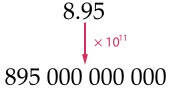
Therefore, in scientific notation, \(895~ 000~ 000~ 000 = 8.95 \times 10^{11}\).

Example 4

Write \(70~900~000\) in scientific notation.

Take a moment and try this problem on your own.

Solution

Step 1: Locate the appropriate number between \(1\) and \(10\). 

This number should consist of the digits \(7\), \(0\), and \(9\), in that order. Note: The \(0\) between \(7\) and \(9\) is important, so we have to keep it in our number. We can only drop or truncate the zeros that follow the digits which are important

\(\class{hl2}{70~9}00~000\)

The number we are looking for is

\(7.09\)

That means that we have put the decimal point between the \(7\) and the \(0\).

Step 2: Multiply by the appropriate power of ten.

So to get \(70~900~000\) from \(7.09\), we must multiply \(7.09\) by \(10^7\).
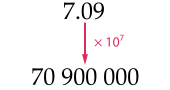
Therefore, in scientific notation, \(70~ 900~ 000 = 7.09\times 10^{7}\).

Check Your Understanding 3

Question

Which of the following represents \(42\ 300\ 000\ 000\) in scientific notation?

  1. \(423 \times 10^8\)
  2. \(4.23 \times 10^{10}\)
  3. \(423 \times 10^{10}\)
  4. \(4.23 \times 10^8\)
Answer
  1. \(4.23 \times 10^{10}\)
Feedback

The first number must be between \(1\) and \(10\) in order to be written in scientific notation.  This number should consist of the digits \(4\), \(2\), and \(3\), in order which means that \(4.23\) is the number we are looking for.  

Next, we must multiply by the appropriate power of \(10\).  To get from \(4.23\) to \(42\ 300\ 000\ 000\), we multiply \(4.23\) by \(10^{10}\).  So,

\(42\ 300\ 000\ 000 = 4.23 \times 10^{10}\)


Scientific Notation (Small Numbers)


Very Small Numbers

Source: Virus - Arek Socha/Pixabay

Viruses are so small that you need a microscope to see them. The virus that causes the flu has a width of  \(\class{hl2}{1.3 \times 10^{-7}}\) metres.

Source: Hummingbird - Anne and Saturnino Miranda/Pixabay

The bee hummingbird is the world's smallest bird. It has a mass of \(\class{hl2}{2 \times 10^{-3}}\) kilograms.

What do you notice about the numbers used in the previous examples?

How are they similar to other numbers we have seen written using scientific notation? 

How are they different?

Negative Exponents

Look at the number \(1.3 \times 10^{-7}\).

The expression 1.3 times 10 to the exponent negative 7. The coefficient 1.3 is circled and labelled

In this example, the use of a negative exponent is likely new to you. The negative sign tells us that base is actually the reciprocal of \(10\). Don't get caught up in the terminology here, this is just saying that the base is actually \(\frac{1}{10}\).

We can rewrite \(1.3 \times 10^{-7}\) by changing the base to \(\frac{1}{10}\). Once we do that, the exponent becomes positive, and has the same meaning as before.

\(1.3 \times 10^{-7} = 1.3 \times \left(\dfrac{1}{10}\right)^7\)

Negative exponents can be used to represent powers of \(10\) that are greater than \(0\) but less than \(1\), without using fractions. But, any power of \(10\) with a negative exponent can be rewritten by changing the base to \(\frac{1}{10}\) and making the exponent positive.

Example 5

Write \(4.2 \times 10^{-4}\) as a decimal.

Solution

The exponent is negative, so we rewrite the base \(10\) as \(\frac{1}{10}\), and make the exponent positive.

\(\begin{align*} 4.2 \times 10^{-4} &= 4.2 \times \left( \dfrac{1}{10} \right) ^4 \\ &= 4.2 \times \dfrac{1}{10} \times \dfrac{1}{10} \times \dfrac{1}{10} \times \dfrac{1}{10} \\[2mm] &= 0.000~42 \end{align*}\)

Therefore, \(4.2 \times 10^{-4} = 0.000~42\).

Multiplying by \(\frac{1}{10}\) is the same as dividing by \(10\).
You can think of \(4.2 \times 10^{-4}\) as saying \(4.2\) is divided by \(10\) four times.


Check Your Understanding 4


Question

Write \(6.2\times 10^{-3}\) as a decimal.

Answer

\(0.006\,2\)

Feedback

The exponent is negative, so we rewrite the base \(10\) as \(\frac{1}{10}\), and make the exponent positive.

\(\begin{align*} 6.2\times 10^{-3}&=6.2\times \left(\frac{1}{10}\right)^3\\ &=6.2\times\frac{1}{10}\times\frac{1}{10}\times\frac{1}{10}\\ &=0.006\,2 \end{align*}\)

Therefore, \(6.2\times 10^{-3}=0.006\,2\).


Example 6

Write \(0.007\) in scientific notation.

Solution

Let's try to follow the same steps that we used to write a larger number using scientific notation.

\(0.007\)

Step 1: Locate the appropriate number between \(1\) and \(10\). 

\(7\)

Step 2: Multiply by the appropriate power of ten.

To get from \(7\) to \(0.007\) we must multiply \(7\) by \(\frac{1}{10}\) three times. 

\(\begin{align*} 0.007 &= 7 \times \frac{1}{10} \times \frac{1}{10} \times \frac{1}{10} \\ &= 7 \times \left( \dfrac{1}{10} \right) ^3 \\[1mm] &= 7 \times 10^{-3} \end{align*}\)

 Therefore, in scientific notation, \(0.007 = 7 \times 10^{-3}\).

Example 7

Write \(0.000~042\) in scientific notation.

Solution

\(00.000~042\)

Step 1: Locate the appropriate number between \(1\) and \(10\). 

\(4.2\)

Step 2: Multiply by the appropriate power of ten.

To get from \(4.2\) to \(0.000~042\) we must multiply \(4.2\) by \(\frac{1}{10}\) five times. 

\(\begin{align*} 0.000~042 &= 4.2 \times \frac{1}{10} \times \frac{1}{10} \times \frac{1}{10} \times \frac{1}{10} \times \frac{1}{10} \\ &= 4.2 \times \left( \frac{1}{10} \right)^5 \\[1mm] &= 4.2 \times 10^{-5} \end{align*}\)

Therefore, in scientific notation, \(0.000~042 = 4.2 \times 10^{-5}\).


Check Your Understanding 5


Question

Which of the following represents \(0.043\) in scientific notation?

  1.  \(43\times 10^{-3}\)
  2.  \(4.3\times 10^{-1}\)
  3.  \(4.3\times 10^3\)
  4.  \(4.3\times 10^{-2}\)

Answer

d. \(4.3\times 10^{-2}\)

Feedback

\(0.043\)

Step 1: Locate the appropriate number between \(1\) and \(10\).

\(4.3\)

Step 2: Multiply by the appropriate power of ten.

To get from \(4.3\) to \(0.043\) we must multiply \(4.3\) by \(\frac{1}{10}\) by two times.

\(\begin{align*} 0.043&=4.3\times \frac{1}{10}\times \frac{1}{10}\\ &=4.3\times \left(\frac{1}{10}\right)^2\\ &=4.3\times 10^{-2} \end{align*}\)

Therefore, in scientific notation, \(0.043=4.3\times 10^{-2}\).


Multiplying Decimals

Example 5

Unfortunately, when we're multiplying decimal numbers, we cannot always guarantee that we will be multiplying by a power of \(10\).

Remember when we learned how to multiply a decimal by a whole number.

Calculate \(0.13 \times 8\).

Solution

Approach 1

Our first approach showed us that we can convert this decimal to a fraction, meaning that 

\(\begin{align*} 0.13 \times 8\ &\; = \dfrac{13}{100} \times 8 \end{align*}\)

Falling through the multiplication of fractions, making sure to convert back into a decimal number, we would find that the answer is 

\(\begin{align*} 0.13 \times 8\ &\; = \dfrac{13}{100} \times 8 \\ &\; = \dfrac{13 \times 8}{100} \\ &\; = \dfrac{104}{100} \\ &\; = 1.04 \end{align*}\)

Approach 2

Our second approach was that we could solve a similar problem. So we would recognize that \(0.13 \times 8\) was similar to the problem \(13 \times 8\).

We knew that \(13 \times 8 = 104\), and since \(13\) was \(100\) times larger than \(0.13\), then the answer \(104\) is \(100\) times larger than the answer to \(0.13 \times 8\).

Again, our final answer would be \(1.04\)

Notice that these calculations are basically the same.  

In the second approach, we are merely dealing with the factor of \(100\) separately.

Check Your Understanding 6

Question

Evaluate \(0.6 \times 4\).

Answer

\(2.4\)

Feedback

We can solve this problem without converting to fractions by solving a similar problem.

Since \(6\) is \(10\) times larger than \(0.6\), we know the answer to our similar problem is \(10\) times larger than the answer \(0.6\times4\).  In other words, 

Thus, \(0.6 \times 4 = 2.4\).

Example 6

So let's now look at an example that multiplies two decimal numbers. 

Calculate \(0.3 \times 0.7\).

We don't actually have a plan on how to multiply these two decimals as they are.

Solution

Approach 1

Can we use our knowledge of how to multiply fractions to multiply two decimals?

We can rewrite the decimals as fractions, we get

\(\begin{align*} 0.3 \times 0.7 &\; = \dfrac{3}{10} \times \dfrac{7}{10} \end{align*}\)

Following our rules of fraction multiplication, making sure to take it back to a decimal number, this is equal to

\(\begin{align*} 0.3 \times 0.7 &\; = \dfrac{3}{10} \times \dfrac{7}{10} \\ &\;= \dfrac{3\times 7}{10 \times 10} \\ &\;=\dfrac{21}{100} \\ &\;= 0.21 \end{align*}\)

Does our answer make sense?

Check Your Work

Thinking about multiplication as scaling, we could estimate that our answer should be less than \(\dfrac{1}{2}\) of \(0.7\), and if you check, you will find that it is. 

\(\dfrac{1}{2} \text{ of } 0.7 = 0.35 \gt 0.21 \) 

Approach 2

Now, at the beginning of this lesson, we discussed that if a number is given in a decimal form, we're often expected to give a decimal answer back. So is there a way that we could save time by skipping the fractions altogether? 

We really need to ask ourselves, how is the computation of \(0.3 \times 0.7\) related to the computation of \(3 \times 7\)?

We know that \(3\) is \(10\) times larger than \(0.3\) and \(7\) is \(10\) times larger than \(0.7\).

So the answer to \(3 \times 7\) is \(10 \times 10\), or \(100\) times larger than the answer to \(0.3 \times 0.7\).

Now, we can quickly multiply \(3 \times 7\) to show that it's equal to \(21\), and from there, \(0.3 \times 0.7\) is going to be equal to \(21 \div 100\). We need to remove that extra factor of \(100\) that we have included. Our final answer is going to be \(0.21\). 

Our strategy for multiplying two decimal numbers is similar to multiplying a whole number by a decimal number. We see that to multiply two decimal numbers, we introduce the factors of \(10\) that we need to make those numbers whole, and then remove those same factors at the end.

Example 7

Calculate \(0.55 \times 0.2\).

Take a moment and try this problem on your own.

Solution

To do this, we consider how the computation \(0.55 \times 0.2\) is related to the computation \(55 \times 2\). We know that \(55\) is \(100\) times larger than \(0.55\). We also know that \(2\) is \(10\) times larger than \(0.2\).

What this tells us is that the answer to \(55 \times 2\) is going to be \(100 \times 10\), or \(1000\) times larger, than the answer to \(0.55 \times 0.2\).

We can multiply to determine that \(55 \times 2 =110\). Since the answer is \(1000\) times larger than the answer to our original problem, we have that \(0.55 \times 0.2=0.110\).

Check Your Understanding 7

Question

Evaluate \(0.27 \times 0.06\).

Answer

\(0.0162\)

Feedback

We can solve this problem without converting to fractions by solving a similar problem. 

Since \(27\) is \(100\) times larger than \(0.27\), and \(6\) is \(100\) times larger than \(0.06\), we know the answer to our similar problem is \(10~000\) times larger than the answer to \(0.27 \times 0.06\). In other words, 

Thus, \(0.27 \times 0.06=0.0162\).


Try This Problem Revisited

Try This Problem Revisited

 Jane was shopping for new winter boots and found a sale. The boots were first marked down to \(75\%\) of their original price, and then marked down another \(50\%\) off of the sale price.

What percentage of the original price are the boots currently on sale for?

Source: Boots - Pichunter/iStock/Getty Images Plus

Solution

To answer this problem it's important to note that we don't actually know what the cost of the boots are. But we can write an expression to represent how we would calculate their sale price. 

So if we have the original price of the boots, the first discount we're going to take is to find \(75\%\) of the original price. This following expression now represents our sale price.

\(\begin{align*} \left( 75\% \text{ of original price} \right) \end{align*}\)

So if we are wanting to further discount the sale price by \(50\%\), we want to calculate 

\(\begin{align*} 50\% \text{ of } \left( 75\% \text{ of original price} \right) \end{align*}\)

Now at this point we must remember that "of" means to multiply. So we can simplify this to be 

\(\begin{align*} &50\% \text{ of } \left( 75\% \text{ of original price} \right) \\ =\;& 50\% \times ( 75\% \times \text{original price} ) \end{align*}\)

But we also know that because of the properties of multiplication that the brackets here are not necessary and can be removed.

\(\begin{align*} &50\% \text{ of } \left( 75\% \text{ of original price} \right) \\ =\;& 50\% \times 75\% \times \text{original price} \end{align*}\)

If we multiply these two percentages together, this will give us the combined percentage of the original price for which the boots are on sale. But to multiply these percentages we must first convert them to decimals. We get

\(\begin{align*} &50\% \text{ of } \left( 75\% \text{ of original price} \right) \\ =\;& 50\% \times ( 75\% \times \text{original price} )\\ =\; & 0.5 \times 0.75 \times \text{original price} \end{align*}\)

From here, we calculate

\(0.5 \times 0.75\)

Aside

This problem is similar to \(5 \times 75\) which is equal to \(375\).

Since \(5\) is \(10\) times larger than \(0.5\), and \(75\) is \(100\) times larger than \(0.75\), the answer \(375\) is \(1000\) times larger than the answer to \(0.5 \times 0.75\).

This tells us that \(0.5 \times 0.75\) is going to be equal to \(0.375\).

Putting this back into our expression, we can simplify and show that our expression is now equal to

\(0.375 \times \text{original price}\) or \(37.5\% \text{ of original price}\)

Therefore, the boots are on sale for \(37.5\%\) of their original price.

Check Your Understanding 8

Question

A convenience store has enough candy to fill exactly \(7.1\) jars. If each jar can hold \(8.8\) kilograms of candy, how many kilograms of candy does the convenience store currently have?

Answer

The convenience store has \(62.48\) kilograms of candy.

Feedback

\(\begin{align*} \text{total mass of candy } &= \text{ number of jars } \times \text{ mass in each jar} \\ &= 4.5 \times 1.3 \\ \end{align*}\)

To multiply these decimals, we need to solve the similar problem \(45 \times 13 = 585\).

Since \(71\) is \(10\) times \(7.1\), and \(88\) is \(10\) times \(8.8\), that means the answer to our similar problem is \(100\) times the answer to \(7.1 \times 8.8\). In other words, 

Thus, the convenience store has \(62.48\) kilograms of candy.

Take It With You

You are told that

\(1.5 \div 0.2=7.5\)

  1. How could you use this information to calculate \(3\div 0.4\) quickly?
  2. What about \(1.5 \times 5\)?